Truckee man accused of defacing cemetery

Truckee Police officers arrested a man they believe vandalized the Truckee Cemetery District on March 26.

Samuel Soto

Samuel Soto

Graffiti was found on the gazebo area and several markers were defaced.

Samuel Soto, 25, is the suspect. Officers went to the last known address of Soto and were told by family members that he was not there. Officers said family members told them they had asked Soto to leave several days before due to his increasingly bizarre and unpredictable behavior.

Late Saturday night an officer near the cemetery saw Soto walking away from there. He attempted to talk to Soto, waiting for additional units due to Soto’s prior behavior. As the officer was talking to him, Soto suddenly fled on foot, leading the officer on a foot chase.  A responding officer located Soto as he was fleeing from the first officer and took him into custody.

Soto was medically cleared and booked into jail felony vandalism to a cemetery, criminal threats to his family, burglary to an occupied residence and resisting arrest.  His bail was set at $52,500.

— Lake Tahoe News staff report


Gambling rats help reveal science of risk

By Pam Belluck, New York Times

When people make risky decisions, like doubling down in blackjack or investing in volatile stocks, what happens in the brain?

Scientists have long tried to understand what makes some people risk-averse and others risk-taking. Answers could have implications for how to treat, curb or prevent destructively risky behavior, like pathological gambling or drug addiction.

Now, a study by Karl Deisseroth, a prominent Stanford neuroscientist and psychiatrist, and his colleagues gives some clues. The study, published Wednesday in the journal Nature, reports that a specific type of neuron or nerve cell, in a certain brain region helps galvanize whether or not a risky choice is made.

Read the whole story


Road beat: Lancer slays the competition

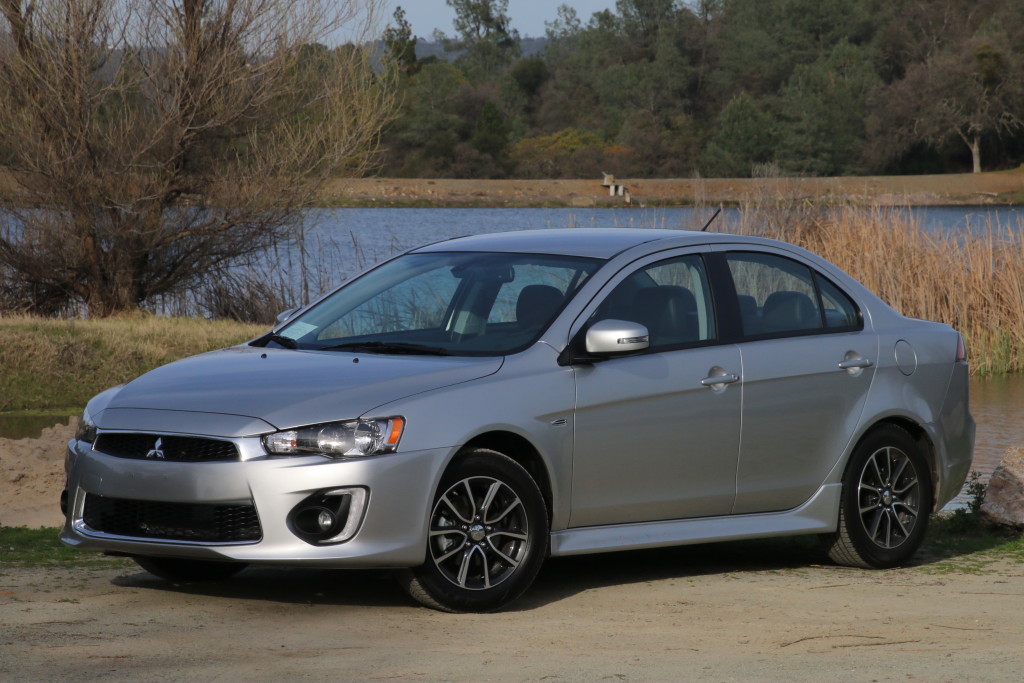
Mitsubishi is turing out quality vehicles. Photos/Larry Weitzman

Mitsubishi is turing out quality vehicles. Photos/Larry Weitzman

By Larry Weitzman

If you haven’t noticed, Mitsubishi is growing with total 2015 sales at about 100,000 vehicles, a sales growth of more than 22 percent, making it one of the fastest growing car companies in the United States. And 2016 is on a pace to exceed those record numbers. And they are making money.

Worldwide, Mitsubishi is huge. And the new Lancer is part of the reason. Dollar for dollar it is hard to get more car for the money.

After spending a week with the Lancer it’s a wonder why Mitsubishi sales aren’t growing faster. The 2016 Lancer’s shape has been in production for several years, and it is still quite the looker with its Concept-X shark nose, but it is slightly softened in its new form. It is still an aggressive, stylish design that still looks great. Its dimensions are pure compact, 104-inch wheelbase, 182-inches long, 69-inches wide and 58-inches high. Track is wide at 60 inches.
Specifications Price $21,995 plus $810 for the boat ride from Japan Engine  2.4L DOHC, 16 valve inline four cylinder 168 hp @ 6,000 rpm  167 ft.-lbs. of torque @ 4,100 rpm Transmission CVT  Configuration Transverse mounted front engine/AWD Dimensions Wheelbase 103.7 inches Length 180 inches Width 69.4 inches Height 58.7 inches Track (f/r) 60.2/60.2 inches Ground clearance 5.8 inches Weight 3,142 pounds Weight distribution (f/r) 59/41percent Fuel tank 14.5 gallons Trunk capacity 12.3 cubic feet Wheels 16X7 inch alloys Tires 205/60X16 all season Steering lock to lock 3.16 turns Turning circle 32.8 feet Performance 0-60 mph 7.39 seconds 50-70 mph 4.59 seconds 50-70 mph uphill 7.77 seconds Top Speed Don’t even consider finding out unless on a race track Fuel economy EPA rated at 23/31/26 mpg city/highway combined. Expect 33-34 mpg on the highway at legal speeds and about 28 mpg overall.

Specifications
Price $21,995 plus $810 for the boat ride from Japan
Engine
2.4L DOHC, 16 valve inline four cylinder 168 hp @ 6,000 rpm
167 ft.-lbs. of torque @ 4,100 rpm
Transmission
CVT
Configuration
Transverse mounted front engine/AWD
Dimensions
Wheelbase 103.7 inches
Length 180 inches
Width 69.4 inches
Height 58.7 inches
Track (f/r) 60.2/60.2 inches
Ground clearance 5.8 inches
Weight 3,142 pounds
Weight distribution (f/r) 59/41percent
Fuel tank 14.5 gallons
Trunk capacity 12.3 cubic feet
Wheels 16X7 inch alloys
Tires 205/60X16 all season
Steering lock to lock 3.16 turns
Turning circle 32.8 feet
Performance
0-60 mph 7.39 seconds
50-70 mph 4.59 seconds
50-70 mph uphill 7.77 seconds
Top Speed Don’t even consider finding out unless on a race track
Fuel economy EPA rated at 23/31/26 mpg city/highway combined. Expect 33-34 mpg on the highway at legal speeds and about 28 mpg overall.

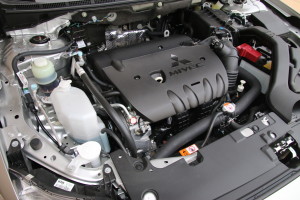
Under the hood is the Global Alliance engine jointly developed by Chrysler, Hyundai and Mitsubishi of 2.4L, four cylinders in line, DOHC and 16 valves with electronic variability. It develops 168 hp at 6,000 rpm and a strong 167 pounds of twist at 4,100 rpm. It is a bit of a torque monster. Now here is where it gets good by offering something only found in one other compact made by Subaru. Mitsu employs a CVT tranny that drives not only the front wheels, but with a switch can drive all four wheels either on demand or all four locked up. In this model its standard equipment. How terrific is that?

And it works great. During a little excursion into 6 inches of snow, absolutely no problems, real surefootedness. It’s also nice in heavy rain. Handling is also enhanced with its advanced fully independent suspension, something not found in most compact sedans. Steering is a hydraulic rack and pinion, albeit a bit slow, but feel is good. It’s also shod with 205/60 series rubber, nothing special there, but the 16 inch alloys are great looking. With stab bars at both ends, handling is quite sporty with limited roll, great steering feel and decent turn-in. Turning circle is a tight 33 feet. Lancer AWC (All Wheel Control) is one of the better handling compacts. It prefers aggressive driving; so will the driver appreciate the extra fun built into the Lancer.

Performance is also near the top of the compact class sprinting to 60 mph 7.39 seconds. Ditto for 50-70 mph passing runs. On level ground it takes 4.59 seconds and up a six percent grade will extend that time to 7.77 seconds, clearly all times at least a second quicker than your average compact. Since peak torque arrives at a low 4,100 rpm, midrange response is outstanding for a compact. There is something here that isn’t found in most other compacts, fun, performance and AWD. Remember that the Lancer is the basis for one of the great hyper-performance cars ever and well known for its rallying capability, the Mitsubishi (Lancer) Evolution, a turbocharged AWD monster with 300 plus hp.

If you are looking for maximum fuel economy look elsewhere, perhaps the base Mitsu Lancer 2.0L which still packs a 148 hp punch should deliver about 4 mpg more than this more performance oriented AWD sport model for a lot less money. My tester delivered 28 mpg overall and 33 mpg at 70 mph on the highway. In a round trip from Rescue to Pollock Pines it averaged 28.6 mpg. EPA rates this Lancer at 23/31/26 mpg city/highway/combined. Fuel capacity is 14.5 gallons.

Of course braking is all wheel discs and their performance is excellent in arresting forward progress stopping the Mitsu in a near benchmark 41-42 feet. The pedal is firm and strong. Of course there are a plethora of airbags and electronic interventions such as ABS, VSC, TC along with a whole alphabet soup of electronic safety devices. That kind of high tech electronic intervention is now on every new car, even back up cameras.

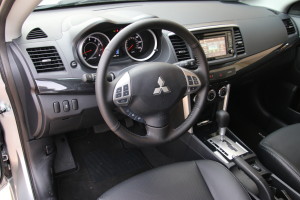
Inside this Mitsu is a leather interior, seats, steering wheel, shift knob and more. It has some luxury touches making it a notch above your average compact and it’s all standard. There is nothing extra to purchase with the SEL. Even the door paneling and dash are soft touch. Seats are comfortable and rear seating is good for two six footers. Instrumentation is also complete with a large standard tach and speedo in dual cowl binnacle which is becoming a bit dated. The trip computer is complete as well. This is a quality car.
Performance in snow is not a problem.

Performance in snow is not a problem.

Spinning at 2,400 rpm at 70 mph gives the Mitsu a relaxed feel on the highway and road noise seems to be a bit subdued for a compact.

So here’s the deal, this very well equipped, AWD, top of the line Mitsu Lancer stickers for just $21,995, plus $810 for the boat from Kurashiki, Japan. It needs nothing. Even the embroidered carpeted floors mats are standard. This is about the most car you can get for the money in a compact. And it is All Wheel Drive. It is a real value. Perhaps that’s the reason for Mitsubishi’s sales growth, making it one of the fastest growing auto companies in the business. People are finding out that nothing sells like real value. What’s even better is you can buy a Mitsubishi Lancer ES AWC for about $20 large. Don’t forget that all Mitsubishi’s come with a standard 5 year/60K mile bumper to bumper warranty plus a 10 year/100K mile powertrain warranty.

Larry Weitzman has been into cars since he was 5 years old. At 8 he could recite from memory the hp of every car made in the U.S. He has put in thousands of laps on racetracks all over the Western United States. 



How immigrants are changing U.S. ski towns

By David Page, Powder

Wednesday is ski day at Mammoth Elementary School. Which, for parents of kids in the program, means an added level of complexity on Wednesday mornings. Not only do the kids have to be in the car by 7:35am, with lunches, homework, combed hair, brushed teeth, and snow boots on the correct feet, but they also have to have their skis, boots, poles, goggles, helmets, gloves, long underwear, jacket, ski pass, sunscreen, snacks, bib, etc. One missing item could mean a kid gets stuck in the lodge all afternoon with a teacher. Or that a parent has to cut out early from work to go pick the child up.


On one such morning last winter, just as the first bell rang, Oscar Ayala (not his real name), dropped his kids at the school. In the near distance, above the paint-speckled ladder on the roof of his third-hand Isuzu Rodeo, Mammoth Mountain Ski Area stood against a blue California sky. They had their heads down, steeled for what lay ahead: four long hours of school—for “dual-immersion” kids like Oscar’s (and mine), education comes half in Spanish and half in English—followed by a short bus ride to the mountain and an afternoon on the slopes. Alison was in second grade; her brother, Oscar Jr., in fifth. Oscar Jr. was born in the U.S.; his sister in Mexico. He has a U.S. passport; she doesn’t. Neither was particularly excited about skiing, at least not early on a Wednesday morning heading into school.

Oscar is one of a growing number of immigrants finding a home in a ski town. He made his way north from Sinaloa, Mexico, in 2001. He had a degree in industrial engineering and went to Tijuana to try to get a job. Angela, his fiancée, had gone to Mammoth, invited by distant cousins on her mother’s side who needed help taking care of their kids while they worked. On the phone, she described to Oscar a place that sounded like paradise: jobs, clean mountain air, trees, a decent school, friendly neighbors, and a general lack of kidnapping, extortion, drug cartels, murder, bad water, extreme poverty, and mean-spirited immigration authorities. There weren’t any jobs in Tijuana—in industrial engineering or anything else. So Mammoth became the dream.

His Mammoth Mountain name tag bore the same name as his fake Social Security card and green card (neither his own name nor the one I’ve given him), for which he paid $150. The money withheld on his paycheck for Social Security, unemployment insurance, workman’s comp, and Medicaid would never be seen again. Not that he was complaining; that’s just how it was. “We have zero permission to stay here,” he says. “We’re the same as those who cross through the desert. The laws are starting to change, but we’re still here with the fear that at any moment for any reason they can send us back.”

Read the whole story


Placer water officials want restrictions loosened

By Lemor Abrams, CBS-13

As reservoirs fill and begin to release more water, one Northern California water agency says the drought is over and wants water restrictions lifted.

Officials with the Placer County Water Agency say if they don’t use all the water up north, it’s just going to flow into the rivers in Sacramento and end up back in the ocean. They’re asking the state to let them make the call on how they use their water.

Water officials will reconsider drought regulations in May at the end of the wet season.

Read the whole story


CalFire begins 2016 fire season early

By Vicki Gonzalez, KCRA-TV

CalFire has called in 400 seasonal firefighters, including dozens in Northern California, for an early start to the 2016 season.

“We see vegetation fires occurring even in the month of January,” CalFire Cpt. John Hotchkiss said. “So compared to years ago, those seasons where we are not having vegetation fires are getting shorter and shorter every year.”

His unit normally starts hiring seasonal firefighters in late April or May, but he was able to start six weeks early thanks to drought funding from the state.

Read the whole story


Letter: ZCTCF grateful for Soroptimist grant

To the community,

Zephyr Cove Tennis Club Foundation is extremely grateful for the generous grant from Soroptimist International of Tahoe Sierra.

We will use this money to expand our junior tennis program, which starts in May and runs through August. It is open to all first- through eighth-graders. The Soroptimist award will allow us to offer scholarships to youths who otherwise would not have been able to attend either the after school or summer program. We also will be able to purchase rackets and other tennis equipment for youngsters to use.

Multiple studies have proved that participating in sports improves self-esteem and leads to better academic performance.

Zephyr Cove Tennis Club Foundation is an all volunteer nonprofit that operates Zephyr Cove Tennis Club on Warrior Way off Highway 50 in Zephyr Cove through a multiyear contract with Douglas County.

Thank you,

Carolyn E. Wright, ZCTCF president


Reno becoming a significant freight hub

By John Harrell, USA Today

RENO — It’s 5:30am at Reno-Tahoe International Airport. A ramp agent shepherds a line of nondescript boxes up a conveyor belt into the belly of a Southwest Airlines Boeing 737 that’s scheduled for a 5:55am departure to Las Vegas.

Once that flight arrives to Vegas, those packages could be bound for almost any of the other points on Southwest’s route map. Nashville, perhaps, on Southwest Flight 1310. Or maybe Hartford, Conn., after a stop in Tampa along the way on Flight 589.

Wherever the boxes might end up, they began their journey in Reno amid what’s being called a “surge” in air-cargo operations here, says Matt Buckley, Southwest’s vice president of Cargo and Charters. “Over the past four years, we’ve tripled our volume” here, he adds.


2015 was a good year for cargo operations at the airport, “the best year for Reno ever” in terms of cargo carriage, says Hasaan Azam, Reno-Tahoe airport’s manager of Air Service Development.

Read the whole story


Snippets about Lake Tahoe

ltusd·       Lake Tahoe Unified School District is asking people to take this online survey. It will up through April 18.

·       Engel & Völkers, a European-based real estate company, has opened an office in Truckee.

·       According to AAA, in the last five years pothole damage has cost U.S. drivers more than $15 billion in vehicle repair bills.

·       Rude Brothers Bagels is staying open at its current location through April – 30 days longer than expected. A new site is still being worked out.


K’s Kitchen: Lentil soup full of health benefits

By Kathryn Reed

Lentils come in a variety of colors, with each having its own characteristics. But not all are good for every dish.

Red lentils tend to be sweeter and nuttier in flavor compared to brown and green lentils. They also get mushy when cooked. This can make them ideal for soups. With this recipe calling for the soup to be blended, it doesn’t matter that lentils are mushy.

Lentils in general have a tremendous amount of health benefits, though each color varies so read the label. Fiber, protein and iron are some of good things in lentils.

Fresh tomatoes would be fabulous for this dish in summer. I have a hard time using fresh tomatoes this time of year because they are waxy and lack flavor. That is why I used canned.

I sprinkled the top with a little oregano and paprika to make it look prettier, but that is truly optional.

lentil soupRed Lentil Soup

2 T unsalted butter

1 medium onion, chopped

2 carrots, finely chopped

3 celery stalks, finely chopped

5 garlic cloves, thinly sliced

1 tsp ground cumin

½ tsp ground coriander

½ tsp chile powder

1 14½ ounce can stewed tomatoes

2 C red lentils

8 C water

Salt

Yogurt, optional

Naan bread, optional

Melt the butter in a large pot, then add onion, carrots, celery and garlic. Cook over medium heat for a few minutes until vegetables are softened. Add cumin, coriander and chile powder. Add the tomatoes and cook for 3-4 minutes. Add the lentils and 8 cups of water.

Simmer until the lentils are soft, about 30 minutes.

Puree the soup with a blender. Season with salt.

Serve with a dollop of yogurt per serving. Use naan bread for dipping.