Straw bale gardening ideal when soil is tough
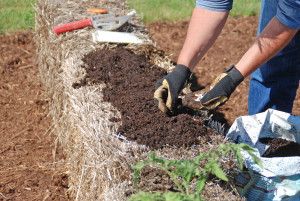
Create a planting bed for seeds by covering the straw bale with a one- to two-inch layer of planting mix. Photo/Melinda Myers, LLC

Create a planting bed for seeds by covering the straw bale with a 1- to 2-inch layer of planting mix. Photo/Melinda Myers LLC

By Melinda Myers

Add productive garden space and raise your planting bed with straw bale gardening. This technique allows gardeners to create raised bed gardens on a patio, lawn or any area with poor compacted soil. Straw bale gardening has been around for centuries, but thanks to Joel Karsten’s book “Straw Bale Gardens” it has gained new popularity.

All that is needed are a few straw bales, fertilizer, a bit of compost and time to condition, plant and water the garden.

Be sure to purchase straw bales made from alfalfa, wheat, oats, rye or other cereal grain that have less weed seeds than hay. Start a few weeks before the designated planting date.

Place the bales in their permanent location with the cut sides up and twine parallel to the ground. Once you start the condition process, the bales will be very heavy and hard to move. When the bales are in place you are ready to start the conditioning process. This is done to start the inside of the straw bales composting, so they’ll support plant growth.

On day one, spread fertilizer over the top of the bale.  Use a ½ cup of a complete garden fertilizer or 3 cups of an organic fertilizer. Then completely moisten the bale. The organic fertilizers feed the microorganisms that help decompose the straw into a nutrient rich planting medium.

Thoroughly soak the bale everyday. On days three and five you will add more fertilizer at the same rate used on day one.

Days seven through nine use half the rate used on day one. This would be one-quarter cup of a complete garden fertilizer or 1½ cups of an organic fertilizer. Thoroughly water the bale each time.

On day 10 you will add one cup of 10-10-10 or 3 cups of an organic fertilizer rich in phosphorous and potassium. This completes the conditioning process.

Bales treated with a complete fertilizer should be ready to plant. You may need to wait a few more days when using an organic fertilizer.  The inside of the bale should be the temperature of warm bath water or cooler for planting. If it is hotter than this, wait for the bale to cool a bit before you plant.

Use a trowel to pry open a hole in the bale. Place the plant in the hole and cover the roots with potting mix or compost.

Create a planting bed for seeds by covering the bale with a 1- to 2-inch thick layer of planting mix. Follow the planting directions on the back of the seed packet.

Regular watering is critical for success with this method. Soaker hoses or drip irrigation make this an easier task. You can also use gallon milk jugs with holes in the bottom or inverted 2-liter soda bottles placed near the base of each plant to provide water where it is needed.

Give your straw bale garden a nutrient boost about once a month or as needed throughout the growing season.

Follow these steps and you’ll be well on your way to growing a productive straw bale garden to enjoy throughout the season.

Gardening expert Melinda Myers has more than 30 years of horticulture experience and has written more than 20 gardening books, including Small Space Gardening and the Midwest Gardener’s Handbook. She hosts The Great Courses “How to Grow Anything: Food Gardening For Everyone” DVD set and the nationally syndicated Melinda’s Garden Moment TV  and radio segments. Myers is a columnist and contributing editor for Birds & Blooms magazine and spokesperson for Milorganite. 


Casinos across Nevada post gains in February

By Associated Press

LAS VEGAS — State officials say Nevada gambling revenue was up 8 percent in February compared with the same month a year ago and saw across-the-board gains.

The Nevada Gaming Control Board said Wednesday that the state’s casinos won $990 million in February.

Las Vegas Strip gambling revenue grew more than 7 percent to $570 million last month. Downtown Las Vegas brought in $51 million for a 17 percent gain.

Reno casino revenue was up 7 percent to $48 million, and Stateline revenue was up 4 percent to $16 million in February.

The state collected almost $51 million in tax money based off the winnings, which is down 13 percent from the same time last year.


Outdoor recreationists compete for USFS attention

Winter recreation enthusiasts are interested in the Forest Service's plans. Photo/Susan Wood

Winter recreation enthusiasts are interested in the Forest Service’s plans. Photo/Susan Wood

By Susan Wood

How can Lake Tahoe Basin residents and nature stakeholders deal with the inevitable power struggles that go with sharing open space in winter – whether that power is driven by human or machine?

That’s the pervasive question the Lake Tahoe Basin Management Unit team is asking as it starts the long, laborious process of coming up with a winter recreation plan that serves the needs of those who play and live in the snow. The plan is expected to be completed next year.

And as longtime Tahoe park ranger icon Don Lane puts it: “How tolerant are you of what others do in this special place we call Tahoe?”

Leaning against the table in the LTBMU conference room Tuesday night in its first open house on the subject, Lane was gesturing while pointing out to Fallen Leaf Lake resident Peggy Laughlin during their debate over the history of Tahoe that many people experience this beautiful winter recreation paradise in different ways.

And therein lies a balancing act as delicate as protecting the lake itself.

Some people cross country skiing in the basin like to stop to close their eyes and not hear any noise. Snowshoers often enjoy opening their eyes to see virgin snow with no tracks in sight. Snowmobilers relish the thrill of manipulating a sled in a mighty hairpin turn through powder. Fat tire mountain bike riders may want to hear the crack of the crust. And now there’s a cross between a snowmobile and bike to plow through the white stuff.

Whatever floats the boat of the winter recreational enthusiast, sharing the land has its challenges. But in this case, the plan dictating the guidelines is long overdue.

The last time the Forest Service developed a plan here in the basin was 1975.

The federal land use agency was given the directive to revisit the “Snowmobile Guide” while the overall Forest Service general plan was being adopted because many winter enthusiasts were commenting on this type of recreation. The Forest Service’s general plan is due to be signed at any time by the regional office in Vallejo.

In the meantime, LTBMU agreed to host open houses to receive input. The next one is slated for April 5 from 5-7pm at the North Tahoe Event Center, 8318 North Lake Tahoe Blvd. in Kings Beach. The third is scheduled in Sparks on April 19 at the same time in the Humboldt-Toiyabe office at 1200 Franklin Way.

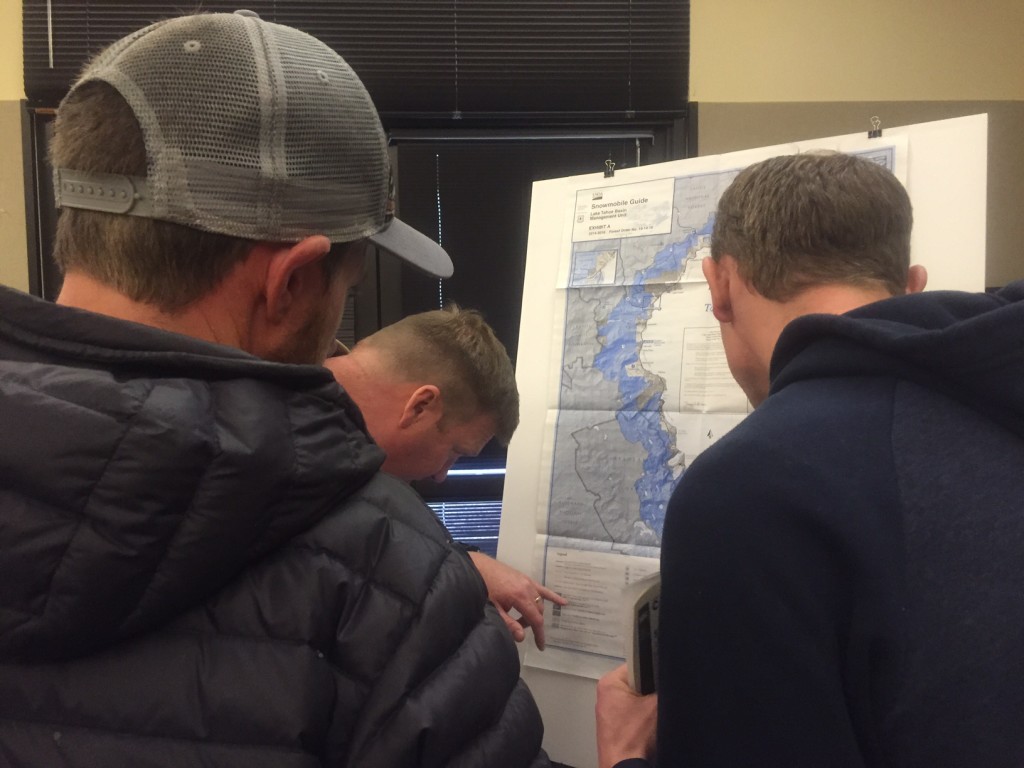
More than 50 people showed up for the South Shore’s March 29 meeting, filling the room with varied opinions. A comment box was placed on a table, along with questionnaires situated near a handful of Snowmobile Guide maps placed on easels around the room. Many gathered around them, pointing to different areas they ski in or ride a snowmobile in.

To help spur the process, the Forest Service asked:

·      “What do you value about your winter recreation experience and opportunity?

·      What conditions or circumstances detract from a high quality experience for you, and how could those be improved through different LTBMU management?

·      What is working well with the current Snowmobile Guide regulations and with current conditions regarding winter recreation opportunities, access and experience?

·      What kinds of partnerships or strategies might the LTBMU explore to provide improved winter recreation access and opportunity as well as improved resource stewardship?

·      What other information or input might help the LTBMU develop a comprehensive proposed action for winter recreation?”

The questionnaire instructed the participant to submit the form to an LTBMU employee, the front desk or electronically to comments-pacificsouthwest-ltbmu@fs.fed.us.

Phil Brand, who has lived in South Lake Tahoe for 53 years, told Lake Tahoe News he would take his home to work on.

Brand owns two snowmobiles and likes to ride up Oneidas Street to Armstrong Pass in the South Shore and in Blackwood Canyon and the Rubicon Trail on the west side where more unrestricted region exists. He recalls the days in the 1960s when “you could go almost any place” on the South Shore.

“Over the years it’s gotten where more and more areas are closed off. It’s harder to find places to go,” he said, adding that a segment of people “don’t want us there.”

He says that with a degree of understanding. Brand is also a cross country skier and occasionally pulls the snowshoes out.

When comparing this area to Mammoth, Brand contends those residents live in more harmony than Tahoe. He’d like to see more areas open up to snowmobilers, but that’s not his expectation.

“The way things are going, I’d settle for not less,” he said.

Longtime Tahoe environmental activist Laurel Ames said she wants the same – only for cross country skiers. Ames would like to see High Meadows east of the Black Bart region stay off limits to the snowmobilers because it’s “a special place for skiing” and represents an environmentally sensitive region.

“I want to see places quiet. (Snowmobilers) have a lot of places to go,” she declared.

Currently, the Snowmobile Guide outlines closed off zones in Desolation Wilderness, High Meadows and the Meiss Meadows region on the South Shore; Granite Chief Wilderness, Sugar Pine Point and Burton Creek state parks on the West Shore; East Shore beaches at Secret Harbor, Spooner and Lake Tahoe Nevada state parks on the east side; and the North Shore’s Tahoe Meadows, which LTBMU Recreation Supervisor Gina Thompson calls the most contentious area.

Thompson hopes that by having open houses where stakeholders may share their points of view they’ll come to a better understanding and therefore consensus on how to share the space.

Even the collaborative team of citizens assembled a few years ago didn’t come to that, so the Forest Service took back its own project.

“The collaborative focused on open and closed areas. There were other things to focus on,” Thompson explained.

For example, the issue of where to park came up repeatedly. Most snowmobilers place their sleds on big trailers. While skiers simply want to get off the road when they leave their vehicles for hours.

“The challenge becomes who’s going to plow and who’s going to pay for that,” Thompson said.

Keep in mind the Forest Service spent half its budget on fighting fires this year.

Thompson also realizes many users would like to see more signs.

Either way, it’s a long road ahead.

LTBMU hopes to return in the fall with a proposal from the comments, a submitted NEPA document and a call for another meeting.

“It’s really hard to give everyone their own little piece (of Tahoe), but we’ve got to be respectful,” she said.


Opinion: New Golden Rule of playing outside

By Christopher Solomon, Outside

Earlier this season, ski tracks appeared on Josies Ridge above Jackson, Wyoming. Ski tracks around Jackson usually aren’t news. But the Forest Service closes Josies and other areas to recreationists from December through April to give deer and elk a break from human disturbance during the winter. Signs announce the closures.

One week later, skiers poached Josies again.

When we play in the mountains and forests, we think we’re simply having fun. (Leaving no trace! Communing with nature!) But whether we’re in closed or open areas, studies show that even Sierra Club-approved activities like hiking, cross-country skiing, and bird watching can negatively affect the environment more than you’d think. Take research in Boulder that discovered a roughly 100-yard “death zone” for songbirds on both sides of a trail, as one scientist put it, pointing to low nesting success and lower populations. Moose increased their movement by 33 percent, burning more energy, after encountering skiers, a study in Scandinavia found. In one not-yet-published survey of 218 studies that looked at the effects of recreation on wildlife, researchers found more evidence for impacts by non-motorized activities than by motorized ones.

Nature once had plenty of elbowroom. Today natural places—those places we like to play in—are increasingly squeezed by climate change and a booming human population.

Read the whole story


Future of U.S. wine isn’t where you’d expect

By Mark Ellwood, Bloomberg

Dan Dunn spent much of his adult life drinking, albeit for professional reasons (he’s the former nightlife columnist for Playboy). He’s a whisky aficionado, cocktail expert, and beer enthusiast. The only tipple that never tempted him was wine.
So when he finally decided he needed a break from the fast lane, Dunn decided to take a slow road trip around the U.S.—and it occurred to him he could structure it around eliminating his last booze blind spot.

So on that 15,000-mile trip, he set himself a single mission: learn everything he could about wine.

He turned that booze-soaked road trip into the new memoir-slash-travelog, “American Wino: A Tale of Reds, Whites and One Man’s Blues”. He wanted to understand, in particular, how wine drinking and making had changed stateside since the Judgment of Paris, when upstart American wines bested French vintages in a blind tasting. That was 40 years ago this May, and the unexpected New World victory kickstarted a Californian wine rush. After sipping his way through dozens of vineyards across the country, he has a prediction for what’s next. “At least right now, they’re not making wine anywhere in the United States better than California. Forty years from now? Things are going to look a whole lot different.”

Read the whole story


California delays BPA warning rules

By Associated Press

California plans to delay state-required warnings on metal cans lined with the chemical BPA, arguing too-specific warnings could scare stores and shoppers in poor neighborhoods away from some of the only fruits and vegetables available — canned ones, officials said Thursday.

Instead, the state on May 11 will require stores to post general warnings at checkout counters about the dangers of BPA and note that some canned and bottled products being sold have liners with the toxic chemical.

The decision and rationale of the California Environmental Protection Agency are angering some community and public-health groups.

It’s “ridiculous. It’s paternalistic,” said Martha Dina Arguello, executive director of Physicians for Social Responsibility-Los Angeles. “I just can’t imagine that it’s a better idea not to let us know what’s in our food.”

The warnings are coming on line in California under the state’s Proposition 65, a measure approved by voters in 1986 that requires businesses to notify the public about high levels of chemicals in products or places.

California officials decided last year to add BPA, or bisphenol A, to the list of about 800 chemicals requiring Proposition 65 notices. Manufacturers use BPA in epoxy liners of some cans, bottles and jars.

Some studies have determined the chemical is an estrogen-like substance that at high levels could harm the female reproductive system.

That 2015 decision by California is controversial. The U.S. Food and Drug Administration banned BPA from baby bottles and sippy cups in 2012, but it says the level of BPA that leeches into food is safe otherwise. The federal agency also is awaiting the results of more studies.

Ordinarily, the state would either require manufacturers to put those warnings on the cans, or make grocers post signs on canned-goods shelves specifically warning that “Brand X tomato sauce, Brand Y green beans” have the targeted chemical in the can, said Allan Hirsch, chief deputy director of the state EPA’s Office of Environmental Health Hazard Assessment.

For BPA, though, “we think that would be kind of chaotic,” the state official said. “Retailers might react … by just pulling canned and bottled foods off their shelves entirely,” which would be bad news in neighborhoods without good grocery stores.

“We would want to make sure that people, especially in low-income communities, still have access to canned fruits and vegetables. That’s certainly better than not having access to them,” Hirsch said.

Hirsch also acknowledged hearing “some concern from retailers” about how the warning is going to work.

Kathleen Roberts, executive director of the can industry’s North American Metal Packaging Alliance, said Thursday that confusion “from these warning signs could further limit healthy choices, particularly for low-income families in inner-city neighborhoods and rural communities.”


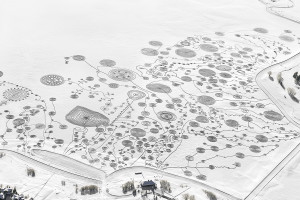
Artist creates snow drawings in the Sierra

Creating art on snow can be a fleeting endeavor. Photo/Sonja Hinrichsen

Creating art on snow can be a fleeting endeavor. Photo/Sonja Hinrichsen

By Lori Halloran, KQED-TV

For the past seven years Sonja Hinrichsen has made snow drawings all over the world. Over time she’s come to terms with the completely unpredictable nature of her work.

Though she spends months planning her projects, she can never be sure if the weather will cooperate, until the appointed day arrived. If there’s no snow, there’s no canvas. If the snow is falling, she has to wait out the storm.

Even when conditions are perfect and her creation is complete, it’s a race against time to photograph the work before the next snowfall covers it up or it simply melts away.

Read the whole story


Team gearing up to start Hwy. 89-Fanny Bridge work

Construction of the Highway 89 realignment and Fanny Bridge rebuild in Tahoe City are expected to start this summer, with completion slated for 2017.

Rerouting the highway and the roundabouts on either end will be built this year.

The new roundabout at the Tahoe City Y, the rebuild of Fanny Bridge and the creation of a complete street along what will be old Highway 89 or  West Lake Boulevard are planned for construction in summer 2017.

Tahoe Transportation Department is the lead agency. Designs on the bridge are under way. Two gateway monumental design concepts are being reviewed.


Job totals trail pre-recession levels in Nev.

By Christopher S. Rugaber, AP

WASHINGTON — Ten U.S. states — Nevada among them — still have not regained all the jobs they lost in the Great Recession, even after six and a half years of recovery, while many more have seen only modest gains.

The figures help illustrate the uneven nature of the economic rebound since the Great Recession ended in June 2009. They also suggest why many Americans feel the improvement has passed them by. Ongoing economic anxiety, despite some data suggesting the economy has recovered, is fueling much of the support for insurgent presidential candidates such as Donald Trump and Bernie Sanders.

Wyoming had 3 percent fewer jobs last month than it did in December 2007, when the recession began, the Labor Department said Friday. That is the biggest percentage decline among the states. Alabama’s job total trails its pre-recession level by 2.7 percent, followed by New Mexico, where job totals are 2.6 percent lower.

Some larger states are also still behind. New Jersey has nearly 1 percent fewer jobs than it did at the end of 2007, and Missouri is just below its pre-recession level.

The other five are: Mississippi, Nevada, Maine, Connecticut, and West Virginia.

Other states have notched very small gains that likely trail population growth. Illinois has 8,600 more jobs than it did in December 2007, a gain of just 0.1 percent. Arizona’s job count is up just 9,200, or 0.3 percent. And Ohio has added 58,100 jobs, or 1.1 percent.

All those gains are far below the 4 percent increase in jobs nationwide from December 2007 through February 2016, according to government figures. Three-fifths of states have seen job gains below that national average.

Some areas have seen much greater hiring. Four states have recorded double-digit increases in their total payrolls, along with Washington, D.C.: North Dakota, Texas, Utah, and Colorado.

The oil and gas drilling boom has lifted North Dakota’s job count by more than 20 percent, even though falling energy prices have caused significant layoffs in the past year.

Texas has also benefited from the energy boom, as well as greater high-tech hiring in cities like Austin. Utah and Colorado have also benefited from fast-growing information technology companies.

The data also shows how the decline in the unemployment rate in some states has exaggerated the improvement in their economies. The rate in Michigan, for example, fell to 4.8 percent last month, down from 5.9 percent a year ago and one-tenth of a point below the national average.

Yet Michigan’s job count has increased just 1.6 percent since the recession began, less than half the nationwide gain.

Its unemployment rate has fallen in large part because many of those who lost jobs have since given up looking for work. When people stop job-hunting, they are no longer counted as unemployed.


New SLT art gallery owner to give talk

Tahoe Art League’s next meeting will feature a young artist from the Los Angeles area who now runs the Genius Fine Art Gallery in South Lake Tahoe.

Scott Forrest’s abstract paintings are featured in this gallery along with the work of Rashad Hopkins, Salvadore Dali, Pablo Picasso, Joan Miro, and Marc Chagall.

The April 13 talk is free. The meeting, with refreshments starts at 6pm, with the presentation at 7pm at the South Lake Tahoe Senior Center, 3050 Lake Tahoe Blvd.