
Lake Tahoe Brewing closes throughout the region

By Mike Higdon, Reno Gazette-Journal

In the last two months, Lake Tahoe Brewing Co.’s four locations in Carson City, Truckee, Fernley and Reno closed or never opened. What would’ve been the region’s largest locally-owned beer franchise fizzled down to nothing after a series of legal troubles flattened the brand.

Brewery owner, Michael Candelario, said he is wrapping up closure of the final Fourth Street location that he planned to open as a tap house and largest barrel-aging facility in the region. In Carson City, the brewery represented the fourth brewery to close in the same downtown location since Stew’s Brewery, Doppelgangers and High Sierra Brewing Co. shuttered in 2011 and 2014 respectively.

The troubles for Lake Tahoe Brewing started in February when Lake Tahoe Brewing was evicted from its downtown Carson City location.

Read the whole story


IVGID contemplating raising water, sewer rates

Incline Village General Improvement District is proposing a sewer and water rate increase.

Average water rates would go up by 2.4 percent and sewer rates by 3.8 percent.

The board is also proposing amendments to its Sewer and Water Ordinances. More information is available online.

There will be a public hearing on the 2016-17 budget on May 18 at 5:30pm at the Chateau.


Artists sought to create Calif. duck stamp

The California Department of Fish and Wildlife will accept submissions for the 2016-17 California Duck Stamp Art Contest from May 13-June 13.

The contest is open to U.S. residents who are 18 or older as of March 14, 2016. Entrants need not reside in California.

The winning artwork will be reproduced on the 2016-2017 California Duck Stamp. The top submissions will also be showcased at the Pacific Flyway Decoy Association’s art show in July.

The artwork must depict the lesser snow goose.

The design must be the contestant’s original hand-drawn creation. All entries must be accompanied by a completed participation agreement and entry form. These forms and the official rules are available online.

Entries will be judged at a public event to be held in June. The judges’ panel, which will consist of experts in the fields of ornithology, conservation, and art and printing, will choose first, second and third-place winners, and an honorable mention.

Since 1971, CDFW’s annual contest has attracted top wildlife artists from around the country. All proceeds generated from stamp sales go directly to waterfowl conservation projects throughout California. In past years, hunters were required to purchase and affix the stamp to their hunting license. Now California has moved to an automated licensing system and hunters are no longer required to carry the physical stamps in the field (proof of purchase prints directly onto the license). However, CDFW will still produce the stamps, which can be requested online atwww.wildlife.ca.gov/licensing/collector-stamps.


1 plan left for stalwart SLT worker — retirement

Judy Finn has been the go-to person for city planning issues for 16 years. Photo/Provided

Judy Finn has been the go-to person for city planning issues for 16 years. Photo/Provided

By Susan Wood

While it isn’t a one-woman unit, those who do business with South Lake Tahoe’s planning department have been relying on the same person for the past 16 years – Judy Finn.

The associate planner is retiring this month.

“I have to tell you, this is the worst news to come out of the city for a long time,” attorney Lew Feldman said. “Judy’s awesome, and she’ll be sorely missed. I couldn’t be more happy for her. She’s so deserving.”

Feldman is the king of representation for high-dollar, town-altering projects that have needed Finn’s gentle hand and rational guidance to get off the ground. Think of projects like the Marriott-anchored Heavenly Village.

The declaration from Lake Tahoe News of her looming retirement sent shivers down the spine of the Tahoe-area collective that relies on her to help them turn their ideas into brick-and-mortar reality.

Finn started as a temporary permit clerk in 1990. She left in 1991 because there was no full-time job. It was in 2000 that she started her current tenure. In 2001, she was promoted to senior permit technician and in 2006 she became an assistant planner. In 2009, she earned a certificate in land use and environmental planning program from UC Davis extension. She’s been in her current post for four years.
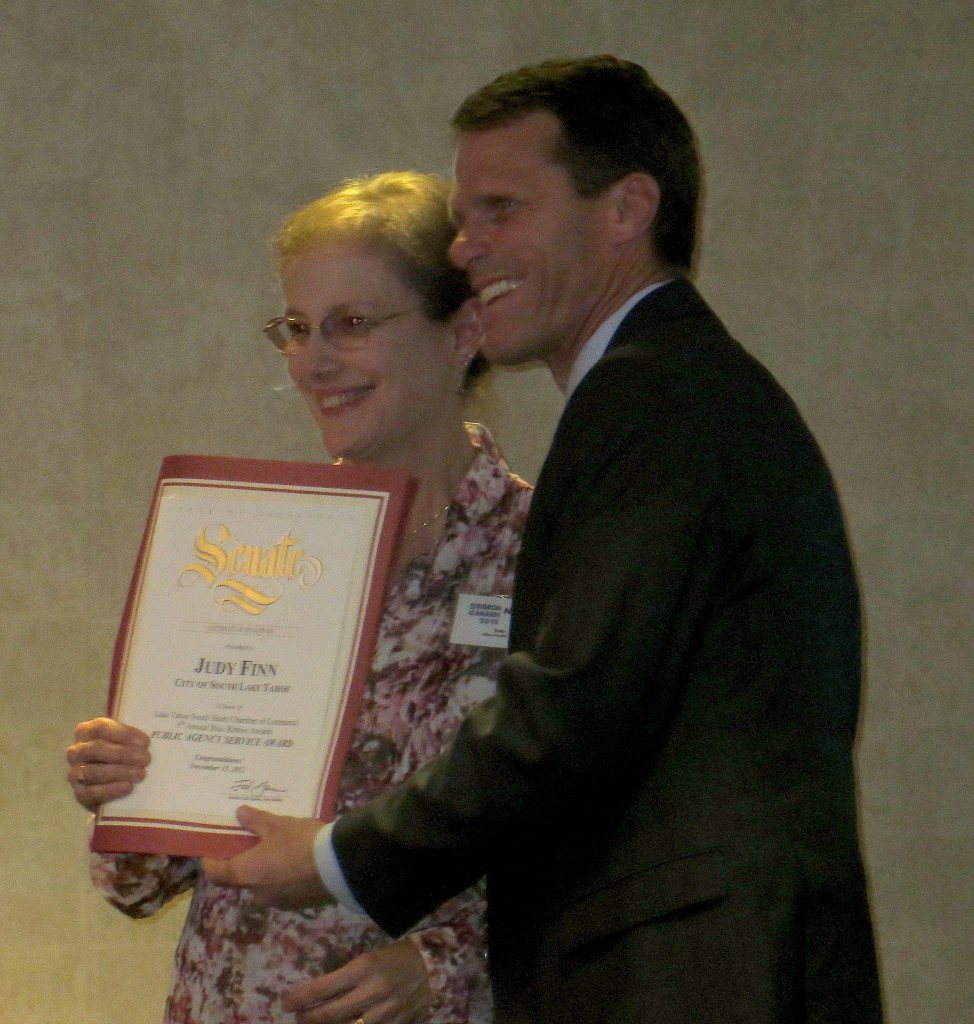
State Sen. Ted Gaines with Judy Finn the night she was awarded 2012 Tahoe Chamber Blue Ribbon Award for Public Service from Ted Gaines.

State Sen. Ted Gaines with Judy Finn the night she was awarded the 2012 Blue Ribbon Award for public service from Lake Tahoe South Shore Chamber of Commerce. Photo/Provided

“Judy has a warmth and kindness that separate her from many who interact with the public in that capacity. It’s not an easy position. She always goes above and beyond,” Feldman told Lake Tahoe News.

And then, the professional care goes beyond the work.

“We’ve absolutely been interested in one another’s well being outside the role of work,” Feldman said as if losing a friendly confidante at the counter.

Some implied the city planning department should brace itself because projects may be hitting the counter in the hopes Finn would work on them before she leaves. Another suggested placing Finn on speed-dial during retirement to get that institutional knowledge at crunch time.

Mick Clarke of Signs of Tahoe, who seemed in complete shock after hearing the news, said he was genuinely worried. Clarke’s thriving sign business has seen a lot of action at the city in its 36 years of existence.

“Of all the planning staff I’ve ever worked with, Judy is light years ahead of anyone. She understands. She really cares about local business people. I tell all my customers to make sure they talk to Judy,” Clarke told Lake Tahoe News.

City Councilman Tom Davis, who has known Finn for decades, sends difficult applicants to the planner. He recalled how TJ Maxx experienced challenges with sprinklers and water connection fees, but Finn worked through the process with grace.

The longtime politician pointed out in an age where government can get in the way Finn demonstrates a “can-do” attitude.

“I knew if I sent them to her, (problems) would get resolved. She’ll be missed,” Davis said, while joking he’s “not accepting her resignation.”

Nick Exline of Midkiff and Associates also shared an example of Finn’s empathetic work ethic.

Getting the Landing Resort hotel off the ground was “complicated,” needing a creative solution to keep 40 construction workers on the job while the city worked out how the high water table would affect the excavation depth relative to the final best management practices design.
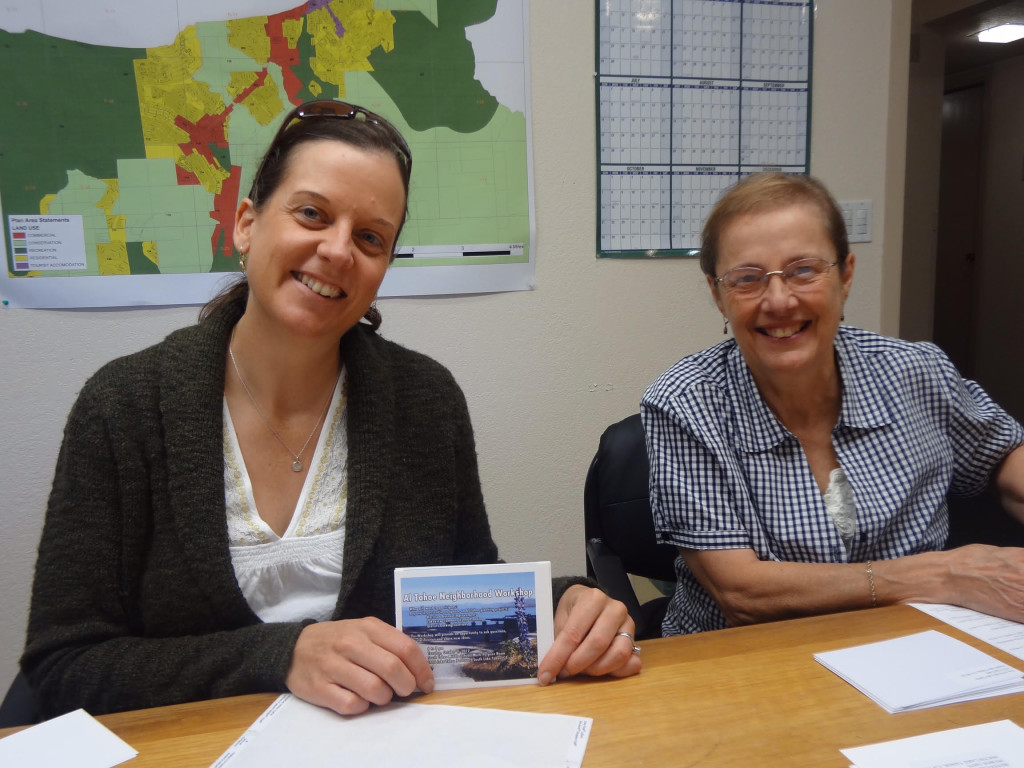
Hilary Roverud, left, knows it will be hard to replace Judy Finn. Photo/Provided

Hilary Roverud, left, knows it will be hard to replace Judy Finn. Photo/Provided

“Judy was very aware of issues, and she allowed us to keep working – all because she understood the difficulties of the site,” Exline said of the crew. “It’s a genuine customer service approach.”

The listening skills didn’t end there. Finn kept up on the latest happenings of Exline’s children and shared her own experiences about her grandchildren – one of the personal interests that will receive added attention in retirement.

The other area of attention will be her tomato starts in the yard. Finn’s boss, Hilary Roverud, said she will miss the fresh produce, but it will be Finn’s work ethic and gentle demeanor that will be hard to replace. The development services director, who refers to Finn as “a friend to everyone,” singled out Finn as having an “uncanny ability to handle situations with unhappy people and make them feel that their issues are important.”

Roverud mentioned how she’s appreciated the support from Finn “so many times.”

“These will be hard shoes to fill – to have someone with that kind of experience who knows the town really well. I don’t think you plop someone in the chair, and they become Judy Finn. It’s a tough job. Part of the job is regulation. It’s the regulation part that you have to tell people the law doesn’t allow you to do that. She has a talent for being able to work with people to calm them down. Her calming ability is very valuable,” Roverud said. “She’s good at finding solutions within the law.”

Roverud noted there were several instances in which Finn received compliments from customers and citizens.

Finn plans to stay in her hometown of 45 years.

“I definitely have mixed emotions. I enjoy my job. This is a very gracious community and often times I feel like I make a difference, and I still have contact with these people,” said Finn, while preparing to volunteer for St. Theresa’s annual St. Patrick’s Day dinner. Her service to the church will be another post-retirement priority, along with cooking, sewing, reading and gardening. Finn grows those “tricky” tomatoes as well as herbs and zucchini.

She’ll miss her work and colleagues.

What advice does she have for the person filling her shoes?

“My advice is just try not to be bureaucratic and on a power trip. Think of both sides. Think of what the applicants and business owners want. It’s such a short building season here, and people depend on these jobs. Of course at the end of the day, you still need to stand in front of the council and justify your actions. When people come into a government office and ask: ‘How can I do this,’ they’re nervous. You can’t always say yes, but you try to find a way to make it happen,” Finn said. “It’s really rewarding when they come back and say thank you. You don’t expect it.”

(Reporter’s note: Thanks Judy for making sense of convoluted planning complexities over the years. – Susan Wood)



Opinion: Closing the racial wealth gap

By Beadsie Woo

Like many economists who care about American families struggling to make ends meet, I spend a good amount of time thinking about how parents can earn more income to give their children better opportunities and reduce stress in their daily lives. But my real mission is one you hear less about in the debate over income inequality. For families to make their way to a better life, it’s not enough to earn more. They’ve got to keep and grow their earnings, too.

Savings and assets—homes, cars, retirement funds—are launching pads to something better, even as they cushion against today’s inevitable emergencies. But for generations, policies to help families build the savings and assets they need to give their children a better life have created a persistent and widening gap in net worth between white families and African-American and Latino families.

As a country, we don’t like to talk about race. Our inequality conversations are often framed more generally, as the difference between the 1 percent and the rest of us. But when nearly 70 percent of children living below the federal poverty line are non-whites—a rate much higher than the representation of nonwhite children in the overall U.S. population—it’s time to look honestly at the role race and ethnicity continue to play in the prospects of future generations.

A long and shameful pattern of discriminatory policies—from redlining by federal housing authorities to disparate access to the benefits of the GI Bill—have disadvantaged African-American and Latino families, among others, in developing savings and assets for generations. While those overtly discriminatory policies have been taken off the books, a legacy of different fates remains.

Between 2010 and 2013, for example, as the U.S. economy was climbing out of the Great Recession, the net worth of white families increased by 2 percent while black and Latino families saw their assets plummet by 34 percent and 15 percent, respectively. The gaps show African-American and Latino families face steep odds when it comes to building any kind of financial cushion, while white families are more likely to inherit a house or savings. A median white family is likely to have a month’s income in savings on hand for emergencies, while a median Latino family has only 12 days’ worth, and a median African-American family only five days’ worth.

Saving money isn’t easy—nearly half of Americans don’t have enough put away to handle even a $400 emergency. And the more a family depends on its income for daily subsistence, the less there is to put away. An unexpected bill or health crisis can be financially crippling to families operating on a thin margin. Poor families might not qualify for conventional loans and resort to payday lenders whose ready access comes at a high price. Predatory lending practices cost families $8.7 billion a year in interest and fees, perpetuating the cycle of poverty.

The Annie E. Casey Foundation, where I use my background as an economist to analyze and communicate data, recently released a brief with four practical policy recommendations to help all families build the savings and assets they need for their children to succeed. The Institute on Assets and Social Policy at Brandeis University analyzed two of these policies at our request and found that both could reduce the racial wealth gap—one of them quite substantially.

One of these vehicles, the federal My Retirement Account program (known as myRA), was established in 2014 to allow workers who lacked vehicles for retirement savings through their employers to save up to $15,000 in a no-fee, government-backed starter retirement account. If participation were expanded and everyone eligible were to save the maximum, myRA could reduce the black-white wealth gap by 5 percent and the Latino-white gap by 7 percent, the analysis indicates. And because myRAs are funded with after-tax dollars, contributions can be available for emergencies without incurring tax penalties.

The other policy analyzed—a more ambitious, broad investment in children’s savings accounts—showed potential for the greatest social dividends. The recommendation was that federal funds seed accounts for every child born in the U.S., with larger deposits for infants in low-income families with minimal savings. At age 18, a young person could use the money for tuition or training, a business or a home. Countries from Singapore to the United Kingdom have already offered accounts like this.

Research suggests that children in the United States with savings accounts in their own names are substantially more likely to go to college than those who don’t. And the Institute on Assets and Social Policy analysis found that, depending on how much is invested in each account, the racial wealth gap could be narrowed by 20 to 80 percent or even more.

The models show the United States can begin to narrow its racial wealth gap with modest public investment, and get more impact the more we invest. Are there other ways to spend our money? Of course. But ensuring all children have opportunities to succeed would strengthen our economy and help realize our American ideals of fairness and equity.

Retirement accounts and children’s savings accounts would make the biggest impact in combination with other policies, such as raising the amount of savings and assets families are allowed to keep while still qualifying for public benefits and expanding access to programs that promote saving for homeownership.

Children from families without savings and assets are more likely to struggle at school and have low self-esteem. While Americans rush to keep pace with our global competitors in innovation and technology, we can’t afford to leave so many of our citizens permanently behind. Instead, let’s help them grow what they have worked so hard to earn.

Beadsie Woo is a senior associate at the Annie E. Casey Foundation in Baltimore.


Expiration law may cut food waste

By Tara Duggan, San Francisco Chronicle

Food waste is a hot topic quickly moving into the political mainstream, largely because it touches so many issues at once — the environment, hunger, household budgets and the overall economy.

Now, proposed legislation from Assemblyman David Chiu, D-San Francisco, aims to address the issue by changing one simple but crucial thing: the expiration dates on food.

As of now, shoppers see myriad versions of expiration dates indicated on packages of food, be it fresh ground beef or a can of chili. Common verbiage includes “best by,” “freshest by,” “sell by” or any number of other similar phrases.

With the exception of infant formula, none of these dates is federally regulated, and all are determined by the manufacturer. In the majority of cases, the dates indicate the manufacturer’s best guess as to when product is at best quality — and don’t have anything to do with safety, even with that suspect carton of milk.

Read the whole story


Snippets about Lake Tahoe

drugs·       People may drop off unused prescriptions on April 30 from 9am-1pm at the Gateway Shopping Center in Truckee or old vacant fire station in Tahoe City.

·      High Fives Foundation’s Silver Tie Gala is April 29 starting at 6pm in the show room at Dolan Lexus located on South Virginia Street in Reno. More information is available online.

·       Barton Health physicians and staff voted Amanda Weavil as their favorite doctor.

·       Kevin Monsma, superintendent of Pollock Pines Elementary School District and superintendent/principal of Silver Fork Elementary School District, has been tapped to be associate superintendent of Educational Services for El Dorado County Office of Education.

·       April 11 is National Pet Day. According to Vacasa, out of 190,038 reservations in 136 markets South Lake Tahoe captured 14 percent of the market.


EDC teen latest person to overdose on fentanyl

Counterfeit hydrocodone pills are being laced with fentanyl. Photo/El Dorado County Sheriff’s Office

Counterfeit hydrocodone pills are being laced with fentanyl. Photo/El Dorado County Sheriff’s Office

By Claudia Buck and Samm Caiola, Sacramento Bee

The potent painkiller fentanyl widened its reach Thursday, as a new overdose case appeared and law enforcement officials confirmed the fentanyl-related death of an 18-year-old El Dorado Hills resident.

The March 28 death of George Berry, whose cause of death previously was listed as undetermined, now is linked to the recent rash of overdoses by pills or tablets containing fentanyl, according to the El Dorado County Sheriff’s Office.

Also Thursday, the UC Davis Medical Center reported that another patient is suffering from a fentanyl-related overdose – the center’s 17th case – according to a hospital spokeswoman.

Read the whole story


Report: Nev. worst for ‘real unemployment’

By Mark Robison, Reno Gazette-Journal

Nevada ranks No. 1 in the United States for “labor underutilization” in 2015, with 13.9 percent of the population unemployed, underemployed or who wants to work but have given up.

Some call it the “real unemployment rate.”

That compares with an overall “U-6” unemployment rate last year in the United States of 10.4 percent, according to data released March 31 by the Bureau of Labor Statistics.

Read the whole story


Nev. sheriff links crime hike to Calif. law to reduce prison crowding

By Ricardo Torres, Las Vegas Sun

Depopulation in California jails and gang members moving to the Las Vegas Valley might be contributing to the rise in violent crime, according to Metro Police Sheriff Joseph Lombardo.

There’s a “plethora” of reasons why the valley might be experiencing a hike, Lombardo said during an editorial meeting with the Las Vegas Sun, but Metro has had an increase of interactions with California gang members during arrests and investigations.

“That influx is directly related to, I believe, the depopulation of the prison system in California,” he said.

Read the whole story