Desolate snowshoe tests navigation skills

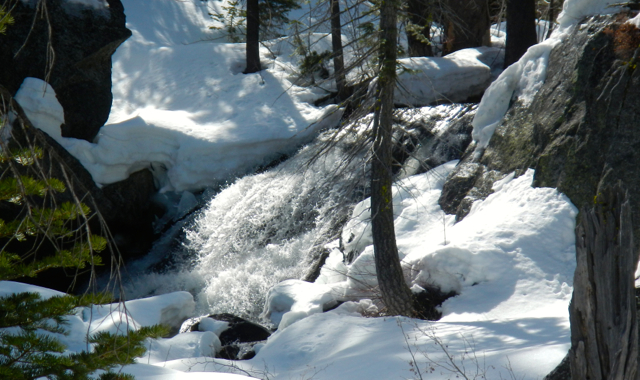
A waterfall along Meeks Creek in Desolation Wilderness. Photos/Kathryn Reed

A waterfall along Meeks Creek in Desolation Wilderness. Photos/Kathryn Reed

By Kathryn Reed

MEEKS BAY – While there has been more snow than recent years, it still hasn’t been normal in Lake Tahoe. A snowshoe in late February put the exclamation point on this statement.

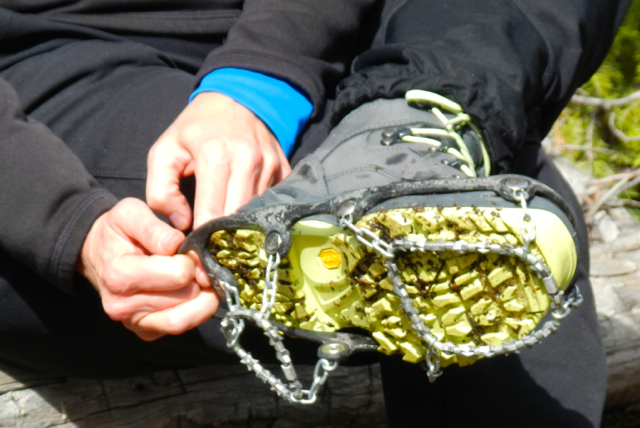
Rarely were the snowshoes even on; part of the time Yak-Tracks were worn and much of the time all that was needed were hiking boots.

Water was in abundance, especially at the start of the route. It was more reminiscent of late April or early May on the West Shore.

The intent of the five people and two dogs was to hike a portion of the Tahoe-Yosemite trail. And while that is exactly what we did, we never made it to a single lake. Finding the trail became cumbersome, so we turned around.

Yak Tracks help provide stability in slick conditions.

Yak Tracks help provide stability in slick conditions.

The accumulation of water on the trail was problematic at times – as was having to cross the creek. Once we hit a substantial amount of snow is when we started postholing. That’s when the ’shoes came on.

We tried to follow tracks laid by earlier adventurers, but eventually they ran out. Even with a GPS device, we were doing a bit of a zigzag that got tiresome.

When the trail is clear of snow it is a 12-mile round trip with Lake Genevieve, Crag Lake, Hidden Lake, Shadow Lake and Stony Ridge Lake as destinations.

We made it a five-mile adventure.

It didn’t matter that we didn’t make it to our destination of at least one lake. The scenery was stunning. Being in Desolation Wilderness is always a feast for the senses. It was also one of those rare times where it lived up to its name. Not many people venture out there this time of year, where as when it’s just dirt on the ground, it is a popular spot.

Another advantage of going this time of year was seeing a waterfall that I hadn’t seen in drier climate. This is along Meeks Creek, which eventually flows into Lake Tahoe.

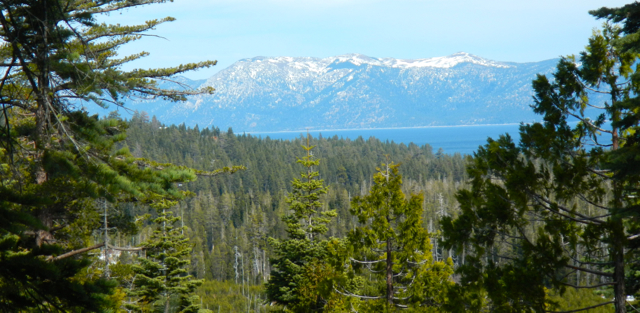
Lake Tahoe makes an appearance on the way back to the vehicles.

Lake Tahoe makes an appearance on the way back to the vehicles.

—–

Getting there:

From South Lake Tahoe, take Highway 89 north to Meeks Bay. Just past the fire station that is on the right, there is parking on the left in the dirt. A small paved lot exists where the actual trailhead starts. Be sure to fill out the free Desolation Wilderness permit.


Opinion: Education standards failing students

By Rachel Burstein

Why can’t history classes show students why history matters?

That’s what I thought as I read through a new framework for teaching K-12 history in the U.S.—California’s History-Social Science Framework.

This is supposed to be the new, 21st century approach. It spans hundreds of pages of minute detail. But this document doesn’t seem to recognize the value of history.

Consider the framework for fifth grade. In 164 pages, it defines the theme for the year (“making a new nation”) and provides a jumble of guiding questions (e.g., how proximity to water affected the lives of North American Indians) teaching resources, and classroom activities (e.g., team analysis of paintings depicting the American Revolutionary War).

Absent, though, is any concise statement of why all this content, and the skills needed to thoroughly analyze that content, are important. In other words, why should anyone care?

There are good answers to that question. I have a doctorate in history and used to teach college history courses; now I’m a social studies curriculum designer at an education technology company. I know that history can be more than engrossing. It teaches students about the messiness of the world and invites them to argue and speak truth to power. It shows them that they, too, are historical actors. In a word, it is empowering.

But it’s hard to sense that when reading through the various state frameworks for social studies. Unlike math and language arts, social studies has no set of standards approved by multiple states, so the documents are idiosyncratic and sometimes conflicting. California’s is far from the worst: It doesn’t have the whiff of politicization in Texas’ elementary school standards, which ask teachers to communicate the “benefits of the free enterprise system,” or the local bias of Tennessee’s—which asks second-graders to identify 11 “major” American cities, four of which are in Tennessee.

In many ways, California’s framework is a model. It trusts teachers to find different ways to communicate ideas. And it draws on new research about teaching effectiveness, inclusion of underserved groups of students, and fostering 21st-century skills.

But nowhere does it say why history matters.

I can guess why the standards don’t answer this question. In most schools across the country, it’s math and language arts, and the testing tied to them, that drive instruction. So educators are forced to present social studies as serving the other subjects. Students use their graph-reading skills in history class to reinforce math lessons. Reading primary sources lets students exercise critical thinking skills learned in language arts classes.

The problem is that learning history isn’t merely useful for learning other things. History is illuminating and transformative on its own.

When I taught survey courses on global and American history, I asked students to become teachers. Each student was to draft a short lecture that identified and explained themes we had covered over the course of the semester. The lecture assignment was an opportunity for students to think not just about facts and figures—the Chinese dynastic periods, the transatlantic slave trade—but to make connections between them.

Students had different reactions to the assignment. For some, the assignment seemed like a betrayal of the unspoken rules for most survey classes; it required more than simply doing the reading and memorizing names and dates. On the other hand, students who naturally thought beyond the limits of the textbook were energized. These were the ones who forgot to do the reading on the Cold War and Soviet politics because they were so excited to get a head start on Aleksandr Solzhenitsyn. These were the students who could identify the big ideas of social discord and globalization, the students who wanted to debate with me even though I was the authority figure. These students might not earn A’s, but they were using history to make sense of the world around them.

These are the students state officials should be thinking about when they design history standards.

Any guide to teaching history should open with a few clear paragraphs laying out the vision. Forget about the usefulness of history for a moment and concentrate on what history education can do for students. It teaches them how to make sense of the world around them—so that they might make history of their own.

Rachel Burstein has a doctorate in history and is a social studies curriculum designer at IXL Learning. Burstein’s views are her own and do not necessarily represent the views of IXL Learning.

Study: Chocolate can boost your workout

By Gretchen Reynolds, New York Times

Adding a little dark chocolate to a training diet may effortlessly improve endurance performance, according to a new study of sports nutrition. The findings provide ammunition both for athletes looking for an edge and those hoping for an excuse to indulge.

For some time, dark chocolate has been touted as a relatively healthy treat, with studies showing that small amounts may have benefits for the heart and brain. Most of this research has focused on the role of a substance called epicatechin, a plant nutrient found in cocoa. Dark chocolate is generally rich in epicatechin, though levels vary, depending on how the sweet was produced.

Levels of epicatechin tend to be much lower in milk chocolate, which contains little cocoa, and white chocolate contains little or none of the nutrient.

Read the whole story


Not happy with the candidates? Try a new country

By Julie Lasky, New York Times

On Feb. 15, Rob Calabrese, a Canadian radio disc jockey, launched a website inviting Americans to take refuge on a Nova Scotia island. The site, Cape Breton if Donald Trump Wins, has received 977,000 visits and so many inquiries about emigrating that it now offers a link to the Canadian government’s application. (President Obama even mentioned it during his state dinner with Justin Trudeau, the Canadian prime minister.) The site was, of course, a response to a familiar refrain, the threat to move abroad if politics doesn’t go your way. In the wake of primary victories by Hillary Clinton and Trump on Super Tuesday, people took to Twitter to vow to move to Canada, and the use of the search phrase “move to Canada” surged on Google.

The Association of Americans Resident Overseas estimates that eight million nonmilitary Americans currently live abroad, in more than 160 countries. While there are no reliable statistics about motives, few of the expatriates are believed to have left out of disgust with their politicians. Much more likely, they made a job-related move. Or retired to a warmer climate and friendlier economy. Or simply took a vacation and never came home.

Nan McElroy, for instance, had been working as a film and video editor in Atlanta when she visited Italy for the first time at the age of 40. She fell in love with the country, and ultimately moved to Venice 11 years ago. Now 60, she works as a sommelier and oarswoman, teaching people to row boatsstanding up in the Venetian style. “Even when it’s simple, it’s really complicated,” she said about emigrating. “You have to really want to do it.”

Read the whole story


Nevada mine now a Superfund site

By Jason Hildago, Reno Gazette-Journal

Nevada “cautiously” agreed on Tuesday with efforts by the Environmental Protection Agency to include an abandoned copper mine near the town of Yerington on its priority list of contaminated sites.

Gov. Brian Sandoval announced the decision in a letter to the EPA, allowing the agency to include the Anaconda copper mine to the National Priority List of contaminated sites without opposition from the state.

The agreement, however, was contingent on several assurances that Nevada is requiring from the EPA. These include ensuring an alternative remedy if the EPA is unable to secure federal funding for the site as well as a solid timetable for the work that must be done. The state also wants the Nevada Department of Environmental Protection to take the lead on the project given its expertise in mine reclamation projects. NDEP is specifically looking at the Arimetco portion of the site, which is not covered by the work being paid for by former Anaconda site owner Atlantic Richfield Co.

Read the whole story


Study: Calif. moving toward more extreme weather

By Laurel Hamers, Mercury News

STANFORD — Stanford researchers who studied trends in the atmospheric circulation patterns that affect California’s rainfall have found that conditions linked to the hot, dry weather during our latest drought have become more frequent in recent decades, according to research published Friday.

That means that while this year’s El Niño-driven storms may have brought temporary relief to the Golden State’s parched soil and depleted reservoirs, Californians can expect more frequent droughts in the decades to come, according to the study published by Science Advances.

It’s a finding obscured by focusing solely on the state’s precipitation, which has remained mostly steady over time. That’s because even with an increased chance of drought, the weather patterns that trigger exceptionally wet weather are persisting. In short, California is trending toward more extreme weather, bringing new challenges for managing our water supply.

Read the whole story


Fire operations planned in Tahoe basin

California State Parks, Nevada Division of Forestry and U.S. Forest Service may continue prescribed fire operations beginning April 4, weather permitting.

On the West and North shores, operations may take place in Burton Creek and Sugar Pine Point state parks. On the East Shore, operations may take place near Sand Harbor, Spooner Summit and Camp Galilee. On the South Shore, operations may take place near Lake Tahoe Boulevard and Sawmill Road, Panther Lane near South Tahoe High School, off Highway 89 near Spring Creek, and off Santa Claus Drive and West River Parkway near Christmas Valley. To view a map with project locations and details, go online.

Residual smoke may be seen in locations where operations have taken place over the last several weeks.

Each prescribed fire operation follows a prescribed fire burn plan, which considers temperature, humidity, wind, moisture of the vegetation, and conditions for the dispersal of smoke. This information is used to decide when and where to burn.


Publicly owned Kings Beach parcel for sale

The former Swiss Mart property in Kings Beach is on the market.

This 0.3-acre parcel on Highway 28 is owned by the successor agency in Placer County, the entity that took over when the state made jurisdictions disband redevelopment agencies.

The property consists of two lots, with one of the parcels having an easement for the Kings Beach gateway monument.

The property is a remediated former gas station. Underground storage tanks and structures have been removed, environmental assessment and remediation performed and regulatory closure received.

The minimum bid for this property is $540,000. Guided site visits are scheduled for April 6 at 1pm and April 21 at 10am.

The Swiss Mart property is one of four Placer County properties in Kings Beach that will be offered for sale in the coming months by either a sealed bid or a competitive request-for-information process. All four properties are being offered separately, though it may be possible for a developer to combine two or more properties into a single related or compatible project.


Ski bus catches fire on way to Tahoe

A bus full of college students on their way to ski at Lake Tahoe caught fire this morning.

About 40 University of San Francisco students were on board when flames erupted. No one was injured.

Caltrans officials said the bus was destroyed.

This occurred on Interstate 80 near Rainbow about 9am April 2.

The occupants were taken to the Caltrans maintenance yard at Kingvale where they waited for a replacement bus. The name of the bus company has not been released.

The cause of the fire is under investigation.

— Lake Tahoe News staff report


Tahoe National Forest bats win out over miners

By Michael Doyle, Sacramento Bee

A gate meant to protect bats using a mine shaft in Tahoe National Forest also impedes the miners who have staked a claim on the site.

But now, capping a dispute that has spanned multiple courts and encompassed everything from the Fifth Amendment to federal bat-protection efforts, a judge has dismissed a $50 million lawsuit by two Northern California men who said the gate prevents them for accessing the mine.

“The installation of the bat gates has not deprived (the men) of the ability to develop their claims,” U.S. Court of Federal Claims Judge Elaine D. Kaplan concluded, adding the men “may still develop their valid mining claims any way they see fit provided they comply with applicable government regulations.”

California’s bats, this case made clear, have friends in high places.

Read the whole story