Tahoe trails guru taking on bigger role in USFS

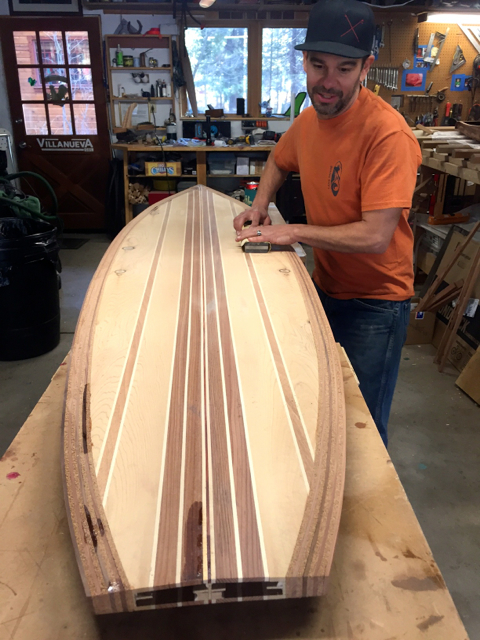
Garrett Villanueva is co-owner of Sawyer Wooden Board Company. Photo/Susan Wood

Garrett Villanueva is co-owner of Sawyer Wooden Board Company. Photo/Susan Wood

By Susan Wood

It’s hard to imagine with his low-key style and everyday dad demeanor, but trails guru Garrett Villanueva is placing Lake Tahoe on the map – yet again.

Villanueva was promoted in December to trail and travel management leader for the U.S. Forest Service’s Pacific Southwest Regional office. The responsibilities encompass the entire state of California. Villanueva has already been diving in. He’s working on five environmental impact statements and three recreational components to Forest Service plans.

Some might buckle under the pressure. But this is just how the 46-year-old recreational enthusiast rolls.

He worked his way up with the Forest Service in the Lake Tahoe Basin Management Unit, arriving in South Lake Tahoe in 1998 from Arizona where he worked as a hydrologist for the Environmental Protection Agency.

“I never thought I’d work in government this long,” Villanueva said, while watching his 8-year-old son, Jace, hop over wooden platform jumps built by dad. The duo was having a father-son day that started with skiing out of Mott’s Canyon on Heavenly and ended with ice cream.

He snickered while reminiscing about the times in Arizona. He didn’t quite enjoy the job and couldn’t believe it half the time. He had to talk to property owners who wouldn’t think twice about pouring toxic chemicals into the ground about the importance of protecting the environment.

Some of these people were rough around the edges. He recalled going out on a field visit that turned into a little-too-close-for-comfort drug bust. He followed law enforcement at full speed on a back road. When they showed up at the house, their guns were drawn. Villanueva took shelter at his vehicle.

“They told me to keep my head down,” he said.

Since then, the agency decided to review its safety protocols.

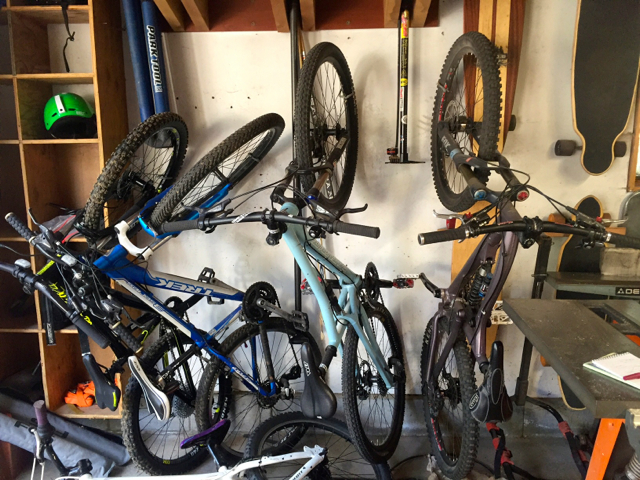
Garrett Villanueva's garage is full of toys to use in Tahoe. Photo/Susan Wood

Garrett Villanueva’s garage is full of toys to use in Tahoe. Photo/Susan Wood

So, coming to South Lake Tahoe in 1998 may have represented a walk in the park. He started out as a temporary employee in a job that monitored whether the Lake Tahoe Basin Management Unit, an arm of the Forest Service here, was performing up to par since the first environmental summit that brought out President Bill Clinton.

Eight months later, he became a full time engineering technician. In 2002, he became a civil engineer – a position he kept through 2015.

“I have an affinity for seeing things in a three dimensional way,” he said of his long tenure with the Forest Service.

That well-rounded experience got him on board the Forest Service’s International Programs run out of Washington, D.C. He visited Israel and Brazil to go over land management practices designed to help spur tourism through trail building and sustainable environmental practices.

“People will travel for trails,” he told Lake Tahoe News, simplifying the missions. He contends building trails is an integral part of community health by using land for recreational purposes.

He’s had a lot of practice.

Villanueva was instrumental in designing the trails throughout the basin. Most notably, he cited the Cold Creek Trail out to High Meadows from Pioneer Trail as especially challenging but rewarding. It turned out the public was extremely persistent on having it along the river.

“It took more effort and cost a lot more, but it turned out more desirable,” he said.

And that made all the difference in the world.

The Corral Trail represents another locally driven project he was glad to work on. Then, there’s the Freel Trail, named after the dominant peak. The Camp Richardson Trail from years ago remains the most popular. And now, he’s very excited about the State-to-State project between California and Nevada as well as the Kingsbury “Stinger” from the Grade.

Villanueva also knows how to build bridges, figuratively and literally.

There’s the Ward Creek Bridge on the Tahoe Rim Trail.

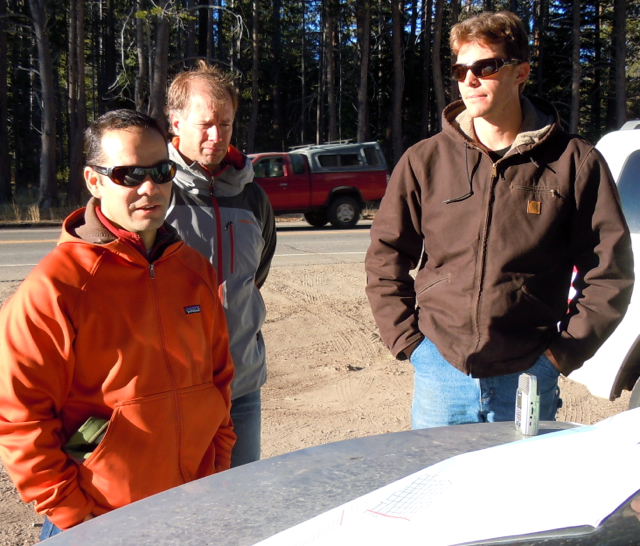
Garrett Villanueva, left, with Mike Gabor and Jacob Quinn working on South Shore trail plans. Photo/LTN file

Garrett Villanueva, left, with Mike Gabor and Jacob Quinn work on South Shore trail plans. Photo/LTN file

So, how is Lake Tahoe doing in terms of being on the frontline of mountain bike trail building?

“Lake Tahoe is an example in large part of sustainable trail systems. It’s an amazing community and has a lot of cohesion,” he said.

This declaration speaks to why he said he in part wouldn’t have taken the job if it meant moving away. So now he does a lot of remote work in checking in with the regional office in Vallejo.

He’s enjoying life, but still thinks about what would be his dream job. He’s also an accomplished paddleboard builder, making about a half dozen high-end boards for various people. He was working in the shop in his garage on his latest board for Phil Moulton to put up at Cold Water Brewery.

“He’s very smart, easy to talk to. I think he’s successful at anything he works on, and he’s got a great work-life balance,” Moulton said of Villanueva. “Our kids play together, a small town you know.”

Villanueva’s roots are not only deep in Tahoe, they’re engrained in his talents to build things. His father started him young, insisting they build a shed one day. At age 8, he decided to take the lawn mower apart. His father just shook his head when he saw his young enterprising son holding a piston in his hand, wondering what to do next, Villanueva recalled.

Villanueva’s buddy and fellow mountain bike rider Ben Fish isn’t surprised how his friend has moved up in the Forest Service.

The duo worked together on the popular city-run Bijou Mountain Bike Park, among other projects. The latest will be the Trails Summit, sponsored by the Tahoe Area Mountain Bike Association. The summit will highlight Tahoe’s prominence in the mountain bike world and is set for May 6-8.

For starters, TAMBA’s resurgence from years of dwindling down to a few members to now a few hundred speaks volumes on the growing popularity of the sport and the persistence of those like Villanueva who dedicate their lives to supporting it with a trail system.

“It makes me proud to see him go and be almost like a spokesman of Tahoe,” said Fish, who’s known Villanueva socially for a decade.

It’s all in the family of riding and sharing experiences. Their sons are good friends.

“He’s pushed all the buttons. We had six or seven years with no mountain bike organization. He helped get TAMBA back together,” said Fish, while manning a TAMBA booth at the Lake Tahoe Business Expo.

“These projects would have never happened without him,” he told Lake Tahoe News.


Concern grows in West over guns, suicide

By David Crary, AP

MONTROSE, Colo. — Keith Carey is a gunsmith in Montrose, a town with a frontier flavor set amid the rocky mesas of western Colorado. He’s a staunch, though soft-spoken, defender of the right to bear arms.

Yet now he’s also a willing recruit in a fledgling effort to see if the gun community itself — sellers and owners of firearms, operators of shooting ranges — can help Colorado and a swath of other Western states reduce their highest-in-the-nation suicide rates.

“Suicide is a tragedy no matter how it’s done,” said Carey, whose adult daughter killed herself with a mix of alcohol and antidepressants a few years ago on the East Coast. However, he sees the logic in trying gun-specific prevention strategies in towns like Montrose, where guns are an integral part of daily life.

“It’s very expedient for people to commit suicide by a firearm, without too much forethought,” Carey said. “Unfortunately, it’s generally effective.”

So at the urging of a local police commander, Carey agreed last year to participate in the Gun Shop Project, a state-funded pilot program in which gun sellers and range operators in five western Colorado counties were invited to help raise awareness about suicide. It’s a tentative but promising bid to open up a conversation on a topic that’s been virtually taboo in these Western states: the intersection of guns and suicide.

The counter in Carey’s tiny shop — where he repairs horns and woodwinds as well as guns — now displays wallet-sized cards with information about a suicide hotline. A poster by the door offers advice about ways to keep guns out of the hands of friends or relatives at risk of killing themselves.

“Consider offering to hold on to their guns or to help store their guns temporarily,” the poster says. “You may save a life.”

Carey says some of his customers take materials home, or ask a few questions. But the conversations tend to be brief.

“Suicide is one of those morose subjects that a lot of us don’t want to talk about,” he said. “But it’s all too common. I believe any method of suicide prevention is worth a good hard try.”

___

Across the U.S., suicides account for nearly two-thirds of all gun deaths — far outnumbering gun homicides and accidental deaths. In 2014, according to federal data, there were 33,599 firearm deaths; 21,334 of them were suicides. That figure represents about half of all suicides that year; but in several western Colorado counties, and in some other Rocky Mountain states with high gun-ownership rates, more than 60 percent of suicides involve firearms.

A map of state suicide rates reveals a striking pattern. Along with Alaska, the states with the highest rates form a contiguous bloc of the interior West — Montana, Idaho, Wyoming, Nevada, Colorado, Utah and New Mexico. All have age-adjusted suicide rates at least 50 percent higher than the national rate of 12.93 suicides per 100,000 people; Montana’s rate, 23.80, is the highest in the nation.

Between 2000 and 2014, gun suicides increased by more than 51 percent in those states, while rising by less than 30 percent nationwide.

Theories abound as to why residents of this Western region kill themselves at such high rates. Commonly cited factors include the isolation and economic hard times that are prevalent in rural areas of these states. A University of Utah psychiatrist, Perry Renshaw, contends that the lower oxygen levels of higher altitudes contribute to elevated suicide rates.

There’s also widespread belief that a self-reliant frontier mindset — admirable in many circumstances — deters some Westerners from seeking help when depression sinks in.

“We embrace the cowboy mentality,” says Jarrod Hindman, director of Colorado’s Office of Suicide Prevention. “If you’re suffering, suck it up, pick yourself up by your boot straps. But that doesn’t work very well if you’re suicidal.”

Underlying all these explanations is the fact that firearms — the most effective of all the common means of suicide — are more ubiquitous in the West than in most other parts of the country.

Catherine Barber, a suicide prevention expert at the Harvard School of Public Health, says numerous studies show that residents of gun-owning homes are at substantially higher risk of suicide than other people — simply because a suicide attempt is more likely to involve a gun and thus prove fatal. According to federal estimates, suicide attempts involving firearms succeed 85 percent of the time, compared to less than 10 percent of attempts involving drug overdoses and several other methods that often allow a suicidal person to reverse course.

“It’s not that gun owners are more suicidal,” Barber argues. “It’s that they’re more likely to die in the event that they become suicidal, because they are using a gun.”

___

Colorado’s Gun Shop Project is modeled largely after a program pioneered in New Hampshire a few years ago; it’s now being tried in Nevada and a few other states. Barber helped design the initiative and hopes that constructive collaboration on firearm suicide prevention can spread nationwide.

“In the past, people shut up about this issue because they thought raising it meant raising the issue of gun control,” she said. “It makes so much more sense to look at gun owners as part of the solution: Gun owner groups have a strong tradition of caring about safety.”

The Colorado project is being expanded this year from five counties to nine, including San Miguel County, home to the Telluride ski resort and some of Colorado’s most spectacular mountains. In a two-week span in late February to early March, the county of 8,000 people recorded three firearm suicides.

Hindman, who oversees the Colorado program, said that when he joined the state health department in 2004, talking about the role of firearms in suicide was discouraged. It’s still a sensitive topic, he said, but some funding has materialized for gun-specific initiatives. One of Hindman’s strategies is to emphasize the toll of firearm suicides, which run more than 5-to-1 higher than gun homicides in Colorado.

“Homicides and mass shootings are tragic,” he said. “But the vast majority of gun deaths are suicides, and we don’t have that conversation.”

In Montrose, Police Commander Keith Caddy has been around guns since childhood as a hunter, lawman, firearms instructor and licensed gun seller. Now he’s doing outreach for the Gun Shop Project — and most of the businesses he has visited agreed to display the suicide-awareness materials once they were assured it wasn’t a gun-takeaway program in disguise.

“Is it doing any good or not? That’s a tough thing to quantify,” Caddy said. “It’s my duty to protect the community I serve. If I can go out there and spend a little time talking to the gun shops, maybe the reward will be saving someone’s life.”

In Grand Junction, western Colorado’s largest city with about 60,000 residents, the outreach was assigned to Dave Fishell, a local historian and author who knew most of the shop owners. He’s a gun aficionado and collector who has made his own bullets.

Fishell says he has another important credential — for many years he battled serious depression, to the point where he contemplated suicide and three times put himself into a psychiatric ward.

“Maybe it’s part of my mission in life,” he said. “When people ask, ‘Do you know what I’m going through?’ I say I do.”

During those episodes of severe depression, he placed his guns in a safe and gave the key to his wife — the kind of precaution he’d like to see more people consider. Yet he also remembers thinking that if he did kill himself, it should not be with a gun. He didn’t want to contribute to giving gun owners a bad name.

At the gun shops he visited, several owners declined to display the materials and expressed skepticism about playing a role in suicide prevention.

“I can see that point of view,” Fishell said. “But making people aware is a first step.”

___

Throughout the region, prevention efforts are fueled to a large degree by people who’ve lost loved ones to suicide, often involving firearms.

Cindy Haerle, a teacher and board member of the Grand Junction-based Western Colorado Suicide Prevention Foundation, grew up in “a real gun family” in Salida, Colorado, and had her own gun by the time she was 5. But she gave up shooting after her brother John, a high school football star and later a sniper in Vietnam, killed himself with a pistol in 1980 at age 29 after prolonged struggles with depression.

“Nothing is as final as a gunshot,” said Haerle, who was 13 at the time.

Jim Doody, a former Grand Junction mayor and city councilor, serves on the foundation’s advisory board. He talks movingly about the suicide of a close friend, Matt Townsend, in 1989 at the age of 33.

They’d met in 7th grade at a parochial school — “We drove the nuns crazy,” said Doody — and stayed close through high school and thereafter. But adulthood proved challenging for Townsend, who took painkillers after a motorcycle injury. He told Doody at one point, “I think I’ll blow my brains out someday.”

Doody says Townsend called him late one night, drunk but seemingly in good spirits, just a day before killing himself with his brother’s handgun. Even 27 years later, Doody feels some guilt for not picking up clues that his friend was on the brink of suicide.

Doody has joined in the recent appeals to gun owners to keep their weapons out of the reach of those at risk of suicide.

“Have we made a difference?” Doody wondered. “We won’t ever know about a life we might have saved.”

Andy Mills, who works for an energy company in the northwest Colorado town of Craig, lost his 15-year-old son, Austin, to suicide in 2010. Mills blames himself for not ensuring that Austin couldn’t find the handgun that was kept in the house, and he now supports the Gun Shop Project’s suicide prevention outreach.

Firearms remain a part of the family’s life, however; Mills replaced the gun that Austin had used with a different model.

“My wife and daughter-in-law, we’ve all talked about it,” he said. “They understood the need, as our protection and our right as gun owners, to still have a gun at home.”

In Fruita, a few miles west of Grand Junction, high school teacher and gun-rights supporter Jami Jones talked about two people she knew who fatally shot themselves in recent years — a mechanic who had seemed devoted to his two young daughters, and a 15-year-old girl who was a classmate of Jones’ own daughter.

The man used his own gun; the girl used a gun she found hidden in her mother’s bedroom.

Jones depicted guns as a fact of life for western Colorado — she has a concealed-weapons permit and joins her husband in hunting and target shooting. But she says gun owners need to think about suicide prevention.

“What’s your plan?” she said. “We’ve got to keep the children safe and the people who are mentally ill safe.”

In a region of ruggedly beautiful peaks and canyons, the high suicide rates puzzle her.

“I don’t really know why,” she said. “You look around: We’re in God’s country.”

___

Suicide presents a distinctive challenge for shooting ranges: Occasionally, someone will rent a gun, then use it to commit suicide at the site.

At the Family Shooting Center at Denver’s Cherry Creek State Park, there have been three such wrenching incidents, including two since Doug Hamilton began managing the range in 2004. One involved a young man upset by post-divorce problems; the other involved identical twin sisters from Australia who shot themselves with rented pistols — one died, the other survived.

Hamilton is open to letting his staff get some suicide-prevention training, though he’s unsure it would help. Those who killed themselves at his range exhibited no signs of stress beforehand.

“How do we identify a bad apple who’s about to go over the edge, and get them the help that they need?” Hamilton asked. “Suicide prevention brochures aren’t something that anyone’s going to pick up who has come out to our range to kill themselves.”

In Grand Junction, a Gun Shop Project poster hangs on the bulletin board at the Rocky Mountain Gun Club, a state-of-the-art shooting range with sections for pistols, rifles and archery.

The general manager, Josh O’Neal, says safety is a high priority; there’s a video system providing live views of all the ranges. Yet he’s not confident of avoiding an onsite suicide attempt.

“We all feel in the back of our minds it’s a question of when, not if,” he said. “We’re not psychologists. A lot of unstable people are good at hiding that.”

The challenges facing shooting ranges are familiar to Dr. Michael Victoroff, a physician in the Denver area whose leisure-time passion is competitive shooting. He’s a certified firearms instructor and was at the Family Shooting Center in Denver when one of the suicides occurred there.

“Nobody wants that,” he said. “It’s bad for your soul, it’s bad for business, it’s bad for the sport.”

Due in part to that incident, Victoroff has become increasingly engaged in suicide prevention, and serves on a state working group seeking to raise awareness of the issue among primary-care doctors. He also has provided firearms instruction to Jarrod Hindman and other suicide-prevention specialists.

Differing from some gun enthusiasts, Victoroff asserts emphatically that the presence of a gun in a household is “an enabler of suicide.”

“It’s a myth that people would just choose some other means if they didn’t have a gun,” he said. “There’s a particular attractiveness about suicide with a gun… It’s by far the most effective means.”

Victoroff belongs to the American Medical Association and the National Rifle Association, and has qualms about both.

“The medical community has been content not to know anything about gun culture and gun safety,” said Victoroff, who offers presentations trying to bridge that knowledge gap. As for the NRA, he’d like to see suicide prevention highlighted in its training materials.

Over the years, firearm suicide has not been a high-profile issue for the NRA; it worries that the topic might be used to advance a gun-control agenda. Though the NRA has no position on Colorado’s Gun Shop Project, it has endorsed a bill in Washington state encouraging gun dealers to participate in suicide prevention efforts, said spokeswoman Jennifer Baker.

The NRA views suicide as a mental health problem, she said. “The goal is to prevent it regardless of how people kill themselves.”

___

The intersection of gun culture and mental health is complicated. And it’s personal for Ed Hagins in Montrose. Deputy director of a local mental health center and active with the county’s suicide prevention coalition, he had a cousin who fatally shot himself.

Beyond that, Hagins says he has suffered from depression for much of his life, including instances as a teenager when he considered suicide. As an enthusiastic gun owner who enjoys target shooting, he’s leery of proposals to deny gun rights to people diagnosed with mental illness.

“I meet that criteria,” he said. “That’s one of my biggest fears — legislation that I can’t have a gun.”

It’s personal, too, for Ken Constantine, owner of Elk River Guns in Steamboat Springs.

“I don’t want to sell a gun to someone to commit suicide,” he said. “That happened once in this shop — it weighs on me.”

He recalled the sale of a handgun to a woman several years ago: “She seemed completely normal. No telltale signs.”

But he learned later from police that the woman, within a week of purchasing the gun, killed herself with it.

Having been through that experience, Constantine is troubled by the Gun Shop Project’s offer of training for shop employees so they can better identify customers at risk of suicide.

“I won’t assume the responsibility of a mental health professional,” he said, suggesting instead that therapists in the area should get permission from their at-risk patients to temporarily place their names on a private list of people who shouldn’t acquire guns.

But that approach has been tried and doesn’t work, said Tom Gangel, director of a mental health center serving the area.

“We have asked patients who we think are really in danger, can we give their names to gun shops or they can self-report, but only one or two have done that,” Gangel said. “In our area, not very many people want to give up the right to be able to go buy guns.”

The local Gun Shop Project is coordinated by Meghan Francone, who constantly reassures gun owners and sellers that the outreach program poses no threat. She got involved after her 15-year-old brother-in-law, Austin Mills of Craig, fatally shot himself in 2010.

“Keep your guns. Keep a dozen. I don’t care. But please make sure they are locked and out of the reach of someone who’s in crisis,” she said. “I’m not asking any gun shop owner to be a psychologist. I’m asking them to be their brother’s keeper.”

States seek ways to lower high suicide rates

By David Crary, AP

Throughout the interior West, states in a belt from Montana to New Mexico are looking for ways to lower their highest-in-the-nation suicide rates, although gun-specific initiatives are a touchy topic.

In Montana, with the highest rate, suicide prevention coordinator Karl Rosston acknowledges some frustration as the toll rises, including the recent deaths of several teenagers who used guns from their own homes.

“People are afraid we’re trying to take away guns, which is not the case,” Rosston said. “I understand the sensitivity of it, but I’ve got to ask the questions when we have kids who shoot themselves.”

One of Montana’s hardest-hit areas is the city of Butte and surrounding Silver Bow County, where, according to local health director Karen Sullivan, the rate of gun ownership is far above the national average. Jolted by the recent firearm suicides of six young people, including a good friend of her daughter, Sullivan and others formed a suicide prevention committee and began distributing gun locks.

“All six had ready access to a firearm, and we’re not OK with that,” Sullivan said. “This issue has become very personal to me.”

In Colorado and Nevada, the states’ suicide prevention offices have been reaching out to gun stores and shooting ranges, offering suicide-prevention materials and training. One of the outreach workers in Nevada, Richard Egan, regularly visits gun shows, sometimes giving away high-quality gun locks to people interested in his message.

Egan, who developed expertise in weaponry during a long Air Force career, said he was heartened by recent news that prosecutors would pursue a felony child-abuse charge in the case of an 8-year-old Las Vegas boy who committed suicide last year. The boy had been left at home without adult supervision, and used a gun left unsecured by the boyfriend of the child’s mother.

“That’s huge,” said Egan of the charge filed against the boyfriend. “We’re now going to hold the gun owner accountable.”

In Arizona, the overall suicide rate is not quite as high as those of its Rocky Mountain neighbors, but three of its counties — Yavapai, Mohave and Cochise — have among the highest firearm suicide rates in the nation, according to federal data.

Arizona’s suicide prevention officer, Kelli Donley, has been working cautiously to see if there are ways to cut down on gun suicides.

“Politically we have to be very careful,” she said. “People love their guns in Arizona — we can’t tell people not to have guns.”

Last summer, Donley said, she went to Mohave County for a suicide-prevention meeting, and got logistical help from a fire department battalion chief in Kingman.

“One week later he killed himself — that was totally defeating,” said Donley, recalling how she sobbed during the phone call that relayed the news. “I gave that man every resource I had, and he didn’t acknowledge what he was going through.”


West Slope woman headed to prison in child sex case

A Placerville woman is one of two defendants to plead guilty to sexual exploitation of children.

Stormy M. Avers, 36, of Placerville faces up to 20 years in prison when she is sentenced June 24. Jason S. Wymer, 44, of Citrus Heights faces up to 30 years at his July 29 sentencing.

According to court documents, the case began when a parent accidentally texted a photo of her 8-year-old to a wrong number that turned out to be Wymer. Thinking he received the picture from a child, Wymer responded and began a dialog. The parent brought the cellphone to the FBI, and an undercover employee, pretending to be an 8-year-old, continued the dialog with Wymer, whom investigators were subsequently able to locate.

Officers found photos of Wymer and Avers molesting a child who was approximately 3, with the intent to create child pornography. Avers had custody and control of the child at the time.

Wymer pleaded guilty in this case and to a separate instance of sexual exploitation of a 4-year-old in August 2011.

A third defendant, Jolene Davis, 40, of Stockton, is charged with having participated with Wymer in the sexual exploitation of a child of whom she had control or custody. Davis is scheduled to appear for a status conference on April 22, 2016.


— Lake Tahoe News staff report 


EDC lets economic stimulus policy lapse

By Kathryn Reed

Even though a goal of El Dorado County’s Board of Supervisors is economic development, a policy to stimulate such growth has been abandoned.

But it might be resurrected now that it has been called to the attention of Supervisor Sue Novasel. After Lake Tahoe News inquired about what is known as Policy J-7, Novasel decided to reverse course.

“Supervisor Novasel asked that it be reinstated at the earliest possibility,” Judi McCallum, Novasel’s assistant, told Lake Tahoe News. “She met with Assistant CAO Shawne Corley, who is now working with Economic Development Manager Jeff McLaughlin to get J-7 onto the Board of Supervisors’ agenda on April 19 with additions that Jeff McLaughlin is working on.”

It was on Dec. 17, 2013, that the board directed staff to prepare an economic policy to include incentive tools designed to attract, support and expand economic development in the county. On Feb. 11, 2014, the board approved what became Policy J-7. It was revised on Feb. 10, 2015, and had a sunset date of Nov. 10, 2015.

The policy stated, “The purpose of this policy is to: A. Identify targeted business sectors that have the highest potential for growth and will offer the highest economic impact through the use of incentives. B. Identify economic incentive options. C. Establish a formalized analysis, fair process, and transparent review of economic development incentives for businesses starting in, expanding in, or locating to El Dorado County. D. Ensure any and all incentives offered to job-creating firms in El Dorado County offer benefit to the goals of the County as well as the business.”

That all goes hand-in-hand with the strategic plan the board is working under.

The chief administrative officer was supposed to write detailed procedures, but never did.

Creighton Avila, spokesman for the County Administrative Office, did not know if was a conscious decision to let the policy lapse or an oversight on behalf of staff and the electeds.

He added that one company, Bloo Solar, tried to take advantage of the policy, but never received compensation.


SLTPD looking for convicted sex offender

Rafael Corea, a convicted sex offender, is wanted by the South Lake Tahoe Police Department.

Rafael Corea

Rafael Corea

In 1995, Corea was convicted for lewd and lascivious acts with a teenager.  This conviction requires him to register as a sexual offender for the remainder of his life. Last fall he failed to register with the South Lake Tahoe Police Department as a sexual offender.

Failure to register is a felony.

Detectives discovered Corea moved out of his former residence in South Lake Tahoe, and his current whereabouts are unknown.


Anyone who may have information about Corea is asked to call 530.542.6100, or remain anonymous by calling Lake Tahoe Secret Witness at 530.541.6800.

— Lake Tahoe News staff report


Popular vet killed self before sex crimes investigation completed

Well-known Carson Valley veterinarian Lance Gorrindo was under investigation for sex crimes with a minor before he committed suicide on Monday.

“At the time of Lance Gorrindo’s death he was the sole suspect being sought by the Douglas County Sheriff’s Office in connection to an active lewdness with a minor investigation. The identity of the victim is confidential by law and not subject to disclosure,” the sheriff’s department said in a statement April 8.

Gorrindo worked at Carson Valley Veterinary Hospital in Minden, where he had a number of Lake Tahoe clients.

The 39-year-old graduated from Douglas High School in 1995.

— Lake Tahoe News staff report


King Fire arsonist going to prison for 20 years

Wayne Allen Huntsman is going to prison for 20 years for starting the destructive 2014 King Fire.

Wayne Allen Huntsman

Wayne Allen Huntsman

In El Dorado County Superior Court in Placerville on Friday he changed his plea to guilty. Judge Daniel Proud handed Huntsman, 38, the maximum sentence. He was also ordered to pay $60 million in restitution.

In addition to the more than 97,000 acres that burned that fall – mostly in the Eldorado National Forest — 12 houses and 68 outbuildings were destroyed at a loss of $6.5 million. The fire started near Pollock Pines and spread rapidly from there in a northeast direction.

One firefighter was hurt fighting the blaze that took 27 days to contain.

Smoke from the fire could be seen from the Lake Tahoe Basin that fall.

Huntsman took video of himself at the scene became evidence.

The Pollock Pines man was tearful April 8 as he admitted to the crimes he was charged with.

“I’m pleading guilty because I’m guilty,” Huntsman told the court.

This video from the El Dorado County District Attorney’s Office shows how the investigation unfolded.

— Lake Tahoe News staff report


Event to cultivate job skills, business opportunities

A one-day summit aims to provide Lake Tahoe residents with the necessary tools to make Tahoe a viable place to succeed personally and professionally.

The Make Tahoe Work for You Leadership Lake Tahoe Summit was created with the goal to help locals successfully navigate roadblocks and create a fulfilling life in the home they love.

The May 6 event features keynote speaker Donna Hartley, author of “Fire Up Your Life,” as well as speakers Tracy DeLuca and Matt Westfield . The day will also include interactive workshops and panel discussions focused on personal growth and business development. Sessions include financial and accounting strategies, resume and interview skills, lessons learned from starting a business, building community momentum, and professional opportunities, among other topics. Attendees are encouraged to create connections during the summit lunch and networking hour.

Tickets are $30 per person and includes lunch. For more information and to purchase tickets, go online.


Calif. economy expected to outpace that of U.S.

By Natalie Kitroeff, Los Angeles Times

California’s economy will grow faster this year than the national economy, and unemployment will drop to 5 percent in early 2017, according to a new report by the UCLA Anderson Forecast.

Personal income in California will increase more slowly than it has in recent years, when the state’s economy was bouncing back from the high unemployment of the recession.

In 2016, personal income in California will grow 3.6 percent, compared with 4.5 percent in 2015, the report said.

Read the whole story