Construction about to resume in Kings Beach

Q & D Construction is planning to start some highway work in Kings Beach on April 18, weather permitting.

This work will consist of raising manhole lids to grade throughout the highway corridor. Q & D has approximately two months of work left.

The second phase of the project is also planned for construction this season. Disney Construction’s work will primarily be on the two ends of town, extending the pedestrian, bicycle, water quality and transit improvements to the limits of the project area. The construction management team is working to provide separation between the two construction operations to avoid excessive congestion and delays.


Letter: SLT warm room advocates thankful

To the community,

On behalf of the Tahoe Coalition for the Homeless (TCH), I would like to thank our community for a successful inaugural season of the South Lake Tahoe Warm Room and the first overnight homeless services in the Tahoe Region.

Our agency appreciates vital funding provided this winter by the El Dorado Community Foundation, Tahoe Magic, and Reliapro Painters, along with many other community partners.

Each week we received food, clothing, toiletry, and supply donations from caring and compassionate community partners such as the Junior S Club of South Lake Tahoe Middle School, Girl Scouts, South Tahoe High School, and Tahoe Beach and Ski Club. Harrah’s and Harveys Employee’s Reaching Out and Barton Health both hosted large supply drives as well, providing most of our needed items. Other supportive groups included the Rotary Club of South Lake Tahoe, Soroptimist International of South Lake Tahoe, Soroptimist International of Tahoe Sierra and the Tahoe Douglas Rotary.

Special thanks to Amanda Burroughs and staff at Imagine Salon who provided our guests with fresh haircuts in March.

The South Lake Tahoe Warm Room closed on April 1 for the season. The Warm Room served 107 unduplicated individuals during this cold and snowy winter and provided 1,820 shelter bed nights. We appreciate our volunteers who dedicated over 1,600 hours to this project this winter.

Tahoe Coalition for the Homeless can be contacted at tahoewarmroom@gmail.com or 775.573.0822. Please visit our website.

Marissa Muscat, Tahoe Coalition for the Homeless

PS: Donations are welcomed to aid in funding the Warm Room 2016-17 season. Checks may be made payable to Live Violence Free (our fiscal sponsor), note “Warm Room” in the memo line and mail to P.O. Box 13514, South Lake Tahoe, CA 96151. Online donations are possible; note “Warm Room” in the additional information box.


Truckee police officers recognized for work

Truckee Police Department, which was formed in 2001, recently had its inaugural awards ceremony.

The department completed a comprehensive study of incidents of the last 15 years that potentially warranted special recognition.

Awards included:

Employee of the year: Community Service Officer Martin Schneider — He has been employed by the town since 1995. His job duties have evolved from strictly animal services to also addressing parking issues townwide.

Volunteer of the year: Al Salas – He has more than 10 years of service with the Truckee Police Volunteer Program. During this time he has been a rock solid contributor to various aspects of the program.

Medal of Merit: Officers Daniel Baraz and Andrew Holbrook, and Jeremie Elliott. On Sept. 7, 2009, Truckee officers responded to reports of a plane crash on Martis Dam Road and Highway 267.  The single engine plane occupied by four people had crashed in a field, coming to rest on its roof.  Three occupants were trapped inside.  All occupants were rescued due to the brave actions of the recipients.


Officer Ryan Moreau, retired Officer Daniel Baraz and Sgt.John Mon Pere: On April 30, 2012, officers received a call of an armed, suicidal subject in central Truckee.  The subject was a Vietnam veteran and had told family members that he had started a one-hour countdown to end his life. Officers were given a vehicle description and began searching for it. At one point he approached the officers holding a gun to his head. After a volatile situation, the subject was taken into custody without incident due.


Officer Austin Harper: Oct. 28, 2014, Harper was on patrol when he was flagged down by a citizen who reported a suspect breaking car windows. Harper drove to the Beacon Station where he interrupted an assault in progress. The suspect had grabbed the victim around her neck and was choking her. Harper quickly engaged the suspect who had ignored his command to stop, punched him once in the face and pulled him off of the victim, placing the suspect under arrest without further incident.

Medal of Valor: Retired Officer Bryan Berry — On Aug. 18, 2009, Berry forced his way inside of a burning apartment and carried a mortally injured woman outside where she was treated by paramedics. Officer Berry’s actions were performed under extreme and selfless bravery, risking his own life in an effort to save another.


Forest sees rebirth after devastating King Fire

By Hudson Sangree, Sacramento Bee

The day after an arsonist pleaded guilty to setting the massive King Fire in September 2014, dozens of volunteers gathered Saturday near Stumpy Meadows Lake to help bring the forest back to life.

The volunteers ranged from children to senior citizens. They were members of the Girl Scouts and Boy Scouts, the Auburn Kiwanis Club and an off-road-vehicle club, among others. They planted hundreds of pine seedlings in the popular Black Oak Campground, which was singed by the King Fire.

With another fire season looming in drought-stricken California, the landscape decimated by the nearly 98,000-acre King Fire in El Dorado and Placer counties is slowly coming back to life. Wildflowers are blooming in the blackened earth, and the long, arduous task of replanting a vast swath of the Eldorado National Forest is just beginning.

“The recent fires are horrible events, but they present a great restoration opportunity,” Maria Mircheva, executive director of the nonprofit Sugar Pine Foundation, said last week. The foundation, based in South Lake Tahoe, helped coordinate the recent volunteer effort, as it has in other fire zones.

Read the whole story


California showers won’t ease drought

By Associated Press

April showers delayed a ballgame and prompted flood advisories as they scooted through California on Saturday, but the overall rain totals won’t do much to ease five years of drought, forecasters said.

Light rain began falling Friday, and scattered showers should continue today, with a slight chance of thunderstorms, according to the National Weather Service. Snow is falling in the higher reaches of the Sierra on Sunday, with chain controls in place on some highways.

In San Francisco, a downpour delayed the Giants-Los Angeles Dodgers baseball game for 41 minutes.

In Central California, about 2 inches of rain fell in some places. The National Weather Service issued flood advisories until 3pm for Merced, Mariposa and southwestern Tuolumne counties. Heavy showers hit Bakersfield later in the day, bringing minor flooding.

In Nevada, firefighters rescued four people from flooding caused by heavy rain.

A 50-year-old man got stuck in a flood control channel in Las Vegas, Clark County Assistant Fire Chief Larry Haydu said.

Then a crew discovered three more people trapped in another channel nearby. All three were rescued and one was hospitalized for a minor leg injury.

It was relatively dry in Northern and Southern California. No more than a quarter-inch of rain was expected to fall throughout the day, with the south only beginning to see heavy showers in the afternoon or evening.

The coast, deserts, valleys, foothills and mountains could see anywhere from a half-inch to 1 1/2 inches of rain as a Pacific weather system moves over southwestern California, according to the weather service.


While the El Nino warming phenomenon in the Pacific Ocean brought rain and snow to California this winter, most of those storms hit northern areas including the Sierra Nevada while bypassing the southern half of the state.


Foster families needed in South Lake Tahoe

El Dorado County Health and Human Services Agency is looking for individuals in the South Lake Tahoe area to serve as resource families, providing shelter care (up to 30 days) or full term homes (up to and more than 18 months) for foster children.

Resource family is the new California term for foster parents, relative caregivers, non-related extended family members, and adoptive families who care for children and youth in out-of-home placement. Reimbursement is provided.

A foster child is a child who has been removed from their current home because of abuse, neglect, exploitation or other problems. While the child is in foster care, efforts are made to assist the child and their parents to address the problems and, whenever possible, ultimately reunite them.

Individuals interested in learning more about becoming a foster parent resource family are invited to attend an information session on April 20 at 6:30pm at Lake Tahoe Community College, Room 106, South Lake Tahoe.

For more info, contact Roger Hardin at 530.573.3205.


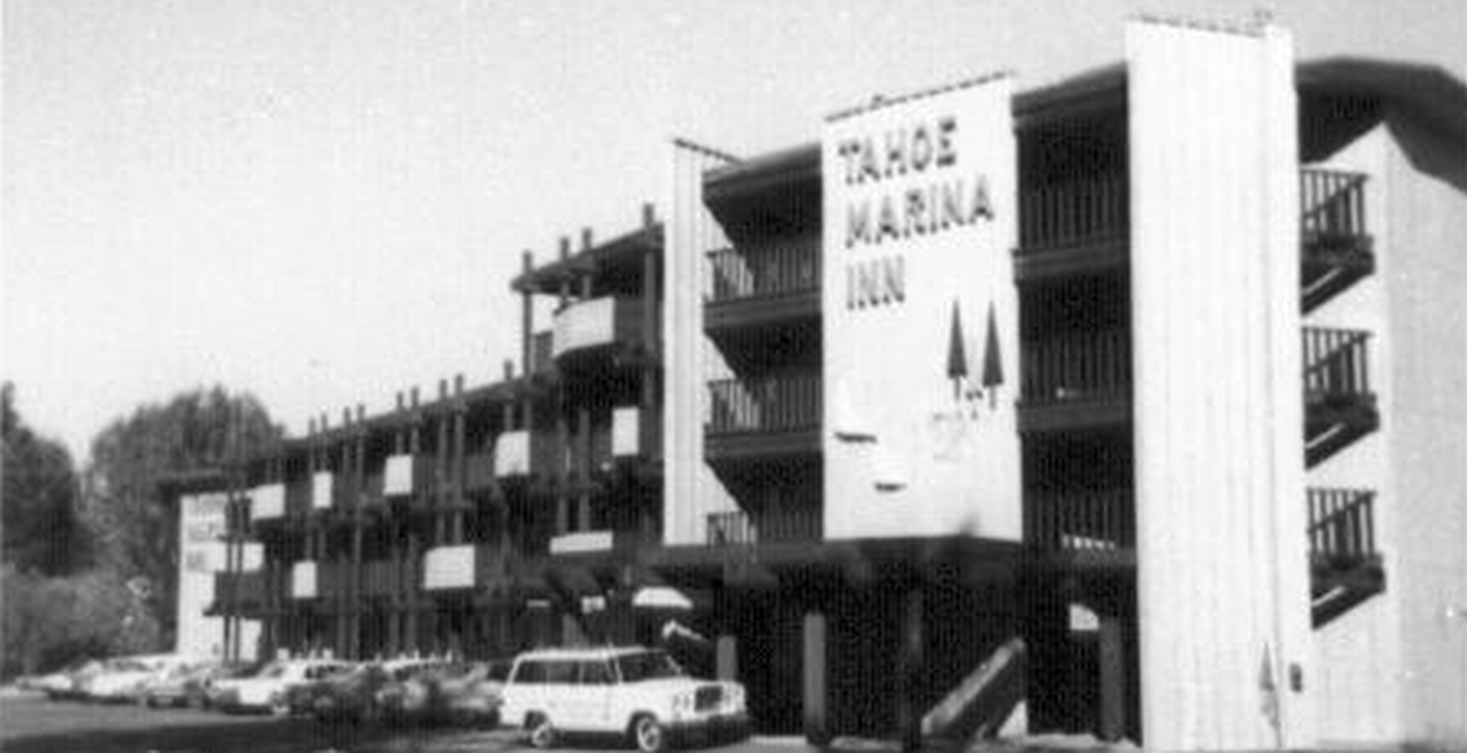
Then and now: Tahoe Marina Inn

The Tahoe Marina Inn in 1966. Photo/Bill Kingman

The Tahoe Marina Inn in 1966. Photo/Bill Kingman

Known as the Tahoe Marina Inn in the 1960s, albeit no marina, this fashionable multi-story motel with a pool was built on the Bijou beachfront about a block east of the Timber Cove pier.

Local radio station KTHO had its offices and studio in the TMI lobby in 1966.

Lakeshore Lodge and Spa in 2015. Photo/Bill Kingman

Lakeshore Lodge and Spa in 2015. Photo/Bill Kingman

Later owners changed the name to Lakeshore Lodge and Spa. It stands adjacent to today’s Lakeland Village and behind Heidi’s Pancake House.

— Bill Kingman


1960’s era South Tahoe hotel getting face lift

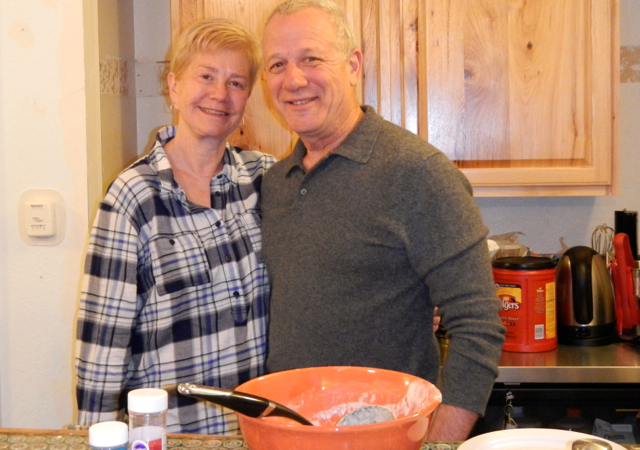
Debbie and Bill Hirsch with fixings for breakfast at the 7 Seas Inn. Photo/LTN

Debbie and Bill Hirsch with fixings for breakfast at the 7 Seas Inn. Photo/LTN

By Kathryn Reed

This is the last day the 7 Seas Inn will be open as an outdated throwback to the 1960s era lodging establishments that South Lake Tahoe is known for. When it reopens May 1 it will be refurbished, modernized, with the management philosophy more like a boutique bed and breakfast.

Debbie and Bill Hirsch bought the motel last year for $1.2 million. This first phase of renovation will see an infusion of about $300,000 into the property on Manzanita Avenue near Stateline.

By the time they are done the goal is to have gone from a two star to a three star motel.

The rooms, which are no more than 200-square-feet, are cluttered with old furniture. While the mattresses and bedding were replaced at the get-go, now it’s time for the rest of the interior to be modernized.

Christian Oberhauser of Oberhauser Interiors came up with the rustic-modern theme. Wood will be common through out, from vertical slabs for the headboard to the vanity in the bathroom.

Floors will be vinyl designed to look like wood. This will prevent guests from scratching them with ski boots or sand.

Instead of pedestal sinks with no place to set items, the square sinks will be raised. While the plumbing will be visible, a bar will be installed there as a towel rack. A wood slab will be installed where toiletries may be placed.

The tired shower tile will disappear.

Electrical work will be extensive. Wires from the televisions will no longer be visible. Ample outlets to plug-in an array of gadgets will be installed. Light fixtures will also be replaced.

Works from a local photographer will adorn the walls.

“It won’t be like an old hotel anymore,” Oberhauser told Lake Tahoe News. “We’ll have more floor space so visually it expands the room so it creates a cleaner look.”

There are 12 king rooms, three doubles and one queen.

They already redid the manager’s quarters, which is where the Hirschs are living full time.

The reviews are already favorable since the couple took over, a testament to their desire to make the 7 Seas feel like a travelers lodge and not just an ordinary motel.

“People used to select a hotel based on location, price and brand. These days people are choosing based on location and reviews, and they are more flexible on the rate if the review supports it,” Bill Hirsch said.

Their breakfasts, which include pancakes and waffles in addition to fresh fruit and other items, has been well received. In the evening beer and wine are complimentary for guests, along with hors d’oeuvres.

The plan is to extend this area so it’s larger and a bit more cozy. The goal is to keep it open 24 hours as a place for people to chill.

The exterior won’t see much attention this month in terms of improvements, but plans are in the works  to make inviting outdoor seating areas. What used to be a tiny grass area for dogs to do their business will now be for people. Pets are no longer allowed.

The motel has a hot tub, too.

Guests have access to Lakeside Beach. The casinos and Heavenly Village are also within walking distance.


Opinion: Campaign to save India’s tigers ignores human cost of conservation

By Lisa Margonelli

Tigers are a hypothetical necessity.

Hypothetical in the sense that very few of us spend any time around tigers outside of zoos, though we interact with tiger images daily, depending on what type of cereal we eat, or sports team we root for.

Necessities in the sense that the existence of tigers is a certification that wildness still exists and that conservation works.

Tigers in India are a conservation success story, a bright orange stripe in a century of heavy extinction. A hundred years ago, India had tens of thousands of tigers, but by the early 1970s they had dwindled down to a mere 1,200. Prime Minister Indira Gandhi started Project Tiger in 1973, relocating 200,000 people away from designated tiger zones, and creating buffer zones between tigery jungles and developed areas. In 1975, tigers were listed as an endangered species. In January 2015, there were 2,261 tigers in India—70 percent of the world’s wild tigers. (There were about 13,000 non-wild tigers in 2010.)

Project Tiger and other initiatives in the Sunderbans, the giant mangrove swamp on the border of India and Bangladesh, seem to offer a successful model for that: Careful stewardship can preserve whole biological zones, complete with beautiful wild predators. But on closer inspection, Project Tiger is also a cautionary tale about what happens when tigers (and conservation) are a bigger priority than the humans who live nearby.

Some people have paid a very high price for the world’s few tigers. People who live in the buffer areas around the Sunderbans have suffered from so many deadly tiger attacks that there are about 3,000 so-called tiger widows in India and 10,000 in Bangladesh. A few weeks ago, I happened across a journal article, by Arabinda Chowdhury and three colleagues, with the title, “Ecopsychosocial Aspects of Human-Tiger Conflict: An Ethnographic Study of Tiger Widows of Sundarban Delta, India,” published in Environmental Health Insights earlier this year.

Chowdhury, a psychiatrist who spends part of his time working for the National Health Service in the U.K., is particularly concerned about the psychological cost of human-tiger conflict. From 2001-06, he and his team surveyed more than 3,000 households in the Gosaba area, which is right at the edge of the tiger reserve, then did psychiatric evaluations of 49 tiger widows, spending as long as three days with each woman.

Before they ever came face-to-face with a tiger, these women’s families were very poor. Entering the tiger zone to get wood, hunt for honey, or catch tiger prawn seed have become the main local sources of income, but they require paying the government for a permit. Men from poor families haven’t been able to afford the permits so many sneak in at night. In the Indian area of the Sunderbans, about 40 people—mostly those sneaking around without permits—are attacked by tigers every year.

After they lose their husbands to tigers, widows become much poorer. The widows had few skills: Of 65 tiger widows in one survey, only three could read.

The widows’ poverty was amplified by another factor. Tigers are “not just an animal, they’re a god-like concept,” as Dr. Chowdhury put it, and tiger deaths are seen as signs of the wrath of the forest goddess Bonobibi. Families and communities shun tiger widows.

The plight of the tiger widows is just the top layer of a much larger problem: a lack of electricity, clean water, transportation, health care, or industry surrounding the conserved areas, where the World Bank estimates that 1,700 children under 5 died in 2008 alone from dirty water and poor sanitation. The charismatic tiger brings our attention to the tiger widows, of course, but the toll of filthy water is many times higher. Conservation needs a moral compass that considers human costs.

India has been debating how to better balance conservation and development for decades, and in 2006 the country passed legislation on the rights of forest people, but that was not extended to the Sunderbans. Since the study, Chowdhury says, some things have improved in the buffer zone, and a Bangladeshi group called LEDARS has helped many tiger widows on the other side of the border. In central India, a nonprofit called Satpuda works with more than 80 villages near tiger reserves to provide jobs, medical care, and education—in addition to doing tiger conservation. Chowdhury has a dream of training people in villages to do basic psychological counseling as part of a medical team, while encouraging highly skilled psychiatric professionals to visit during their vacations. But it will require a lot of political will to address the deep problems in the area: poverty, population growth, changing climate, and the human-tiger conflicts.

The Western environmental movement of the 1970s aimed to protect wild animals from humans, but the next environmental movement can’t succeed morally or practically unless it also protects and enhances the lives of the poorest humans. When we finally get down to combatting global warming, we also need to tackle development aggressively. This will mean facing up to the real-life tensions between the ideal of living “naturally” in nature and letting nature live.

Ironically, the best approach for humans may be to simply leave nature to the tigers. Indian academics estimate that if sea levels continue rising in the Sunderbans and strong tropical storms keep hitting the area, it’s going to be too dangerous for human beings to continue living there and as many as 13 million climate refugees from the mangroves in India and Bangladesh could flee. There’s a growing discussion that the better solution in the long run may be to move the humans to urban areas with electricity, clean water, jobs, and access to education.

Then, like us, these Sunderbans exiles may live in dense cities, work in high rises, chat long- distance, and eat strange manufactured foods. And the tigers can continue to roam wild. Somewhere out there.

Lisa Margonelli writes the Small Science column for Zócalo Public Square, where she is the science and humanities editor.


Drugged driving a growing problem in Calif.

By Tony Bizjak and Phillip Reese, Sacramento Bee

The horrific crash in Auburn on Sunday, when an allegedly drugged driver plowed into two teenage pedestrians, came as no shock to law enforcement and traffic safety officials. Slowly, but surely, drugged driving is surpassing drunken driving as a lethal threat on state and local roads.

“This is a big, complicated problem that the driving public needs to recognize is serious,” said Chris Cochran, assistant director with the state Office of Traffic Safety, which has begun a public education campaign on the road dangers of everyday drugs.

About 1 in 7 drivers involved in fatal wrecks in California during 2014 tested positive for at least one potentially impairing drug other than alcohol, according to a Sacramento Bee review of data from the National Highway Traffic Safety Administration.

Most drivers aren’t tested for drugs, particularly if they survive a crash or weren’t at fault. Among California drivers who died and were tested in 2013 and 2014, more than one-third had drugs in their system, state and federal data show.

Read the whole story