Film highlights draw to the backcountry

Sammy Carlson’s two-year endeavor, “The Sammy C Project”, will have its Tahoe premiere screening at Sierra Nevada College on April 20.

In 2014, after winning five X Games medals, Carlson abruptly stepped away from competition and dropped out of Olympic contention even as slopestyle skiing was about to make its Winter Olympic debut. Instead, he decided to pursue a new path that would push him and the sport of skiing to new places at all costs.

Carlson’s newfound focus landed in the backcountry, where his drive and creativity could max out far beyond the limits of preset slopestyle courses.

The event is free and open to the public, with a $5 donation encouraged to support SNC’s Freeride Club.

Doors open at 7pm, with the film at 7:30pm in TCES 139/141.


SLT trying to get input from residents

South Lake Tahoe is trying to engage residents in many ways as it can.

The latest venue is through Flash Vote. The citizens engagement program will ask people to take a short survey each month.

“The information will be provided to City Council members and to staff.  The survey’s purpose is another way to collect citizens responses in addition to SpeakUpSLT and eComment, which were both launched in 2015,” city spokeswoman Tracy Franklin told Lake Tahoe News.

People may only take each survey once, or at least only once per email address.

Go online to sign up.

— Lake Tahoe News staff report


SAR teams busy in Tahoe area

El Dorado County search and rescue teams were called out to bring two groups of hikers to safety on Saturday.

Five people from the Bay Area had to be rescued April 16 on the trail to Horsetail Falls. They got lost in the thick brush. The route to this waterfall off Highway 50 near Lover’s Leap is not always well defined. And with overnight temperatures still in the 30s in the Tahoe area, the daytime heat goes away quickly when the sun starts to set.

It was 10pm by the time rescuers got the stranded hikers back to their vehicle at the trailhead.

At Cascade Falls a threesome lost their way and called for help about 7:30pm. Before the SAR team found them they met up with other hikers who helped them find their way.

— Lake Tahoe News staff report


What happens when books go to war

By Molly Guptill Manning

In January 1942, thousands of New Yorkers gathered on the steps of the legendary New York Public Library at 5th Avenue and 42nd Street wearing their Sunday best and warmest coats.  When standing room became scarce, crowds formed across the street. Nearly everyone had at least one book in hand. These were not overdue, nor did they need to be returned to the library; instead they were “Victory Books,” bound for soldiers overseas.

It may be difficult to appreciate the significance of a book drive held nearly 75 years ago. But this was no ordinary campaign. At the time, books—vehicles for new ideas—were being banned and burned in Europe by the German army. As the Nazis swept through Europe—occupying Poland, France, Czechoslovakia, Austria, Norway, Belgium, the Netherlands, and Denmark—restrictions were placed on the authors and titles that could be read in these conquered territories; books by American, British, and Jewish authors were outlawed. The most severe penalty for being caught with such contraband was death. This threatened punishment produced Germany’s desired effect: Strict compliance with the book bans was the norm.

With this threat across the Atlantic, Americans felt an urgent need to preserve books and all they symbolized. To spread this message, Hollywood celebrities, popular musicians, politicians, and military officials visited the New York Public Library in January 1942 to give speeches and performances that were broadcast nationwide over the radio. Katharine Hepburn, Chico Marx, Benny Goodman, Mayor Fiorello LaGuardia, Wendell Willkie, and Danny Kaye were among the famous who visited the library. They stressed that the best defense against Germany’s war on books was to do the opposite: read and spread information. And so books became a sort of weapon in the war—fighting ignorance, censorship, and boredom.

The Victory Book Campaigns of 1942 and 1943 enlisted ordinary Americans and their favorite books. Librarians across the United States scattered giant bins in stores, movie theaters, train stations, schools, and other public spaces to collect “Victory Books” for those serving in the Army and Navy. In 1942, 10 million books were collected by the Victory Book Campaign, making it the largest book drive in the world. Another 8 million books were collected the following year.

Most of the donations were hardcover books, a reflection of the American book industry at the time. The majority of American publishers refused to enter the paperback trade, fearful that 25- cent softcovers would ruin the handsome profit margins they earned from hardcover sales. The donated hardcovers were fine for stationary Army camps in the United States and aboard Naval ships, where soldiers did not need to carry all of their belongings on long marches or into battle.  When Americans shipped out to North Africa in 1942, they brought Victory Books to pass the long weeks spent sailing to their destination. Lacking any other entertainment, most tucked books into their packs and carried them into the invasion and beyond. But long marches with aching backs and blistered feet caused many to whittle down the possessions they carried; heavy hardcovers were reluctantly tossed.

American publishers heard of the insatiable demand for books overseas and the plight of the ill-suited hardcovers. They banded together to create books specially designed for American sailors and troops. Scrapping the hardcover, using lightweight paper akin to newsprint, reducing page margins, eliminating blank pages, and shrinking the size of books to as small as 3½  by 5½  inches, publishers created volumes sized to fit the pockets of uniforms. These miniature paperbacks were called “Armed Services Editions,” and were sold to the military at cost; they were distributed free of charge to Americans serving overseas. Westerns, sports stories, histories, bestsellers, fiction, nonfiction, short stories, books of humor, and poetry—the range of subjects ran the gamut. Soldiers devoured them. Creased covers, loose pages, taped bindings, and dog-eared pages were evidence of their popularity. No matter how worn, the books were passed from one GI to the next. According to one soldier, “To heave one in the garbage is tantamount to striking your grandmother.”

Homesick and lonesome soldiers found solace in books. Surprisingly, Betty Smith’s “A Tree Grows in Brooklyn” was the most popular of them all, despite being a coming-of-age tale from the perspective of Francie Nolan, a young girl. Troops related to Francie’s difficult upbringing, her discovery of comfort and escape in books, and her resolve to beat the odds and achieve her dream of going to college. Smith received over 10,000 letters of gratitude from Americans in uniform. In one letter, a marine described watching his friend’s final moments of life and said a part of him died with his friend. However, two years later, Smith’s book transformed him and his heart “turned over and became alive again.” Another man wrote Smith that her book inspired him during difficult battles, and that he and his wife vowed to name their first-born daughter “Betty Smith,” to honor the author who helped him survive war.

Other books were appreciated for their ability to amuse. Leo Rosten, author of “The Education of Hyman Kaplan”, received a letter of praise from a unit stationed in the Persian Gulf, whose only other entertainment was “a ping-pong set—with one paddle only.” Rosten’s humorous tales became the hottest commodity on the post; the men assembled each night by campfire and “roared” with laughter as they read one Kaplan story per day—it was their “ration on pleasure.”

Publishers received letters suggesting future titles to be printed. One man explained that the books that were in the highest demand had “at least an essence of—to put it bluntly—sex and a lot of it.” He asked for “Forever Amber, Strange Fruit”, and Tiffany Thayer’s “The Three Musketeers”, as they were all endowed with that quality. One man wrote: “For days, I’ve been hunting through our service club, bothering the Red Cross, scanning our library shelves and hunting unrelentlessly through the barracks—for what????” He desperately wanted a copy of H. Allen Smith’s “Low Man on a Totem Pole”, a popular book of humor. Another soldier summed up the success of the publishers’ Armed Services Editions: “You have no idea how many hours of pleasure your books give to us.”

The German army, by V-E Day, had burned an estimated 100 million books and destroyed hundreds of libraries, institutes, and rare book collections across Europe. By contrast, American librarians and publishers distributed over 140 million Victory Books and Armed Services Editions to those serving in the U.S. Army and Navy. These books made a lasting impact on the Americans who read them. Thanks to the Armed Services Editions, 12 million veterans returned home with an insatiable appetite for paperbacks. Demand was so high that publishers could not ignore this new market. A scant 200,000 paperbacks were printed in the United States in 1939; a staggering 95 million paperbacks were printed in 1947. Publishers realized they could earn a profit off paperbacks after all. In doing so, they printed books that attracted a larger audience of book readers than expensive hardcovers could.

Besides revolutionizing the book industry, the provision of books to those in the armed forces also changed attitudes toward higher education. Before the war, most Americans did not dream of going to college; expensive tuition made it a financial impossibility. However, the passage of the GI Bill, which promised a free education on the government’s dime, coupled with a newfound interest in books and learning led many veterans to consider returning to school. After all, they had proven to themselves that they enjoyed the scholarly activity of reading even under the stresses of war. Over 2 million Americans pursued an education under the GI Bill.

The next time you see a tattered paperback, think of the millions of Americans in uniform who cherished them while at war. These Americans not only fought and won a military victory against the Axis powers; the reading habit they gained led to the democratization of higher education and access to books at home.

Molly Guptill Manning is author of the New York Times best seller “When Books Went to War: The Stories that Helped Us Win World War II”. With a master’s degree in American History from the University at Albany and a law degree from the Cardozo School of Law, she is currently a staff attorney at the U.S. Court of Appeals for the Second Circuit.



Letter: Heavenly store managers at B&B

To the community,

A very energetic and outgoing volunteer team from Vail Resorts’ Retail Group joined the Bread & Broth volunteers to donate their time to serve the April 11 evening dinner at St. Theresa Grace Hall.

With funds provided by the Vail EpicPromise Grant program, Heavenly Mountain Resort sponsored the Monday meal and had Retail Group store managers Ryan Olm, Heather Searcy, Amy Grannick, Josh Bastille and Marcie Canale team up and participate in the dinner event.

“It was a wonderful night seeing the community come together to serve food and share a smile,” said Ryan Olm. “Our VRR Team had a good time with the regular volunteers and enjoyed being a part of such a thoughtful operation.”

The VRR team was really helpful serving the dinner and making sure that all of the dinner attendee’s had milk, butter and eggs to take home with them along with bags filled with fruits, vegetables and bread/pastries.

Thanks to the efforts and donations made by our many supporters, the volunteers at Bread & Broth have been able to provide nutritious meals and take home food to those in the our community who struggle with hunger and just try to make end meet. Kudos to Heavenly Mountain Resort and its outstanding team members for the ongoing commitment to B&B’s goal of easing hunger.

For more B&B information, go online or find us on Facebook.

Carol Gerard, Bread & Broth


Bill advances to curb ADA lawsuit abuse

By Allen Young, Sacramento Business Journal

Businesses would have a new tool to help avoid abusive ADA lawsuits under pending California legislation that has already drawn strong bipartisan support.

The legislation by Democratic Sen. Richard Roth would give businesses a window of time to fix Americans With Disabilities Act compliance issues before being served with lawsuits. The bill is supported by both theCalifornia Chamber of Commerce and the Consumer Attorneys of California, a trial lawyers group.

Read the whole story


Snippets about Lake Tahoe

stpud·       South Tahoe Public Utility District board of directors will be having a public hearing on the budget May 12 from 6-7:30pm at the district, 1275 Meadow Crest Drive, South Lake Tahoe. The board will take action on the budget May 19 at 2pm at its regular meeting.
·       Lake Tahoe Mountain Bike Race is June 18 in Tahoe City. For more info, go online.

·      Wanderlust, the largest yoga lifestyle event in the world, returns to Squaw Valley on July 14-17. Details are online.

·      Squaw Valley Alpine Meadows has partnered with Protect Our Winters to offer free premium parking to guests who carpool to the resort with four or more passengers in the vehicle.

·       South Lake Tahoe is putting on a Fourth of July parade starting at 10am that will go from the Y, down Highway 50 and end at Bijou Community Park.


Financial workings of South Tahoe unveiled

By Kathryn Reed

It is up to the finance department of most agencies to have the pulse of the organization. South Lake Tahoe is no different.

“We try to remain emotionally detached,” Mark Carlson, assistant city manager and director of Financial Services said.

He admits the council has made decisions he disagrees with. All he can do is keep them informed of the consequences of those actions.

Everything that goes on in the city touches the finance department because those employees are the keepers of money.

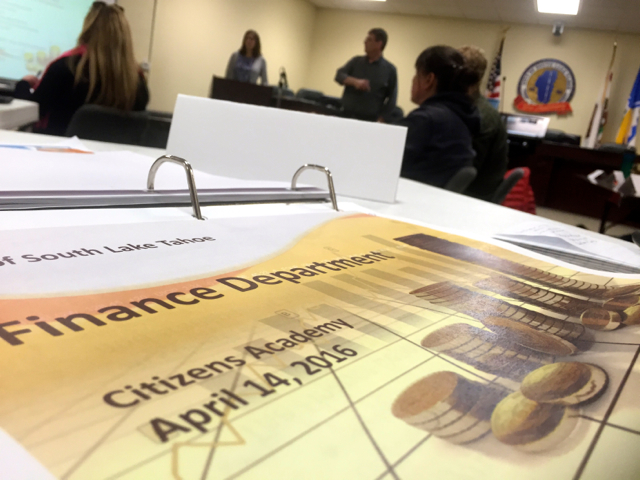
Carlson, along with Maryann Brandt, who is the manager of the department, delved into the city’s finances with this year’s Citizens Academy students.

The free seven-week course is designed to give residents a better understanding about how the city works as well as an opportunity to ask questions of staff. (This reporter is part of the current class.) The first session was an overview about the city, the incorporation and basic functions.

Members of South Lake Tahoe's Citizens Academy learn about financial dealings of the city. Photo/LTN

Members of South Lake Tahoe’s Citizens Academy learn about financial dealings of the city. Photo/LTN

Also part of the April 14 session was a lesson about the airport by Sherry Miller, who oversees that facility. The city is actually a tenant of the airport’s, paying $1.45 per square foot. That will go up to $1.50 a square foot in June per the council’s approval earlier this year. That is the same rate all tenants pay.

The finance gurus touched on how the city has $160 million in debt, with the bulk of it – $90 million – being for the construction of Heavenly Village. That total, though, does not include pension debt for the California Public Employee Retirement System. A change in how the state wants financial documents recorded will put that $19 million liability on the ledger in a more visible manner. Carlson stressed how the city has no ability to change PERS.

The debt would be substantially higher if the city had not changed its health care plan.

Carlson explained how public safety employees are the most expensive because of their training, equipment and pension costs.

Carlson also stressed how there is no denying South Lake Tahoe is a tourism-based economy.

“We live and die by the tourists who come to town,” he said. He mentioned how the city is considering raising the hotel tax by 2 percentage points, which could be on November’s ballot.

The next academy group will be hearing about the financial part of the city from other workers. This is because Carlson is leaving at the end of the month to take a job in Union City and Brandt is retiring in late summer.

The airport used to be a much larger financial drain on the city’s coffers. Seven years ago $630,000 came from the General Fund for the facility, while today it is $106,000.

Any money that is made at the airport – including the vending machine – must be reinvested in the airport per Federal Aviation Administration rules.

The FAA has tremendous say over what goes on at Lake Tahoe Airport. The city even looked into closing the facility and the feds said no way. It’s deemed too valuable for the region.

It’s the FAA that wants more trees cut down because they are deemed an obstruction. Miller has a meeting scheduled for Monday to talk to various agencies about which ones will come down. It’s a careful balance between negotiating for safety (trees aren’t why planes go down here) and keeping the natural surroundings as they are.

While the South Lake Tahoe airport has not had commercial air service since 2001, it has some of the infrastructure from those days. A tunnel on the runway level runs the length of the upstairs entrance and council chambers. This is where the baggage would come in. A spot on the ceiling is obvious where the conveyor belt would have come down to carry bags to the carousel that was in what is now the empty entrance way. Today the tunnel is used for storage.

Even without commercial service, the airport is busy. Caesars flies in guests at least once day, sometimes five times. There are 23,000 takeoffs and landings a year. Helicopter tours are given, a flight school operates there and the medical helicopter CalStar is stationed at the airport. The busiest time is during the July celebrity golf tournament.

Miller is a one-person department. New to her plate is having to deal with drone activity.

“They are starting to fly in the same airspace as the big airplanes,” Miller said.
“They can be just as dangerous or more so than birds. It would only take one to be ingested into an engine or fly into a cockpit window.”


Letter: Cave Rock project should be stopped

To the community,

NDOT is in the process of “selling” the Tahoe community on its plans for an extension of the Cave Rock tunnel. Their proffered justification is that our community needs such a tunnel extension to prevent future accidents that might be caused by rocks falling from the Cave formation.

This is not a good idea. Indeed, it is a terrible waste of money that will increase the risk of accidents, cause extended traffic delays, destroy one of the most scenic entrances to the Lake, and expend money that could be better used for other projects.

The following points should be emphasized:

1. Accident Risk: There have been no accidents precipitated by falling rocks. NDOT tells us, though, that such an accident might happen in the future. We have had, however, several accidents involving bikes hit by cars and trucks in the very short tunnels that now exist. Extending the westbound tunnel by 60 feet will greatly increase the risk of accidents for bicyclists. NDOT is increasing the risk for known dangers while ostensibly reducing the risk for unknown dangers.

Why does NDOT focus only on the northern end of the westbound tunnel? Do they expect that rocks will only fall on that one segments of road? Why not the other three entrances/exits? Do they plan to extend the tunnel at all four openings?

The community should also note that a tree fell across Highway 50 by the Zephyr Cove firehouse just a while back. Would NDOT want to construct a canopy or tunnel to guard against future tree falls? What distinction merits a tunnel for falling rocks?

Finally, NDOT views the steel nets that protect motorists from falling rocks as “temporary”. What is the basis for that designation? Why not keep the steel nets in place and forego the tunnel?

2. Aesthetic Destruction: The northern entrance to the westbound tunnel offers motorists the first lake-level view of the lake. It is a stunning view. The proposed tunnel will obliterate that view entirely. For TRPA to endorse the destruction of that view is the ultimate bureaucratic hypocrisy.

3. Traffic Delays: NDOT itself projects interminable delays that will cripple traffic this summer and well into the end of the year (if not further). With the lake economy just now recovering, it is a terrible time to make the journey to the lake more difficult for visitors, especially those who fly into Reno.

4. Cost-Benefit Analysis: NDOT hasn’t provided any meaningful cost data and absolutely no information that would facilitate a careful benefit-cost calculation. Given the tiny probability of a future rock/vehicle accident (especially with steel nets in place) and the high costs of construction, environmental destruction, and traffic delays, it seems impossible that this project could withstand an objective cost-benefit analysis.

In view of the foregoing points, the Tahoe community should vigorously oppose NDOT’s proposed tunnel extension. To do so, the community should petition our congressman, our governor, and interested agencies to put a halt to this project .

Brad Schiller, Cave Rock


Calif. lawmakers collect public pensions and legislator’s salaries

By Patrick McGreevy, Los Angeles Times

Republican state Sen. John Moorlach of Costa Mesa has emerged as a leading voice in the Legislature against skyrocketing debt piled up by public pension systems.

But some in the pension reform movement say the former Orange County treasurer may be contributing to the problem: Moorlach receives an $83,827 government pension check from the Orange County Employees Retirement System while making $100,113 a year as a senator.

At least 16 other state lawmakers collect two checks each month, including Assemblyman Jim Cooper (D-Elk Grove), who retired two years ago at 50 as a captain in the Sacramento County Sheriff’s Department. When added to his legislative pay, Cooper’s annual pension of $173,820 brings his total income each year to $273,000.

Read the whole story