Loop road specifics begin to emerge

By Kathryn Reed

STATELINE —  “This project is not going to cure everything,” Carl Hasty said of the proposed loop road on the South Shore.

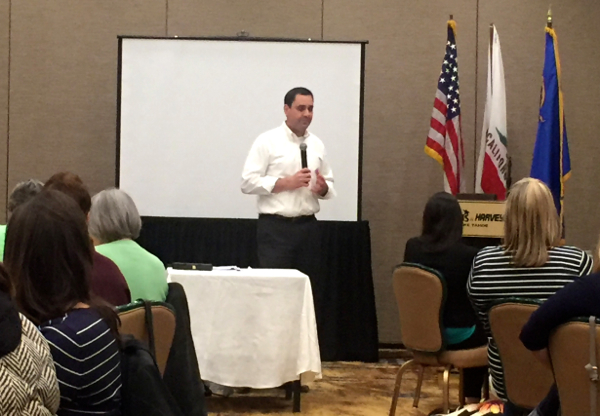
Hasty, the district manager for the Tahoe Transportation District, gave an update on the project April 13 to the Tahoe Regional Planning Agency’s Advisory Planning Commission.

His response was in regards to a question about parking. He added that the only parking associated with the loop road will involve any development that goes on – such as affordable housing.

Part of the presentation included a high-speed video of vehicle and pedestrian interaction near Heavenly Village during Presidents Day weekend. The purpose was to visually show the conflicts. The goal is to do it again on a busy summer day. There was no mention of documenting the area during normal flows to see what, if any, conflicts exist during the bulk of the year.

One of the visuals had a Heavenly gondola tower becoming a feature of the median.

There will be an overpass built to get people from the Harrah’s parking lot to Van Sickle Bi-State Park. Even though this state park has had funding issues since the get-go, it will be the park’s responsibility to keep the overpass clear of snow. The actual structure will be Caltrans’ liability

The loop road plan calls for making the current Highway 50 from about Pioneer Trail to Lake Parkway a city-county street, and turning the street behind Harrah’s-MontBleu into the five-lane highway. To make this happen commercial and residential buildings in South Lake Tahoe would be razed, and streets realigned.

One APC board member asked for a future rendering to identify the right-of-way that will need to be acquired to make the project a reality.

Hasty said the district has talked to properties involved, but no rights-of-way have yet to be secured, but added such a slide could be developed.

Another member asked if the bypass would speed up the flow of traffic.

“You don’t want it to go faster,” Hasty said. The expectation is for traffic to flow more easily and be more fluid.

To get bicyclists through the area more safely a cycle track is being proposed for city-county road.

The draft environmental documents are now slated to be released in June. The final could be done in September. In between those time there will be more public hearings. One alternative is doing nothing – which has to be included. It will address current standards in terms of public safety and traffic issues.



DRI officials fear university takeover

By Associated Press

Members of one of Nevada’s top environmental research organizations fear that the pending exit of its president will lead to a takeover by the state’s largest universities.

Longtime Desert Research Institute President Stephen Wells will leave this summer for another job in New Mexico. Organization officials say they are concerned state leaders will try to fold the institute’s resources into one or both of Nevada’s universities, the Las Vegas Review-Journal reported.

“Our faculty are nervous,” Wells said. “I’ve encouraged them to be very candid about what their feelings are, and I would say most people want to stay as an independent institution.”

Nevada System of Higher Education Chancellor Dan Klaich said there are no plans at this time to overhaul the institute. Klaich did question the potential merits of a takeover during a faculty meeting, but he said that those were theoretical.

“Change makes folks nervous — especially change in leadership,” Klaich wrote in an email Friday. “At an institution like DRI where there has not been a change in almost twenty years and where reorganization was discussed during the budget cuts, it is natural that some are concerned.”

DRI Faculty Senate Chair Dana Trimble wrote in a March 23 email addressed to Klaich and Board of Regents Chair Rick Trachok that the senate would like to formally end talks of mergers, even In the abstract.

“It’s always something on the table — the merger discussion is always happening,” Trimble said. “We worry about it because we’re a very small institution and we feel very vulnerable.”

DRI supporters said the presidential search should be top priority and that questions about the institute’s future can wait.

UNR officials said Friday that the school is not involved in any discussions about a merger.

“DRI is a valued partner in research and graduate education,” UNR President Marc Johnson said in an emailed statement. “The productive collaboration between DRI and UNR has extended over many, many years.”

UNLV officials did not respond to requests for comment.


Supreme Court sides with Google, not authors

By Associated Press

WASHINGTON — The Supreme Court turned away a challenge Monday to Google’s online book library from authors who complained that the project makes it harder for them to market their work.

The justices let stand lower court rulings in favor of Mountain View-based Google and rejected the authors’ claim that the company’s digitizing of millions of books amounts to “copyright infringement on an epic scale.”

Lower courts have said that Google can provide small portions of the books to the public without violating copyright laws.

The Authors Guild and individual authors first filed their challenge to Google’s digital book project in 2005. Google Inc. has made digital copies of more than 20 million books from major research libraries and established a publicly available search function.

In October, the 2nd U.S. Circuit Court of Appeals in New York agreed with a judge who concluded that Google was not violating copyright laws when it showed customers small portions of the books. The authors said the project would spoil the market for their work.

The appeals court said that Google’s “snippet view, at best and after a large commitment of manpower, produces discontinuous, tiny fragments, amounting in the aggregate to no more than 16 percent of a book. This does not threaten the rights holders with any significant harm to the value of their copyrights or diminish their harvest of copyright revenue.”

The three-judge appeals panel did acknowledge, though, that some book sales would likely be lost if someone were merely searching for a portion of text to ascertain a fact.

Writers involved in the lawsuit include Jim Bouton, author of the best-seller “Ball Four,” Betty Miles, author of “The Trouble with Thirteen,” and Joseph Goulden, author of “The Superlawyers: The Small and Powerful World of Great Washington Law Firms.”

The case is The Authors Guild v. Google, 15-849.


Talk to focus on tree mortality in Tahoe

Prolonged drought periods often result in forest tree mortality, but this death varies across the Lake Tahoe Basin. The causes of tree mortality range from native bark beetles, forest pathogens (native and invasive), stressors such as drought and salt stress, as well as historical land use.

Patricia Maloney will discuss on May 10 the ecological and evolutionary consequences of forest tree mortality in the Lake Tahoe Basin.

She is a forest ecologist and conservation biologist with UC Davis’ Department of Plant Pathology and Tahoe Environmental Research Center. Her research is aimed at understanding forest dynamics and forest tree species responses to natural and anthropogenic disturbances.

The program will begin at 6pm, with refreshments and no-host bar from 5:30-6pm at 291 Country Club Drive in Incline Village on the campus of Sierra Nevada College.

Seating is open at 5:30pm. to guests who have preregistered, open seating starts at 5:50pm. Cost is $5.


Tahoe Tails — Adoptable Pets in South Lake Tahoe

Chunky Monkey

Chunky Monkey

Chunky Monkey is not one of your typical high-energy pit bulls. The best word to describe him is mellow.

He is very calm in the shelter, doesn’t bark, but wags his tail wildly any time someone comes to his kennel. He takes treats as gently as any dog can, and walks nicely on the leash. He is about 6 years old, weighs about 50 pounds, and is short and stocky (but not overweight). And look at those ears!

Chunky Monkey is neutered, microchipped, tested for heart worm, and vaccinated. He is at the El Dorado County Animal Services shelter in Meyers, along with many other dogs and cats who are waiting for their new homes. Go to the Tahoe animal shelter’s Facebook page to see photos and descriptions of all pets at the shelter.

Call 530.573.7925 for directions, hours, and other information on adopting a pet. For spay-neuter assistance for South Tahoe residents, go online.

— Karen Kuentz


Tahoe social issues top EDC official’s talk

By Kathryn Reed

STATELINE – While many people believe their job runs the gamut, Don Ashton’s literally goes from A to Z – animal control to Zika virus.

Ashton is the director of Health and Human Services for El Dorado County. It’s the largest department in the county, with about 550 employees. Countywide there are approximately 1,800 workers.

Mental health, homelessness and human trafficking are three of the big issues his department contends with in Tahoe.

Ashton spoke last week at the Soroptimist International of South Lake Tahoe meeting, of which Supervisor Sue Novasel is a member.

Don Ashton with El Dorado County talks about issues pertaining to Lake Tahoe. Photo/LTN

Don Ashton with El Dorado County talks about issues pertaining to Tahoe. Photo/LTN

“With mental health, we are seeing more of a need in Tahoe,” Ashton said. He mentioned El Dorado County’s suicide rate is higher than the state average.

Transitional houses – T houses for short – have been established in the basin to help those with mental issues. Twelve beds are available at the lake; on average 10 are full each night.

“T houses use the treatment model. They have to agree to treatment. It’s not just housing,” Ashton explained.

It’s less expensive for the county to pay $500 in rent a month to sleep six than it is to send the person to a board and care facility in Sacramento at a rate of $15,000 per person.

The beds in Tahoe have only been available since last year. Countywide there are 33 such beds, double the number from two years ago.

“Seventy percent of the people in jail or prison have a mental illness,” Ashton said. When they get out they are in the community, often times without the resources to cope.

One of the positives about Tahoe is the community has come together to try to address some of these needs. He mentioned how CASA is working with Live Violence Free to build a program regarding mental health that will likely be brought to the supervisors. The electeds can then decide about going after grant money to fund the program.

Ashton said the county is moving toward creating a “system of care” so people don’t fall through the cracks. He hopes to have it part of the next budget cycle, which the supervisors will be getting under way this spring. The problem now is things are fractionalized and don’t come under one umbrella.

For instance, programs for kids and adults are separate, which doesn’t help families. The other aspect is the broader community that needs his department’s resources. The goal is to make the agency user-friendlier.

What wasn’t brought up at the meeting is how Ashton is being endorsed by various entities to be the next chief administrative officer for the county. This is the highest position. Several electeds wrote a letter to the Board of Supervisors earlier this month saying as much.

Last week El Dorado County Superior Court judges Suzanne Kingsbury, Steve Bailey, Keith Brooks, Ken Melikian and Dylan Sullivan sent a similar letter to the board, as did the Taxpayers Association of El Dorado County.

The county has an interim CAO, Larry Combs, whose ability to understand the budget and make good hiring decisions has been questioned by many in the county, and yet he is the one the supervisors put in charge of hiring the next CAO.


Editorial: Get rid of caucuses in Nevada

Publisher’s note: This editorial is from the April 10, 2016, Las Vegas Sun.

In a society gorging on technology and consumed by new interactive ways to share information and promote points of view, it is befuddling that political scrums known as caucuses, with roots dating to the 1700s, are still conducted in Nevada and 13 other states to boost candidates for the presidency.

Let’s take all the time we need to reflect on all the good things we’ve experienced or heard about the caucuses this campaign season.

Anyone?

OK, then let’s move on to the opposing question: Is there enough time to cite all that is wrong about caucuses?

Everyone who participated in a Democratic or Republican caucus has a favorite story — a gripe, actually — about the experience.

Read the whole story


A case for winter tires

By Bryan Rogala, Outside

Tires have a huge impact on car performance and safety, but most of us rarely give them any thought—until they quit working. That’s what happened in November when our headquarters in Santa Fe, New Mexico, got hit with the first major El Niño storm of the season. On the storm’s biggest day, most of the office drove up a local hill and proceeded to get stuck in the more than two feet of snow that had fallen overnight.

I had to abandon my Subaru Forester, with its regular all-season tires, in a snowbank and hop into a friend’s Toyota. After skinning up the resort and skiing all-time powder, that same friend gave me a ride back down, where we dug out my car, which I then white-knuckled back to town.

I resolved never to drive a snowy road without the proper treads again.

Read the whole story


Study: Fast-food comes with a side of chemicals

By John Tozzi, Bloomberg

People who reported eating fast food in the last 24 hours had elevated levels of some industrial chemicals in their bodies, according to an analysis of data from federal nutrition surveys.

The study is the first broad look at how fast food may expose the public to certain chemicals, called phthalates, that are used to make plastics more flexible and durable. The chemicals, which don’t occur in nature, are common in cosmetics, soap, food packaging, flooring, window blinds, and other consumer products. The Centers for Disease Control says “phthalate exposure is widespread in the U.S. population.”

Though the health consequences of encountering these substances aren’t fully known, scientists have increasingly focused on their effects on health and development, particularly for pregnant women and children. Research in rats has shown that they can disrupt the male reproductive system, and there’s evidence for similar effects in humans.

Read the whole story


Calif. Fish and Wildlife changes anger hunters

By Patrick McGreevy, Los Angeles Times

The number of Californians who hunt has dwindled to less than 1 percent of the population, but some who still carry rifles outdoors complain the state commission overseeing them has become too cozy with the animal rights movement.

Now Gov. Jerry Brown is facing pressure from outdoor enthusiasts to fill two vacancies on the five-person Fish and Game Commission with people who understand hunters and anglers and their role in conservation.

“The commission has shifted from a philosophy of conservation to one of preservation, meaning its direction has gone to where fishing and hunting are more and more limited and very difficult,” said Marko Mlikotin, executive director of the California Sportfishing League.

Read the whole story