Officials: Nevada groundwater wells OK in drought

By Associated Press

CARSON CITY — Despite the ongoing drought across Nevada and much of the rest of the west, state officials say wells are in good shape.

KRNV-TV reports that officials with the Nevada Division of Water Resources, Office of the State Engineer, say state wells and aquifers appear to be resilient to the ongoing drought.

State Engineers Office Deputy Administrator Rick Felling says Nevada’s aquifers are able to withstand short-term and even some longer-term droughts.

Division staff measured groundwater levels in wells throughout various hydrographic basins in the state, focusing on water levels primarily in irrigation and stock wells.

Felling says there has been a small decrease across the board due to pumping during the drought but most areas will recover.


USFS readying Tahoe sites for summer

The U.S. Forest Service recreational facilities in the Lake Tahoe Basin will start to open this month.

Kiva picnic area, Baldwin and Nevada beaches, Big Meadow trailhead, the McKinney Rubicon off-highway vehicle area and Sawmill Pond, Eagle Falls, Chimney Beach and Secret Harbor parking areas open April 30.  The Sandpit OHV area opens May 10. William Kent, Kaspian, Meeks Bay, Bayview, Fallen Leaf and Nevada Beach campgrounds open May 13. Luther Pass Campground opens May 25, and Pope Beach opens May 27.  Blackwood Canyon and Watson Lake campgrounds open June 1.

The Taylor Creek Visitor Center parking area, grounds and restrooms open May 14. The Tallac Historic Site opens April 30, and will be staffed beginning May 21.

Before recreation sites fully open to the public, the Forest Service must hire crews and staff to manage the sites, clean up from winter, remove safety hazards and wait for the danger of a freeze to pass before turning on water systems.


Study: Climate change will bring worse weather

By Sean Greene, Los Angeles Times
 
Since Americans first heard the term global warming in the 1970s, the weather has actually improved for most people living in the U.S. But it won’t always be that way, according to a study.

Research shows Americans typically — and perhaps unsurprisingly — like warmer winters and dislike hot, humid summers. And they reveal their weather preferences by moving to areas with conditions they like best.

A study in the journal Nature has found that 80 percent of the U.S. population lives in counties experiencing more pleasant weather than they did 40 years ago.

Read the whole story


Overachieving Tahoe cyclists being sought

Nominations for the annual Lake Tahoe bicycle achievement awards are being taken until May 1.

Lake Tahoe Bicycle Coalition, through a public nomination process, brings attention to and honors those that have made significant advancements to promoting safer bicycling opportunities for the Lake Tahoe region.

To nominate a candidate — individual, business, agency, or organization — please the name and say something about their contributions to info@tahoebike.org.

LTBC’s board of directors will review all nominations and select the winners. The awards will be given out at Cycle Celebration on June 18.


Golf tourney benefits Barton Foundation

Barton Foundation’s 22nd annual Tiki Tee Off Golf Tournament is June 3 at Lake Tahoe Golf Course in Meyers.

All proceeds support the community health endowment to benefit the health and wellbeing of South Shore residents.

Check-in and continental breakfast start at 7am, with the shot gun scramble tee off at 8am.

Golfers play the scramble game in teams. Registration includes breakfast, golf and golf cart, drink tickets, and a luau lunch. Prizes will be awarded for cart decorating, team spirit, and the tournament winners.

To sign up and for more info, contact Sara Conrad at 530.543.5909.


Dems line up behind McClintock challenger

By Susan Wood

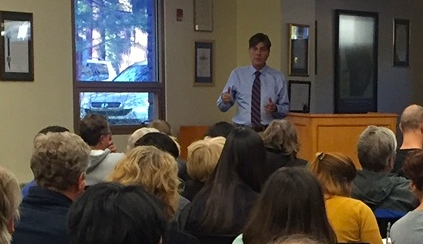
More than 60 people packed a Lake Tahoe Community College room Thursday night to hear Bob Derlet, a Democrat running for the 4th Congressional district, provide a better prescription for government.

He’s running against Rep. Tom McClintock, an Elk Grove Republican who’s been in the seat since 2008 and logged 22 years in the California Legislature before that, having started at age 26 in the Assembly.

When asked by Lake Tahoe News how he plans to unseat an entrenched McClintock when others like retired military officer Charlie Brown failed, Derlet amped up his tone.

“I think people are tired of McClintock. It’s time for a change. This is going to be the most dramatic election we’ll remember in a lifetime, and we’re gonna do it,” Derlet, 66, of El Dorado Hills said as if he’s part of a Democratic movement as a whole.

This race in particular may be difficult. The 4th District is large, encompassing the Sierra Nevada from Truckee to the Sequoia National Forest including Alpine, Amador, Calaveras, El Dorado, Mariposa and Tuolumne, with portions of Fresno, Madera, Nevada and Placer counties. The sprawling region can be a bit overwhelming to a Democrat because it’s half Republican voters, 35 percent Democrat and 15 percent declined to state.

“We’ve got to go after that 15 percent,” Derlet said.

Bob Derlet wants to be the next congressman to represent the California side of Lake Tahoe. Photo/Susan Wood

Bob Derlet wants to represent the California side of Lake Tahoe in Congress. Photo/Susan Wood

There may be a light at the end of the tunnel. The June 7 primary is non-partisan in California, so the two top vote-getters will move on to the Nov. 8 general election – and that will be the real race, Derlet contends. The only other opponent in the primary is Democrat Sean White.

Statistics aside, South Lake Tahoe resident and environmental advocate John Friedrich told Derlet he believes it is “unconscionable” Lake Tahoe, Yosemite and other areas of the Sierra Nevada Mountain Range are represented in the federal government by “a Grade A climate change denier.”

To that, Derlet pledged the global warming phenomenon as a larger priority, joining education, wage equity, consumer rights, Social Security protection, women’s issues and especially health care as other focuses. On the latter, the long time physician admitted to Lake Tahoe News after the April 21 meeting that more work needs to be done on the Affordable Care Act with a monetary shift from administrative to care, but having millions insured when they weren’t before is testimony in itself to good federal policy.

But he spoke to the core of the Tahoe audience when he lauded climate change as “up there” in priorities.

“If global warming is not a priority, what’s the alternative?” he asked.

The South Tahoe Chapter of the Citizens’ Climate Lobby, Tahoe Area Sierra Club and LTCC Ecology Club sponsored the town hall meeting.

Derlet’s occasional declaration brought out cheers and applause from the issues-friendly audience. The cheerleading session made up for the lack in substance in how to address the change that he believes needs to occur.

Some attendees echoed the passion, with one man suggesting using McClintock’s failed natural resources management policies to edge out the career politician.

Another appeared concerned about the Democratic Party, believing it’s divided.

“I think after the conventions, people will come together,” Derlet insisted.

Albeit friendly to his cause, the audience came across more informed than most and at times pressed Derlet to step up the campaign. One person reminded Derlet afterward that he should have asked for money.

In recognizing he’s a little-known candidate, Derlet told Lake Tahoe News his campaign will ramp up soon with signs, more gatherings such as this one and messages in the media.

At age 8, Derlet’s first job involved selling newspapers at the very busy corner of Santa Monica and Vine boulevards in Hollywood. Later in life, he became a physician, eventually leading him to the Me-Wuk Indian Health Center in Tuolumne City. It was there he heard the plights of his patients that prompted him to get into politics.

“I care about people. They need to be protected,” he said.

Derlet comes across with a pleasant, mild-mannered approach. Some would like to see him become a little more aggressive.

“I think he needs to go after McClintock,” resident Kim Carr said after the meeting.

She’s worried about the traditionally low losing rate of incumbents.

“He’s going to have to work hard to get his name out. That’s the dilemma we’re in,” she said.

But there is a bright side.

“I think people are tired of do nothing politics. I think the fact the Republican Party is having a hard time getting behind its candidates with so many factions helps (Derlet’s run),” she added.

Most concurred it’s an interesting time for politics.

“I think the entire election system could be thrown in the air, and anything could happen,” longtime local Laurel Ames said.


Opinion: Invention of the modern political attack ad

By Robert Mann

On Sept. 7, 1964, a 60-second TV ad changed American politics forever. A 3-year-old girl in a simple dress counted as she plucked daisy petals in a sun-dappled field. Her words were supplanted by a mission-control countdown followed by a massive nuclear blast in a classic mushroom shape. The message was clear if only implicit: presidential candidate Barry Goldwater was a genocidal maniac who threatened the world’s future. Two months later, President Lyndon Johnson won easily, and the emotional political attack ad—visceral, terrifying, and risky—was made.

Half a century later, we live in the world of negative political advertising that Daisy Girl pioneered, but there are some curious aspects to the story. First, though it is a famous ad, Daisy Girl, as the ad is known, only ran once. Secondly, it didn’t even mention Goldwater’s name. And finally, by the time the ad ran, Goldwater’s chances against LBJ were slim, even though the ad is often falsely credited with assuring the win. And there were two dozen other ads from LBJ’s camp—humorous, informative, dark, and neurotic. Daisy became the iconic spot of its era not because it was the first Johnson ran in 1964; we remember it primarily because of its brilliant, innovative approach to negative advertising.

Daisy and the other ads were made by Doyle Dane Bernbach (DDB), an eclectic group of ad men at a medium-sized Madison Avenue firm with a stellar reputation for groundbreaking campaigns for Volkswagen and Avis. They didn’t set out to revolutionize political advertising; what they wanted to do was to break the established rules of political ads—then dominated by stodgy 30-minute speeches mixed with shorter policy-focused spots—by injecting creativity and emotion.

Bill Bernbach, the firm’s principal founder, had long maintained advertising was an art, not a science. He favored intuition. He often reminded his employees, “Playing it safe can be the most dangerous thing in the world, because you’re presenting people with an idea they’ve seen before, and you won’t have an impact.”

Famously dismissive of advertising driven purely by research, Bernbach had written a revolutionary memo in 1947 that laid out the philosophy that would eventually characterize his firm’s work. “Advertising is fundamentally persuasion and persuasion happens to be not a science, but an art,” he brashly told his then-employer, Grey Advertising. “It’s that creative spark that I’m so jealous of for our agency and that I am so desperately fearful of losing. I don’t want academicians. I don’t want scientists. I don’t want people who do the right things. I want people who do inspiring things.”

Inspired by Bernbach’s philosophy of relying upon instinct as much or more than research, DDB produced an extraordinary and memorable series of spots for Johnson. The firm capitalized upon Goldwater’s reckless statements by providing viewers with indelible images. DDB mocked Goldwater’s vote against the nuclear test ban treaty with a spot showing nothing but a girl licking an ice cream cone as a female announcer spoke ominously about the fallout from atmospheric nuclear testing and how it might enter the food supply.

Goldwater had once bragged that the nation might be “better off if we could just saw off the Eastern Seaboard and let it float out to sea.” So, DBB served up a humorous 60-second spot of a saw slicing the East Coast from a Styrofoam model of the United States. In another spot, DDB mocked Goldwater’s statement about privatizing Social Security by showing a pair of hands ripping up a Social Security card.

Viewers had never seen anything like this. It’s not that previous presidential campaigns had only been polite affairs. Dwight Eisenhower ran negative TV spots against his Democratic opponent Adlai Stevenson in 1952, subtly tying him to alleged corruption in Truman administration officials. Stevenson’s spots attacked Eisenhower in 1956. John F. Kennedy attacked Richard Nixon’s record as vice president in the 1960 campaign. Goldwater’s attacks against Johnson in 1964 were unrelenting. In almost every case, however, the attacks were rational, fact-based arguments. DDB’s innovation was not negative advertising, per se. It was, rather, to help make emotions (primarily, fear) a staple of political spots. By 1968, political ads—by other agencies—were also transformed.

Even the spot itself was something of a DDB innovation. Before 1964, political campaigns had used 30- and 60-second spots, but not exclusively. Instead, campaigns, including Goldwater’s, pre-empted regular programming with dry, 30-minute speeches or campaign documentaries by candidates. Under DDB’s direction, Johnson’s campaign aired nothing but 30- or 60-second spots, with the exception of two four-minute commercials, including the “Confessions of a Republican” ad (which went viral recently) purporting to show that even Republicans found Goldwater uncomfortably extreme.

DDB broke another rule by recognizing that Goldwater was such a widely known figure that voters needed no education about him. They didn’t have to remind viewers that Goldwater himself had joked about lobbing a missile into the men’s room of the Kremlin. Or that he had written that the U.S. should not fear war with the Soviets. Or that he would give NATO commanders authority to use nuclear weapons without prior presidential authorization. Or that he had declared the nuclear bomb “merely another weapon.” America knew he voted against the Civil Right Act and that, at the GOP convention in July 1964, Goldwater even branded himself an “extremist.” So DDB never once had to mention Goldwater’s name in Daisy. It only had to find viewers’ emotional trigger.

Put another way, the firm believed that viewers should not be given too much information to put their minds and emotions to work. And Daisy Girl’s DNA has continued to provide instructions for today’s political advertising: Ronald Reagan’s famous 1984 “Bear” spot used the animal to symbolize the Soviet Union without explicitly making the association. In 2004, Bush’s campaign skillfully employed the same technique with a spot that used wolves to symbolize al Qaeda.

Voting is not a purely rational act. As the late journalist Joe McGinnis observed, it’s a “psychological purchase” of a candidate. It’s often no less rational than buying a car or a house. DDB understood that arguing with voters would be a losing proposition. To persuade someone, especially in the political realm, a campaign must target emotions. Voters don’t oppose a candidate because they dislike his or her policies; they often oppose the policies because they dislike the candidate.

Reagan’s optimistic 1984 “Morning in America” spot was a good example of this kind of appeal. So was George H.W. Bush’s dark, fear-inducing “Revolving Door” spot in 1988 that exploited the controversy over a prison furlough program of his Democratic opponent, Michael Dukakis. Bernie Sanders’ “America” spot is a current example. They are all very different ads, but are aimed at generating a non-rational, emotional response.

DDB also believed that giving data and facts was less persuasive than telling a story. The best spots provide an experience. In addition to evoking emotions and not repeating what the viewer already knew, many of the DDB spots from 1964 had a narrative arc to them. A good example in 1964 was a Johnson spot reminding viewers of the many harsh attacks on Goldwater by his former GOP opponents. The gold standard for subsequent spots in this genre may be Bill Clinton’s 60-second “Journey” spot from 1992, in which he touted his small-town American values by recounting his childhood in Hope, Arkansas.

Early in his career Bernbach perceived that although research had its place in persuasion, there was something more—something completely unquantifiable: “The truth isn’t the truth until people believe you and they can’t believe you if they don’t know what you’re saying; and they can’t know what you’re saying if they don’t listen to you; and they won’t listen to you if you’re not interesting. And you won’t be interesting unless you say things freshly, originally, imaginatively.”

For better or worse, the Daisy ad made emotions a much more potent weapon in our political campaigns, employing techniques that had previously only been applied to selling cars and soap. The next innovation, already with us to some degree, is nano-targeted TV spots, which will resemble the ads we see on the web but will be on TV. Soon, working with cable providers, candidates will offer up messages specially crafted for certain viewers. Five different people watching the same program might each see a different spot from the same candidate.

Meanwhile, social media has injected campaigns’ storytelling into communication between friends. Without Daisy, would the Facebook flame wars of Trump and Bernie fans have the same raucous fervor? But as campaigning moves further into the virtual world of computers and algorithms, it must overcome a paradox: Now, as then, the best ad campaign has a soul—and that’s something a computer or a poll can’t create for any candidate.

Robert Mann is a political historian, former U.S. Senate press secretary and professor at the Manship School of Mass Communication at Louisiana State University. He is the author of “Daisy Petals and Mushroom Clouds: LBJ, Barry Goldwater and the Ad that Changed American Politics” (2011).


Court: Calif. students have no ‘right’ to quality education

By Bob Egelko, San Francisco Chronicle

A divided state appeals court ruled Wednesday that California’s anemic level of school funding does not violate students’ constitutional right to an education of “some quality” because no such right exists.

The 2-1 decision by the First District Court of Appeal in San Francisco upheld a judge’s dismissal of a suit filed by some of the state’s major participants in public education — school boards and administrators, the California Teachers Association and State PTA, and nine school districts, including San Francisco and Alameda. The plaintiffs argued that a state that trails nearly every other state in per-pupil spending, staffing and student achievement violates California’s 1879 constitutional guarantee of a school system that encourages “the promotion of intellectual … improvement.”

Similar suits have been filed in other states, and a majority have been successful, with courts in at least six states finding that their school finance systems violated students’ rights. The San Francisco court said the right to a public education, guaranteed by the California Constitution, does not include a right to any particular level of educational quality or funding.

Read the whole story


LTCC community games open to non-students

Student clubs at Lake Tahoe Community College are gearing up for the third annual Community Games.

On May 7 from noon-4pm will be events from table tennis, dodgeball and badminton tournaments, to live music, food, kid activities and more.

Admission is free. Funds raised from the for-a-fee tournaments, food sales and a silent auction will help support student scholarships at LTCC.

The dodgeball tournament will be from noon to 2pm in the gym. There is a $30 entrance fee for a team of six players. The badminton and table tennis tournaments will be between 2 and 4pm in the gym, and there is a $5 per person fee to enter.

For more information about the LTCC Community Games, or to register for a tournament or donate an auction item, contact Julie Booth at 530.541.4660, ext. 477 or Booth@ltcc.edu.


NV Energy among top companies to install solar

By Jessica Garcia, Reno Gazette-Journal

NV Energy has been named as one of the select group of energy companies that connected the most megawatts of solar energy to the power grid in the United States in 2015, earning a spot on the annual Top 10 utility solar lists compiled by the Smart Electric Power Alliance, formerly the Solar Electric Power Association.

In survey results released this month, NV Energy ranked No. 7 among investor-owned utilities.

The company had added 224 megawatts of installed solar capacity in 2015 alone. The 2015 listings are the fourth time that NV Energy has made SEPA’s Top 10 list.

Read the whole story