SLT Public Works — the backbone of the city

Azril Kalik with South Lake Tahoe explains snowplow operations. Photo/Kathryn Reed

Azril Kalik with South Lake Tahoe explains snowplow operations. Photo/Kathryn Reed

By Kathryn Reed

South Lake Tahoe would not function without the Public Works Department. Employees do the little things like change light bulbs, the medium work such as maintaining the parks, and the big stuff – snow removal, fleet maintenance and erosion control.

In terms of staff, it is the largest in the city.

Some of the department’s responsibilities include:

·      Maintaining and plowing 258 miles of roads

·      115 lane miles of curbs and gutters

·      29 miles of storm drain pipe

·      13 miles of drainage channel

·      1,800 drainage structures and basins

·      More than 7,000 signs/stakes

·      125,519 feet of bike paths/shared use trails

·      35 acres of landscaping

·      Interior/exterior of 33 buildings, equaling 226,000 square feet

·      348 acres at Lake Tahoe Airport

·      Entire fleet – nearly 250 vehicles.

Managers from the various sectors of Public Works gave an overview last week to members of the Citizens Academy. The free seven-week course is designed to give residents a better understanding about how the city works as well as an opportunity to ask questions of staff. (This reporter is part of the current class.)

“We don’t really repair anything, we restore stuff,” Alan Johnson, maintenance manager for facilities said. This goes for the buildings – some are older than the city, which turned 50 last year.

The same could be said of the aging fleet of vehicles, especially the snow removal equipment. The oldest is from 1970. Even so, the goal still remains to clear every street within 24 hours of a storm.

“There’s a misconception that the gate stops the berms,” Azril Kalik, who manages streets and snow, said. “We work 12-hour shifts until the snow is gone.”

The city’s fleet includes:

·       Airport – 19 vehicles, average age 21 years

·       Parks and Recreation – 43 vehicles, average age 18 years

·       Public Works – 97 vehicles, average age 17 years

·       Fire – 19 vehicles, average age 12 years

·       Other/admin – 11 vehicles, average age 11 years

·       Police – 60 vehicles, average age 9 years.

The department is also the lead on many projects in the city ranging from Bijou Bike Park to Lakeview Commons to stormwater installations.

“A lot of what we do is invisible,” explained Jason Burke, who heads the stormwater division.

This is because so many of the vaults collecting sediment are underground. These are in place so the water reaching Lake Tahoe is as clean as possible.

What gets built though – whether it’s with local, state or federal dollars – eventually is the city’s responsibility to maintain it. That is a key factor officials have to ponder before accepting grant funding – will the city be able to afford the maintenance and operation?

In listening to the general public’s needs, the department launched a work order request form on the city’s website so people can ask for a pothole or something else to be fixed. This is intended to be more convenient and efficient for everyone.

In the last year the department has gone through a reorganization that has employees being cross trained and a succession plan created so as upper managers leave-retire the younger staff will be able to apply for those jobs. Seasonal employees have been hired full time to make all of this work more efficiently in terms of time and money.


Opinion: ‘Bambi’ hoodwinked American environmentalists

By Robin L. Murray and Joseph K. Heumann

When “Bambi was first released in 1942, the National Audubon Society, compared the Walt Disney cartoon film’s consciousness-raising power for the environment to what “Uncle Tom’s Cabin” did for the abolition of slavery.

“Bambi”, about a deer, lost money then, but subsequent re-releases and video rentals brought in hundreds of millions of dollars, and made the film a rite of childhood. Over the years that “emotional groundwork,” took hold in the form of “The Bambi Factor,” a sentimental anthropomorphized view of wildlife, especially deer.

Seventy-four years, the Bambi Factor still animates debates over animal rights and environmentalism.

“Bambi” didn’t start as an American environmental fable. Written for adults in 1928 by an Austrian with the pen name Felix Salten, “Bambi: A Forest Life”, recounts the story of a fawn who grows up to be the prince of the forest alongside his royal father. But his rise to power comes only after the death of his mother and near loss of his mate Faline. While hunters are a problem for these deer, so are animals: In the forest, owls eat mice, crows eat a friendly rabbit, and a fox eats a duck. Early reviewers considered the book an anti-fascist fable and recent writers have speculated that the story was an allegory about the plight of Jews in Europe. Salter’s work was banned in Nazi Germany.

But the simpler film version portrayed deer living in an idealized forest where predators and prey play together and fear only “Man,” who is equipped with guns and fire. The emotional punch of Disney’s “Bambi” is heightened by its artistry, which combines gorgeous natural realism with cartoonish animals, their exceptionally large heads, small noses, and wide eyes resembling human children. Disney sent artists to sketch foliage in Maine’s Baxter State Park and shipped two fawns to the studio as artist’s models.

The film was controversial from the start., Outdoor Life editor Raymond J. Brown called the film “the worst insult ever offered in any form to American sportsmen,” and asked Disney to correct slurs against hunters, according to Matthew Cartmill’s “A View to a Death in the Morning: Hunting and Nature Through History”. Disney claimed sportsmen were not the targets because Salten’s story was about German hunters.

One of the first people bitten by the Bambi Factor was, ironically, environmentalist Aldo Leopold. In 1943, Leopold encouraged Wisconsin to institute an antlerless deer season to allow hunters to thin the overpopulated herd. Leopold was interested in the good of all life as part of an ecosystem. But his Wisconsin proposal was shot down—the public, according to scholar Ralph H. Lutts, was outraged at the idea of culling any of Bambi’s child-like creatures.

There’s another environmental ideology hidden in “Bambi” that’s at odds with reality. “Bambi’s” underlying message is that “Man” and deer can’t co-exist. A gunshot is the last we know of Bambi’s mother. Other hunters go on a chilling rampage, wounding Bambi and causing a final eco-disaster when their campfire explodes into the woods and destroys the animals’ home. In the film “Bambi”, interactions with humans ends only in death or suffering, so the only real choice is a complete separation between the two worlds.

As academics, “Bambi’s” worldview interested us: Did the “paradise” view of the forest precede the more modern idea of the ecosystem in popular culture? It didn’t. A few months before “Bambi” came out, audiences went to see the Fleischer Brothers’ animated feature “Mr. Bug Goes to Town” (1941). Instead of contrasting conflicts between humans and idyllic nature, “Mr. Bug Goes to Town” demonstrates how lowland bugs and humans can live interdependently in a human couple’s Manhattan garden. “Mr. Bug’s” focus on interdependence connects with more realistic views about wildlife management and interconnected communities of plants, bugs, animals, and human animals. While “Mr. Bug” was modeled on sophisticated Hollywood comedies of the time, “Bambi” reflected Disney’s focus on emotional yet traditional folktales for  broad audiences.

Contrary to the Disney story, of course, deer are all too comfortable with “Man,” “Woman,” and “Cars,” not to mention our delicious gardens, lawns, and infant trees. By 2015, predictably, protests against the Bambi Factor started to come from drivers and organic gardeners as the deer population grew dramatically. The National Traffic Safety Administration estimates that deer cause 1.5 million roadway accidents per year with 150 human fatalities and 10,000 personal injuries, as well as $1 billion in property damage.

Bambi lovers want to protect the deer even when the deer are sick. As recently as 2012, naturalist Valerie Blaine blamed the Bambi Factor for the North Rutland Deer Alliance’s opposition to killing deer even to test for chronic wasting disease. According to Blaine, the group felt any herd reduction would spoil their “deer watching experience” in Chicago’s Northwest suburbs.

The Bambi Factor encourages sentimentalized views of wildlife that romanticize nature without accepting its messier aspects.  Instead of looking for a paradise that separates us from wild nature, we need a new vision of living together, balancing habitat preservation with wildlife management. “Bambi” is, after all, just a movie.

Robin L. Murray and Joseph K. Heumann are professors at Eastern Illinois University. They have co-authored five books including “Ecology and Popular Film: Cinema on the Edge” (2009) and “Monstrous Nature: Environment and Horror on the Big Screen” (2016).


Painkiller critics want procedures changed

By Matthew Perrone, AP

Critics of how prescription painkillers are administered in the U.S. are calling on health officials to phase out hospital procedures and questionnaires used to manage pain.

They say the current system inadvertently encourages the overprescribing of addictive drugs like Vicodin and OxyContin, fueling an epidemic of overdoses tied to the opioid medications. Deaths linked to misuse and abuse of prescription opioids increased to nearly 19,000 in 2014, the highest figure on record, according to the Centers for Disease Control and Prevention.

More than five dozen nonprofit groups and medical experts sent a letter this month to the Joint Commission, a nonprofit agency that accredits U.S. hospitals, asking it to revisit its standards for pain management. Only hospitals that have been accredited can receive payments from government plans like Medicare and Medicaid, making the group’s standards highly influential.

The letter specifically takes issue with guidelines instructing doctors to ask patients to assess their pain.

“The Pain Management Standards foster dangerous pain control practices, the endpoint of which is often the inappropriate provision of opioids with disastrous adverse consequences for individuals, families and communities,” states the letter, which is co-signed by health commissioners from Vermont, Pennsylvania, Alaska and Rhode Island.

The Chicago-based Joint Commission rejected the idea that its standards push clinicians to prescribe opioids. Instead, the group said its standards require doctors to assess patients for pain and manage it.

“The standards do not require the use of drugs to manage a patient’s pain; and when a drug is appropriate, the standards do not specify which drug should be prescribed,” it said.

The group also stressed that it does not view pain as a “vital sign,” a medical mantra often debated by pain specialists and their critics.

Beginning in the 1990s, pain specialists and patient groups encouraged doctors to treat pain a vital sign that should be routinely monitored, alongside biological measures like body temperature, heart rate and blood pressure.

“All pain was viewed as being bad and so it pushed providers too often to over-prescribe opioids,” said doctor Michael Carome of the consumer advocacy group Public Citizen, one of the groups signing the letter.

The effort was spearheaded by Physicians for Responsible Opioid Prescribing, which advocates for alternative treatments to opioids, including non-opioid pain relievers, physical therapy and psychotherapy. The group is funded by Phoenix House, a nonprofit chain of addiction treatment centers.

The same coalition filed a petition with the federal agency that administers Medicare and Medicaid, the government health programs for the elderly, disabled and poor. The letter asks that officials eliminate certain pain-related questions from patient-satisfaction questionnaires, such as: “During this hospital stay, how often was your pain well controlled?”

The groups argue that such questions inadvertently encourage aggressive use of painkillers to maintain high patient-satisfaction metrics.

“Aggressive management of pain should not be equated with quality health care as it can result in unhelpful and unsafe treatment,” states the petition, which calls on the government to release a proposal for a new questionnaire within 90 days.

Last week a bipartisan group of senators introduced legislation that would eliminate the connection between pain survey questions and the payment rates hospitals receive from Medicare. Sen. Ron Johnson, R-Wisc., introduced the bill with senators Joe Manchin, D-W. Va., John Barrasso, R-Wyo. and Richard Blumenthal, D-Conn.


Snippets about Lake Tahoe

·       Lake Tahoe Airport received 0.96 inches of precipitation on April 22. This breaks the record of 0.30 inches set in 2010, according to the National Weather Service in Reno.

·       Here are the latest El Dorado-Tahoe and Sierra roadwork schedules from Caltrans.

·      The annual Great Bike Ride is May 10 from 11am-1pm. Meet in Placerville at the El Dorado County Government Center, Building A breezeway. It will be a casual ride on the El Dorado Trail from Forni Road to Missouri Flat Road and back. RSVP to jrice@edctc.org no later than May 6 for a free lunch and T-shirt.

·      El Dorado County District Attorney’s Office has released another cold case video.


2016 on path to be hottest on record

By Tom Randall, Bloomberg

The Earth is warming so fast that it’s surprising even the climate scientists who predicted this was coming.

Last month was the hottest March in 137 years of record keeping, according to data released by the National Oceanic and Atmospheric Administration. It’s the 11th consecutive month to set a new record, and it puts 2016 on course to set a third straight annual record.

Now, it might seem premature to talk about setting a new yearly record after just three months of data, but these months have been such an extreme departure from the norm that Gavin Schmidt, who directs NASA’s Goddard Institute for Space Studies, has already made the call.

Read the whole story


Fire ops to resume in Lake Tahoe Basin

Weather permitting, Tahoe Douglas Fire Protection District and the U.S. Forest Service may continue prescribed fire operations April 25.

On the East Shore, operations may take place near Spooner Summit, Camp Galilee and on Kingsbury Grade near Edgewood Drive. On the South Shore, operations may take place near Lake Tahoe Boulevard and Sawmill Road, Panther Lane near South Tahoe High School, off Highway 89 near Spring Creek, and off Santa Claus Drive and West River Parkway near Christmas Valley. To view a map with project locations and details, go online.

Residual smoke may be seen in locations where operations have taken place over the last several weeks. Each prescribed fire operation follows a prescribed fire burn plan, which considers temperature, humidity, wind, moisture of the vegetation, and conditions for the dispersal of smoke.  This information is used to decide when and where to burn.


Sandoval may not attend GOP convention

By Megan Messerly and Cy Ryan, Las Vegas Sun

Gov. Brian Sandoval he isn’t certain he’ll attend the Republican National Convention this summer in Cleveland, joining a line of Republican politicians who have expressed reservations about attending the convention or have said they’ll skip it altogether.

Sandoval spoke at the national convention in 2012 in Tampa and 2004 in New York City, and called the opportunities “an honor,” but he says he hasn’t received an invitation to appear on the podium this convention.

Read the whole story


Price of college to drop for some Tahoe residents

The final approval to reinstate the Good Neighbor Policy – at least on a limited basis – between California and Nevada became a reality this week.

The board of regents for the Nevada System of Higher Education gave the green light, which came months after both governors signed off on the deal. The new policy should be in place by fall.

“This Interstate Attendance Agreement reduces the cost of attending Lake Tahoe Community College for the Nevada residents in the Tahoe basin by 46 percent, a savings of over $3,500 per year for a full-time student,” Lake Tahoe Community College President Kindred Murillo told Lake Tahoe News. “For California residents, it means a reduced cost for attending Western Nevada College, as this is especially important because WNC provides some programs LTCC does not. This ensures additional access for students, and less duplication of programs.”

Until 2011, there had been a policy in place that allowed Nevada basin residents to attend LTCC at California rates, plus a small fee. Nevada did away with that law. Much of it had to do with politics, which is also the reason the two states took so long to come to another agreement.

— Lake Tahoe News staff report


Cops use taxpayer resources for photo op outside SLT

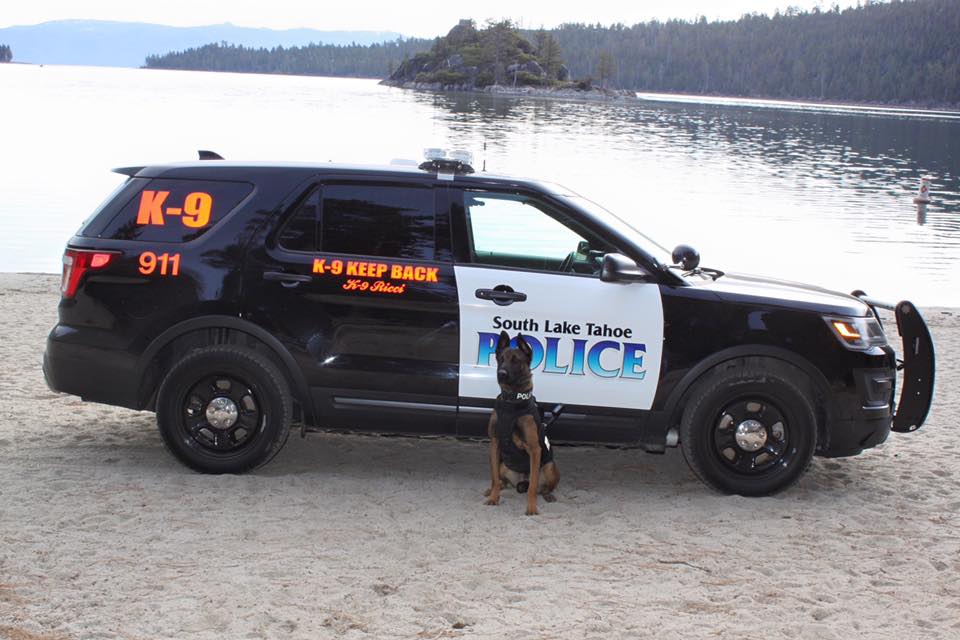
Ricci by his handler's vehicle at Emerald Bay. Photo/SLTPD

Ricci by his handler’s vehicle at Emerald Bay. Photo/SLTPD

By Kathryn Reed

Instead of patrolling the streets of South Lake Tahoe an officer drove out to Emerald Bay and onto the sands in front of Vikingsholm for a photo shoot.

The reason, according to Police Chief Brian Uhler, “To provide a nice photo to Ms. [Lisa] Maloff who donated over $100,000 to the police K-9 program.”

Officer Scott Crivelli’s dog Ricci is sitting next to the police vehicle with Emerald Bay in the background. A non-sworn member of the police department took the photo.

Emerald Bay is not in the city limits. This is also State Parks property. Uhler did not explain why the photo shoot wasn’t done in South Lake Tahoe.

Ricci was authorized to do this by “ranking staff”, which Uhler said he considered “justified”.

When asked if the officer was on overtime, Uhler told Lake Tahoe News, “It was justified, so no answer required for your question.”

Marilyn Linkem, head of the Sierra District for California State Parks, did not return a call or email.

“TRPA code generally does not allow vehicle use on beaches or off-road in stream environment zones,” Tom Lotshaw with the Tahoe Regional Planning Agency told Lake Tahoe News. “That said, there have been exceptions allowed in the past for non-environmentally harmful vehicle-use and equipment on beaches on a limited case-by-case basis.”

Uhler said a park ranger unlocked the gate for the officer to get to the beach.

Uhler said this use of city resources – personnel and vehicles – was a good idea because: “It’s good to promote our organization in a positive way. Community outreach is vital to any police organization.”


Placer works to resolve Kings Beach traffic issues

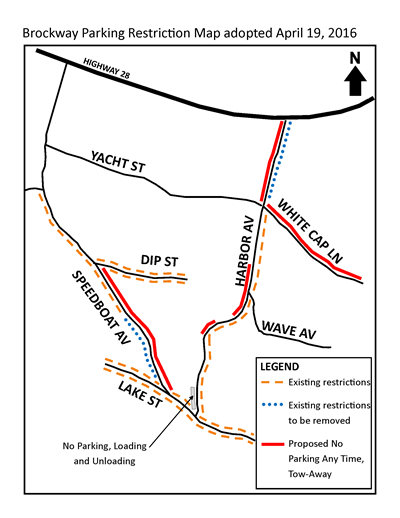
speed boat beach parking

Source: Placer County

Placer County is about to implement more stringent parking regulations near Speedboat Beach in Kings Beach to help alleviated some of the traffic problems in the surrounding neighborhood.

Supervisors on April 19 voted to tighten parking restrictions on nearby county roads and increase the fine for illegal parking from $25 to $100. The board also approved creating a designated loading and unloading area at the main public access point to the beach.

To help make an immediate impact, county staff will pursue a pilot program to fund additional patrols and enforcement of California Highway Patrol parking ordinances.

Several county supervisors went on a tour Monday with staff to get a visual of the problems and proposed solutions.

Much of the Speedboat Beach area is privately owned. Still, the number of visitors has grown. In large part this is because the beach is more expansive because of the drought. More people means more parking and traffic congestion as well as trash in neighborhoods.

Placer County hosted three community meetings last year to hear from locals about how to solve the problem. The improvements proposed to the board this week were ones that had the highest feasibility and strongest community support.

All changes should be in place by June 1. Supervisors will look at the issue again in a year to determine if further changes are needed.

Signs at the beach will help delineate public access areas, identify beach rules and help visitors better appreciate the beach’s natural resources and the need to protect them.

Staff also recommended replacing the aging wooden stairs that provide access to the beach and installing a permanent public restroom with flush toilets. The board encouraged staff to continue refining those proposals with community input.

— Lake Tahoe News staff report