What snowpack says about the water year

By Ian Evans, Water Deeply

The most significant reservoirs in the West are not stored behind concrete dams, but on top of mountains as snowpack. This year, however, snowpack has been alarmingly low throughout most of the West.

“If you look at the overall flow of the Colorado River – at Lake Powell, the main measurement point for the entire Colorado River Basin, it’s less than half of normal,” said John Fleck, director of water resources at the University of New Mexico.

That low flow impacts cities, agriculture and Western ecosystems for the rest of the year, if not longer. Already the Rio Grande River is so low that researchers are rescuing stranded fish by carrying them to wetter parts of the river. In California, instead of snow, the state experienced record-breaking wildfires and floods. Throughout most of the winter rainy season the state looked like it was headed for another devastating drought after only one year of relief.

Read the whole story


Tickets available for Tahoe City food-wine event

One of Tahoe City’s signature events and a fundraiser for the nonprofit Tahoe City Downtown Association, the 13th annual Tahoe City Food & Wine Classic, will return to the shore of Lake Tahoe on June 16 from 1-5pm.

It features more than 30 tasting locations that highlight varietals from area wine producers and gourmet bites from top North Lake Tahoe restaurants and caterers. It all happens along North Lake Boulevard in downtown Tahoe City.

In addition to fine wines, the event also includes craft brews and spirits, as well as non-alcoholic tasting options.

Tahoe City’s stores will be open for shopping, and live music will provide entertainment and dancing.

Wine Walk tickets are $45 per person in advance and $50 day of. Ticket price includes admittance, wine, beer, spirits and non-alcoholic tastings (for participants 21 years and over), commemorative wine glass, bite-sized morsels, music and parking. Designated driver tickets are available for $20 day of and include food sampling only. Kids under 6 are free.

For more information or to purchase tickets in advance, go online. Day of tickets will be available at the Boatworks Mall and the North Lake Tahoe Visitor’s Center (cash only).


Work on I-80 to cause delays

Expect delays on Interstate 80 east of Colfax as work on the Truck Climbing Lane project resumes.

Lane closures will be required to construct a freeway lane cross-over in order to complete the replacement of the Cape Horn Bridge.

Caltrans will utilize both lane closures and “rolling block” escorts of traffic by the California Highway Patrol through closure zones to construct a “cross-over” that will shift westbound freeway lanes to the east in order to allow the structure replacement work to continue on the west side of the Cape Horn Bridge. The cross-over work is anticipated to take place in the project’s construction zone, weather permitting, from 6pm April 30 to 6pm May 2.

Motorists are encouraged to plan for delays and adjust their travel time accordingly.


Animal masks another tool on South Shore fire rigs

By Kathryn Reed

Proper tools can save lives – even those of four legged creatures.

South Shore fire departments are now equipped with kits that have seven different masks; some deliver oxygen, some force air when an animal is unconscious. The duffle bags come with tubing and other necessities.

“A lot of pets go hide and get injured, or have smoke inhalation,” South Lake Tahoe fire engineer-paramedic Mike Mileski told Lake Tahoe News. “The masks are reusable. We’ll have these for many years.”

Mileski was the liaison between the South Lake Tahoe Fire Department and the donor who wants to remain anonymous. They were donated in memory of John Nemes, a longtime elementary teacher with Lake Tahoe Unified School District. Nemes was a lover of animals.
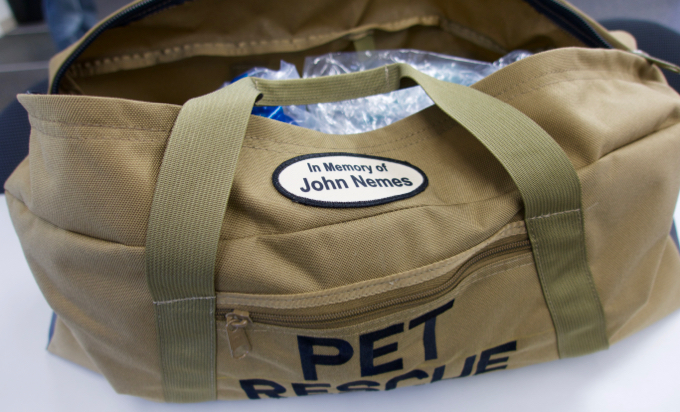
Nine pet rescue bags were donated to four South Shore fire departments in the name of John Nemes. Photo/Kathryn Reed

Each kit has a patch saying “In memory of John Nemes.” SLTFD has two kits, Lake Valley Fire two, Fallen Leaf Lake Fire one, and Tahoe Douglas Fire four.

Mileski said the kits will be able to be used for a range of animals. “For small rodents you could put them in the whole mask.”

If an animal is rescued from whatever the emergency is, they may be unconscious. While saving the life of a dog or cat is similar to humans in distress, it does take some training and specialized equipment.

South Lake Tahoe firefighters just received training in how to use these specialized masks for animals, what to do if a dog is choking and other tips to save a person’s fur baby.

As Neil Powell, veterinarian at Blue Lake Animal Care Center said, it’s important for first responders to understand the animal will be scared, and that it will want to lash out in fear. They can’t be talked to like a human to explain what is going on. That’s why it’s important for the firefighters to know how to protect themselves while delivering care.

Zoe Hill, a nurse at Blue Lake, demonstrated the various apparatuses, how best to position a large dog, as well as small dog or cat, and suggested ways they could use tools on the fire truck to help.
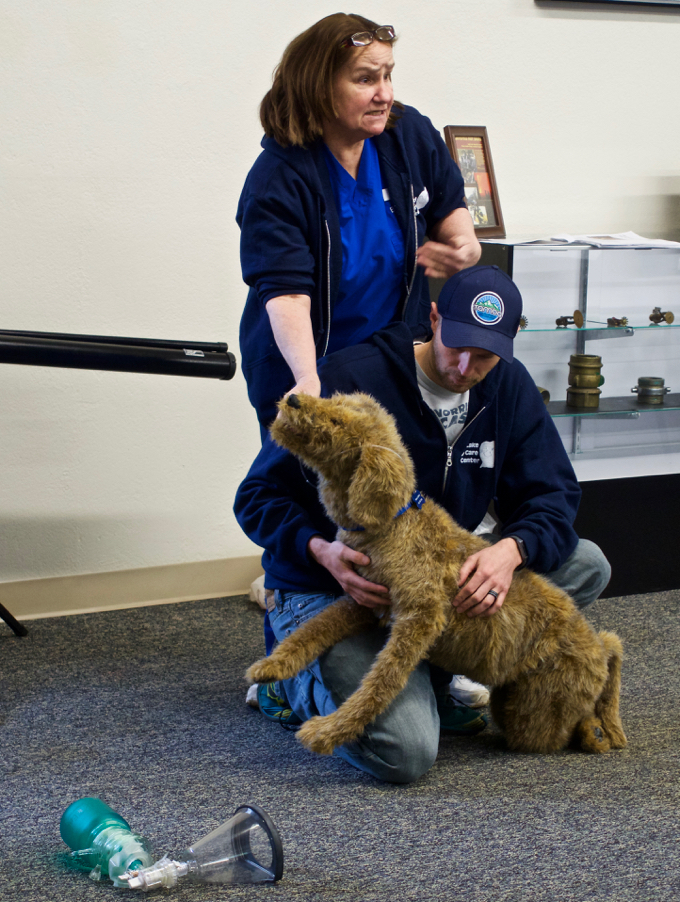
Zoe Hill and Neil Powell with Blue Lake Animal Care Center use a stuffed dog to demonstrate care in an emergency situation. Photo/Kathryn Reed

Having a large dog’s back to the person is key to avoid being lashed out at when the animal comes to. It can be easier to hold a small dog or cat. If a towel or blanket is nearby it’s a good idea to put a cat on it so its claws can be wrapped up for protection.

“You need to make sure the head is extended so they have an air way,” Hill told the firefighters. “I’d do mouth to snout on a big dog.” Sweeping the animal’s mouth for obstructions is a good idea, just like with humans.

When using the air bag a tight seal is mandatory to be effective.

It doesn’t matter which side the animal is on for compressions. It’s near impossible to break a cat’s ribs, and is only a real concern in dogs 13 and older because theirs are more brittle.

“If they are unresponsive, do CPR,” Powell advised. But he said after 10 minutes saving the animal is not likely to happen.

With smoke inhalation, the animal’s airway swells, which is why it is difficult for them to breath.

Hill talked about how IV tubing or a leash can become a muzzle of sorts. She stressed not putting a hand or head under a table to retrieve an animal fleeing a fire or some other emergency because that is likely to result in a human injury. Instead, she suggested making a lasso out of leash or other device and coaxing the animal into it.

Getting the animal to a veterinarian as soon as possible is the best course of action.

Battalion Chief Karl Koeppen recalled how when a dog was hit he got into his vehicle and took it to Powell.

That can’t always happen depending on the emergency.

If an owner is not available to authorize veterinary care, then at least in California it is the county animal control officer who may grant permission. Animal control is supposed to be available 24/7. An animal hospital is not always available after hours on the South Shore, but they all have a recording suggesting where to go.

Statistics provided to the firefighters from Blue Lake Animal Care said that 40,000 pets die in house fires in the United States each year, with another half million affected by the event.



Letter: Rethink restrictions on straws

To the community,

Today I feel compelled to respond negatively to the proposed ban against plastic straws. The people that propose this ban have obviously not thought this through. If ever there was a threat of unintended consequences, this
is one. If plastic straws were banned in South Lake Tahoe, there would be a negative effect on the cheap restaurants that sell soft drinks in a cup. Those soft drinks are sold with a straw so that the kids can drink in the car while mom
or dad drives.

There are other reasons that would make drinking those soft drinks from those restaurants unacceptable. These restaurants would actually lose business. Imagine going through a drive through knowing that you will not be
provided a plastic straw with a plastic lid over that drink. You probably wouldn’t order the drink.

And another thing, I use plastic straws regularly while I drive. The straw keeps the driving safer. With the straw I never take my eyes off the road in front of me when taking a sip through that straw. And in the summertime, I usually do have a soft drink near me while driving. This keeps me well hydrated during half hour drives to Carson City.

I also like the McDonald’s straws. Those are the best. When I have a drink from a McDonald’s I keep that straw and run water through it when I get home. This allows me to use those straws several times. Just try to find a straw like that in a store. I know that you cannot even find stores that sell those straws; they sell cheep little straws.

This idea to ban plastic straws is beyond foolish. If they want to have a positive effect on the environment they should promote the rinsing of straws for reuse. I do it because I don’t like those puny little straws in the stores. Don’t
take away my plastic straws or I will have to move out of town. (Just kidding.)

Daniel Harvey, South Lake Tahoe


Climate change is messing with your dinner

By Agnieszka de Sousa and Hayley Warren, Bloomberg

The world’s dinner tables are seeing the impact of climate change.

As cold regions become warmer, and warm places hotter still, farming and fishing are shifting. An evolving climate means big changes for people who grow, catch and rear for a living, and everyone else who buys and eats what they produce.

There are winners and losers. There are rich-world problems (less cod, more lobster) and poor (drought and pestilence). There are threats to the quality of the world’s basic staples including wheat and corn, as well as such nation-defining luxuries as Bordeaux wine and Java coffee. And whether through dearth or deluge, supply shocks can shake up prices.

As temperatures rise, the best growing conditions for many crops are moving away from the tropics, and from lower lying land to cooler climbs. Fish and other underwater catches, too, are migrating to colder seas as their habitats warm.

Read the whole story


Billions of gallons of water saved by thinning forests

By Cheryl Dybas, National Science Foundation

There are too many trees in Sierra Nevada forests, say scientists affiliated with the National Science Foundation Southern Sierra Critical Zone Observatory.

That may come as a surprise to those who see dense, verdant forests as signs of a healthy environment. After all, green is good, right? Not necessarily. When it comes to the number of trees in California forests, bigger isn’t always better.

That’s in part because trees use lots of water to carry out basic biological tasks. In addition, they act as forest steam stacks, raking up water stored in the ground and expelling it as vapor into the atmosphere, where it’s accessible to humans and forest ecosystems only when it falls back to Earth as rain and snow.

Read the whole story


Nev. pot sales in Feb. outpace projections

By Associated Press

State officials say February was another good month for marijuana sales in Nevada.

A Department of Taxation report issued Monday says taxable sales of adult-use marijuana topped $35.3 million for the month, up 9 percent from January but short of the $35.8 million sold in December.

Read the whole story


Money Matters: Analyzing a company’s stock

By Nic Abelow

What makes a company a good investment? Investment professionals consider several factors when they’re selecting companies to include in a stock portfolio. Here are some of the criteria they’re likely to use.

Nic Abelow

A company’s finances

A strong financial position on the part of the issuing company can make a stock attractive to investors. Analysts typically look at the company’s cash flow to evaluate how much money the company spends, how much it brings in, and how much “free” cash is left after the bills are paid. Reviewing revenues, net income, and earnings per share helps analysts assess the company’s history of sales and earnings growth. Another gauge of financial health is the amount of debt the company has compared to equity.

A look at the business

Stocks of companies that are leaders in their industries generally are desirable choices for a portfolio. Analysts look for profitable companies with limited competition whose products or services are valuable to customers. Keeping an eye on earnings estimates helps analysts determine whether the company is likely to experience rising profits or unexpected slowdowns in the future.

Valuing stock

Analysts use different calculations to assess a stock’s relative value. Some of the most common include:

Price-to-earnings ratio (P/E) shows the relationship between the current stock price and the company’s projected earnings. The P/E is one of the most widely used ratios, and it is used to compare the financial performance of different companies, industries, and markets. The company’s forecast P/E (its P/E for the upcoming year) is generally considered more important than its historical P/E.

Price-to-book ratio (P/B) is a stock’s current price divided by its book value (i.e., total assets minus total liabilities) per share. Both can help identify potentially undervalued stocks and also may be reliable indicators of investor sentiment. Like most ratios, it’s best to compare P/B ratios within industries. For example, tech stocks often trade above book value, while financial stocks often trade below book value.

Return on equity (ROE) is calculated by dividing a company’s earnings per share by its book value per share. The ROE is a measure of how well the company is utilizing its assets to make money. Understanding the trend of ROE is important because it indicates whether the company is improving its financial position or not.

Dividend payout ratio is calculated by dividing the dividends paid by a company by its earnings. The dividend payout ratio can also be calculated as dividends per share divided by earnings per share. A high dividend payout ratio indicates that the company is returning a large percentage of company profits back to the shareholders. A low dividend payout ratio indicates that the company is retaining most of its profits for internal growth.

The personal factor

While metrics are critical to analyzing a company’s stock and whether it may be a good addition to an investor’s portfolio, personal circumstances — e.g., an investor’s other portfolio holdings, goals, time frame, and risk tolerance — should always be considered when determining whether a stock is right for a particular portfolio.

Nic Abelow is a certified financial planner and LPL financial advisor with Abelow, Pratt & Associates Financial Advisors and Wealth Management in Lake Tahoe.


Snippets about Lake Tahoe

·      Olympian David Wise has published the children’s book “Very Bear and the Butterfly.”

·      Unity at the Lake is having an open house April 28 from 2-5pm. It is now located at 870 Emerald Bay Road, upstairs in suites 204-207, South Lake Tahoe. For more information, call 530.544.2266 or email unityatthelake@sbcglobal.net.   

·      Janet Jackson will be at Harveys in Stateline on Aug. 10 at 7:30pm. Tickets range from $69.50 to $149.50.

·      A record high temperature of 71 degrees was set at South Lake Tahoe on April 25. The old record of 68 set in 2001.

·      South Lake Tahoe Fire Department is asking people to take this survey. It will be posted until May 7.