Forensic vets battle pet abuse, neglect

By Colleen Long, AP

The cocker spaniel arrives at the animal hospital with a police officer, whimpering and shaking. He has a pus-filled pink socket for a left eye and is so skinny his spine and ribs show through his caramel-colored fur.

Because animal abuse is suspected, this dog won’t be handled like the other pets coming in for treatment to the American Society for the Prevention of Cruelty to Animals – it will go instead to a specialized team of forensic veterinarians who are trained to treat animals while also developing evidence for possible criminal charges.

“The message to people who are abusing animals is that there is action being taken,” said Dr. Alison Liu, one of the forensic vets on staff. “And if they’re thinking they may not get caught, that’s not always the case.”

The New York-based nonprofit has a team of three forensic vets dedicated to capturing evidence to punish animal abusers. Their jobs include traveling to crime scenes and working with the New York Police Department in a new partnership that has seen cruelty-related arrests doubled in the past two years. They have a necropsy lab, evaluation unit and a rehabilitation center that houses about 60 animals with the goal of adoption.

The team leader, doctor Robert Reisman, developed evaluation standards that are used nationwide in determining cases of abuse and neglect, and testified in some of the first animal cruelty cases to use DNA at trial to obtain felony convictions. The nonprofit agency has also created an animal forensic sciences program at the University of Florida, and has a traveling team of forensic vets that help out around the country – an ASPCA crew rescued some 600 animals from a no-kill shelter in North Carolina in January suspected of abuse and neglect. The nonprofit is funded mostly through donations.

Last year, the forensic team in New York saw 700 animals – mostly cats and dogs, but some chickens and rabbits, too.

“You can’t really separate out what’s happening to animals with what’s happening to people,” Reisman said. “The most obvious reason is the connection between animal abuse and human interpersonal violence. The cases we see on a regular basis are domestic abuse cases where there’s both a human victim and an animal victim.”

One such case was a pit bull named Honey, who was shot in the mouth by a man who was also accused of beating up his girlfriend. He was charged with animal cruelty, menacing and strangulation. The girlfriend and the dog survived.

The team can’t talk about the spaniel because it’s an ongoing case. But each live animal brought in receives the same treatment. They are physically examined and weighed multiple times. A specific set of blood work is completed to rule out possible illness, and then the vets set out to heal the animal.

One dog, a boxer named Brewster, was dropped off last year by a good Samaritan who said he found the starving animal in a park. The dog was shockingly thin with sad, brown eyes.

Police later discovered the Samaritan was actually the owner, who starved him. In part because of the forensic evidence, he ended up pleading guilty to felony animal cruelty charges.

Meanwhile, Brewster was carefully cared for, eventually regaining his health, doubling his weight and getting adopted.

Veterinarian Laura Niestat said that in addition to starvation, the vets often see cases of neglect in which tight collars wear off layers of skin, frostbite destroys ears and tails, and extreme matting of fur chokes limbs like a tourniquet.

Some animals have been shot, others beaten and suffocated.

“We try to focus on how we’re helping the animals,” Niestat said, “and not on how awful it is.”


NorCal towns lack resources to handle oil train fires, spills

By Jane Braxton Little, Sacramento Bee

BNSF Railway trains carrying crude oil and other hazardous materials rumble through this Lassen County community every day – past homes, churches and a scant block from the downtown commercial center.

If a tank car were to derail and explode, Westwood Fire Chief Forest Duerksen would take the only action he’s equipped for: Evacuation. Of all 1,000 residents.

Rural officials like Duerksen have been worried for decades about the chlorine, ammonia, propane and crude oil transported through their Northern California communities by BNSF and Union Pacific Railroad. But a dramatic surge in production in oil fields in the Midwest and Canada increased the volume from about 10,000 railroad tank cars in 2008 to nearly half a million in 2014. In 2015, the U.S. Energy Information Agency reported a 1,700 percent increase in crude oil transportation by rail.

The trains would run through Roseville, downtown Sacramento, West Sacramento, downtown Davis, Dixon and other cities. East of Roseville, the route is uncertain. Trains could arrive via Donner Summit, Feather River Canyon, or through the Shasta and Redding areas.

Read the whole story


Tahoe guide documenting Everest climb

By Adrian Ballinger, Outside

A lot of the stories and images of Everest you’ve seen have been carefully curated by the storytellers to show the rad and beautiful parts of the mountain. This year, photographer Cory Richards and I aim to change that.

This month, the two of us are going to Snapchat various parts of our journey to and up the north side of Everest. (My Tahoe-based guide company, Alpenglow, moved to the north side of the mountain after the 2014 incident in the Khumbu Icefall that killed 16 Sherpas.)

Along the way, we’ll post short videos and photos in real-time to depict an unfiltered look at an unfiltered climb during a crucial season on a changing Everest. We chose Snapchat because “snaps”—unlike posts to Instagram or Facebook—must be posted immediately from a phone’s camera. If we’re successful, you’ll have a complete chronicle of our journey.

Read the whole story


Calif. jurors misusing Internet could face fines

By Sudhin Thanawala, AP

Jurors who threaten to derail trials by researching them on Google or posting comments about them on Twitter are often dismissed with nothing more than a tongue-lashing from a judge.

But that may soon change in California. Legislation supported by state court officials would authorize judges in some counties to fine jurors up to $1,500 for social media and Internet use violations, which have led to mistrials and overturned convictions around the country.

As jurors and judges have become more technology savvy in recent years, the perils of jurors playing around with their smartphones have become a mounting concern, particularly in technology-rich California. A 2011 state law made improper electronic or wireless communication or research by a juror punishable by contempt.

Supporters of the latest California measure say a potential fine would give teeth to existing prohibitions against social media and Internet use and simplify the process for holding wayward jurors accountable.

“It’s disruptive of the judicial process, and there ought to be a fairly simple and convenient way for a judge to sanction a juror based on the order that the judge has given,” said Assemblyman Rich Gordon, D-Menlo Park, who authored the legislation.

But critics question whether it will have any practical effect on jurors who are constantly on sites such as Facebook and Twitter and suggest judges vet the social media activity of potential jurors before seating them.

“If you have an Internet addict who just can’t psychologically stop, you may want to excuse that person,” said Paula Hannaford-Agor, who studies juries at the National Center for State Courts.

Brian Walsh, a judge in the Silicon Valley county of Santa Clara, said a fine could also change the dynamic between judges and juries.

“You want to present the jurors’ obligations to serve as an inviting opportunity to participate in the democratic process,” he said. “One could consider it counterproductive to be laying out all the penalties a juror can incur if they blow it.”

It is not clear exactly how many times juror social media or Internet use has affected trials. But anecdotal evidence suggests it is more than sporadic.

Eric Robinson, co-director of the Press Law and Democracy Project at Louisiana State University, said he used to track cases of juror social media or Internet misconduct using news accounts and other sources, but there were so many “it got to be more trouble than it was worth.”

“Those are the ones we hear about,” he said. “I’m sure it happens a lot more.”

An Arkansas court in 2011 threw out a death row inmate’s murder conviction in part because of Tweets. One said “Choices to be made. Hearts to be broken.” Another said “It’s over” less than hour before the jury announced its verdict.

A New Jersey appeals court in 2014 tossed the heroin possession conviction of two men after a juror was accused of searching the defendants’ names online and finding information about their criminal records.

A California appeals court in January cited juror Internet research in throwing out a fraud conviction against an investment firm CEO. The juror looked up a case involving an accountant the defendant blamed for the fraud.

Judges warn jurors against using social media and the Internet, and have the power to hold them in contempt if they violate those rules.

Greg Hurley, a lawyer who studies juries at the National Center for State Courts, said he is unaware of any state that fines jurors outside the contempt process.

California judges say the contempt process can be time consuming and is rarely invoked. A juror facing contempt has a right to an attorney, and the court could get bogged down in a lengthy formal hearing. So judges often opt to replace a wayward juror with an alternate to keep the proceedings moving.

“Historically, contempt has been something judges are told, ‘Don’t do,'” said J. Richard Couzens, a retired judge from California’s Placer County who now rotates through courts around the state. “You have to follow so many rules to institute a contempt process.”

Couzens, a member of the judicial committee that recommended the fines legislation, said he dismissed a juror years ago in a theft case for using a cellphone to figure out the value of a stolen item.

The fine would be similar to a traffic citation, making it relatively easy to dispense, Couzens said.

Judges could mention it when warning jurors against Internet and social media use, said Steve Austin, presiding judge in California’s Contra Costa County.

“At the very least with the sanction, it would be a good thing you’d be able to tell the jurors,” he added.

The legislation initially called for giving all state judges the power to fine wayward jurors. But it was scaled back after legislators expressed concern that it could dissuade potential jurors from serving.

The bill now authorizes the judiciary to select some county courts for a five-year pilot program, which a legislative analysis said could save participating courts money. It is before the full assembly.


Road beat: Toyota Camry SE — A proper mid-size

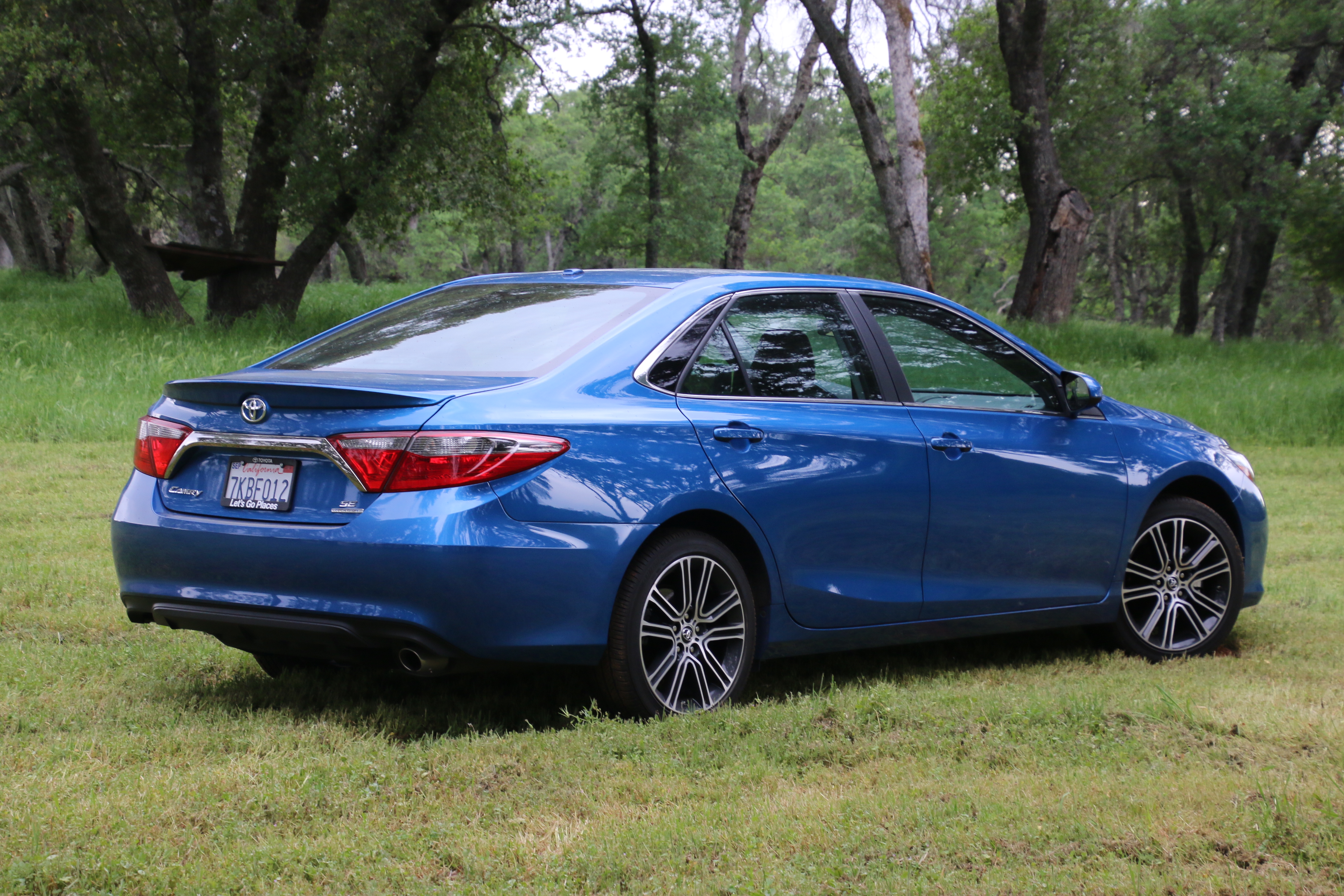
The Camry SE Special Edition is stellar in almost all categories. Photos/Larry Weitzman

The Camry SE Special Edition is stellar in almost all categories. Photos/Larry Weitzman

By Larry Weitzman

If Webster’s had a definition for a mid-size car, it would likely have a picture of a Camry SE Special Edition. Now in its seventh generation Camry has been the bestselling car in the United States from 1997 to 2015 except for year model 2001. For every year but two, sales exceeded 400,000 units. Quite a record.

As Bob Lutz said at an automotive press event about 10 years ago, Toyota has become the “default” brand in the United States, meaning when you need a new car, people simply default to brand “T” without thinking about any other brand. It’s a reputation built on reliability and quality.

While many automotive scribes write that the mid-size sedan market is loaded now with quality choices that are claimed to handle and perform better than some others, this Camry SE “Special Edition” tested here can hold its own with the best of them and in some categories it is the best of them.
Specifications Price (base including transportation) SE $27,075 to over $35 large for a loaded V-6 Engines 2.5L, DOHC 16 valve inline four 178 hp @ 6,000 rpm  170 lbs.-ft. of torque @ 4,100 rpm  Transmissions Six speed automatic  Configuration Transverse front engine/front wheel drive Dimensions Wheelbase 109.3 inches Length 190.9 inches Width 71.7 inches Height 57.9 inches Track (f/r) 62.4/62.0 inches Ground clearance 6.1 inches Weight 3,305 pounds Tow capacity 1,000 pounds Passenger volume 102.7 cubic feet Trunk capacity 15.4 cubic feet  Fuel capacity 17.0  Steering lock to lock 2.85 turns Turning circle 36.7 feet Wheel sizes 7.5X18 inches alloy Tires 225/45X18 Co efficient of drag 0.28  Performance  0-60 mph 7.47 seconds 50-70 mph 3.99 seconds 50-70 mph uphill 6.19 seconds Top speed Do you think that any of the prior nine or so million Camry buyers in the United States really care?  But without intervention electronic or otherwise even the four cylinder should top out at close to 130 mph (but not with me in the car). Fuel economy EPA rated at 25/35/28 mpg city/highway/combined. Expect to achieve 28-29 mpg in overall driving and 38 mpg plus on the highway at legal speeds.

Specifications
Price (base including transportation) SE $27,075 to over $35 large for a loaded V-6
Engines
2.5L, DOHC 16 valve inline four 178 hp @ 6,000 rpm
170 lbs.-ft. of torque @ 4,100 rpm
Transmissions
Six speed automatic
Configuration
Transverse front engine/front wheel drive
Dimensions
Wheelbase 109.3 inches
Length 190.9 inches
Width 71.7 inches
Height 57.9 inches
Track (f/r) 62.4/62.0 inches
Ground clearance 6.1 inches
Weight 3,305 pounds
Tow capacity 1,000 pounds
Passenger volume 102.7 cubic feet
Trunk capacity 15.4 cubic feet
Fuel capacity 17.0
Steering lock to lock 2.85 turns
Turning circle 36.7 feet
Wheel sizes 7.5X18 inches alloy
Tires 225/45X18
Co efficient of drag 0.28
Performance
0-60 mph 7.47 seconds
50-70 mph 3.99 seconds
50-70 mph uphill 6.19 seconds
Top speed Do you think that any of the prior nine or so million Camry buyers in the United States really care? But without intervention electronic or otherwise even the four cylinder should top out at close to 130 mph (but not with me in the car).
Fuel economy EPA rated at 25/35/28 mpg city/highway/combined. Expect to achieve 28-29 mpg in overall driving and 38 mpg plus on the highway at legal speeds.

When the 2006 Camry was introduced, it created the theme for this new generation, with the exact same side window line with this new model adding a piece of applique to the down line of the rear window to make a different look. But the overall shape was a 100 percent improvement with respect to the generation the ceased production in 2005. Size-wise since 2006 and through three generations, the dimensions are essentially the same. Wheelbase remains 109.3 inches, length is 190.9 inches and width is 71.7 inches. As designs go, this is not a spectacular car, but a very attractive design with nothing offensive to spoil its pleasing proportions, except for its upside-down frown front end. The designer at the time must have been going through a divorce or worse.

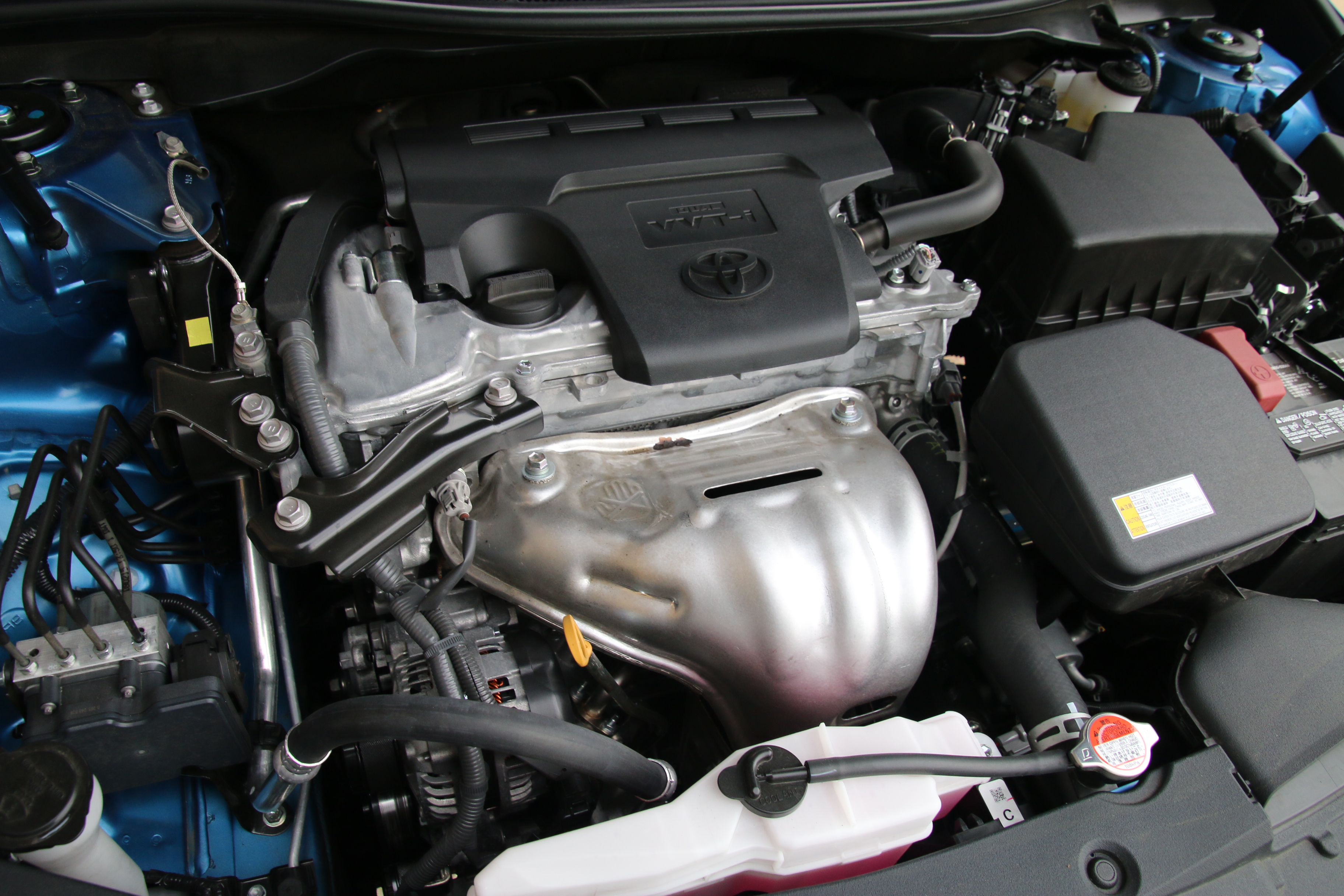
Under the hood is a Toyota 2.5L inline four cylinder DOHC, 16-valve engine that cranks out a very respectable 178 hp at 6,000 rpm and 170 pounds of twist at 4,100 rpms, about average for the class. One thing that would even improve performance and fuel economy more is direct injection with the Camry doesn’t have. With direct injection the Camry would make 10-15 more hp without any fuel penalty. But it is still anechoic chamber room quiet and extremely smooth running. It transmits power to the front wheels via a six-speed cog-swapper and the gears shift quickly and smoothly. Gearing is tall keeping rpms low. At 70 mph the tach shows just 1,950 rpm. Even though this “Special Edition” is there sporty model it is dead quiet, no road engine or wind noise.

Performance for the Camry is very good with 0-60 mph taking just 7.47 seconds, that’s mid-pack or better for this extremely competitive class with the standard engine. Even the class leader the Mazda 6 is only a tenth of a second quicker. Passing performance is also very good with a 50-70 mph elapsed time of just 3.99 seconds and the same exercise up a six percent grade was scored at 6.19 seconds. It is truly amazing how well cars perform today, being able to smoke big V-8 muscle car from the late 1950s.

But here is the difference, the muscle car would be ready for the shredder by 100,000 miles and would average about 12 mpg over its life. The Toyota Camry with reasonable maintenance will go for 300,000 miles or more and average near 30 mpg over its life. And the Camry has a sticker price $27K including destination and with standard equipment that was unknown to the industry even 30 years ago, GPS, full power, Bluetooth and probably some stuff I haven’t discovered yet. Cars today are a phenomenal bargain.

As to fuel economy, the EPA rates the Toyota at 25/35/28 mpg city/highway/combined. It does at least 10 percent better with an overall fuel economy of 28-29 mpg, some city, but mostly rural hills. On the highway at 70 mpg the Camry averaged on a two way run 38.5 mpg. Fuel economy is again mid-pack maybe a bit better.
Handling is not a problem with this Camry

Handling is not a problem with this Camry

But here’s where it gets interesting, the Special Edition Camry with the “tighten up” suspension really acquits itself in the twisties, it is not just competent, it is aggressive. After just a few miles your confidence builds as it goes where you point it, holding its line perfectly with benign response from the quick electric rack steering that goes lock to lock in just 2.85 turns. Cornering power is very good especially with a front and rear track of 62 inches.

Suspension is the usual MacPherson struts up front and a dual link independent set up in the rear with stab bars at both ends, which really limit body roll. But that’s not all, it comes with stock 18X7.5-inch great looking machine finished alloys shod with serious rubber (225/45X18). Hey, Kyle “Rowdy“ Busch won two races in Camrys last weekend and he is on a roll to win it all in NASCAR this year. Yeah, sure Busch’s Camrys just look like a Camry and it is a completely different car. The drive train and chassis are different as is the suspension, but Toyota must be learning from it as this Camry changes direction beautifully.

The other half of the equation is ride quality and this is where the Camry shines. It is extremely quiet like a hybrid and smooth like a Lexus. Camry retains its composure on the most difficult roads. There is no wind and road noise so highway trips, especially with all its room, quiet and fuel economy would be fabulous. And it is super long legged as the fuel tank holds 17 gallons or almost 600 miles with a two-gallon reserve.

Braking performance with the full alphabet soup of acronyms was excellent stopping the Camry in 41 feet at 40 mph. It has a standard back up camera plus a plethora of electronic interventions and enough airbags to refloat the Titanic.
Plenty of power with this engine.

Plenty of power with this engine.

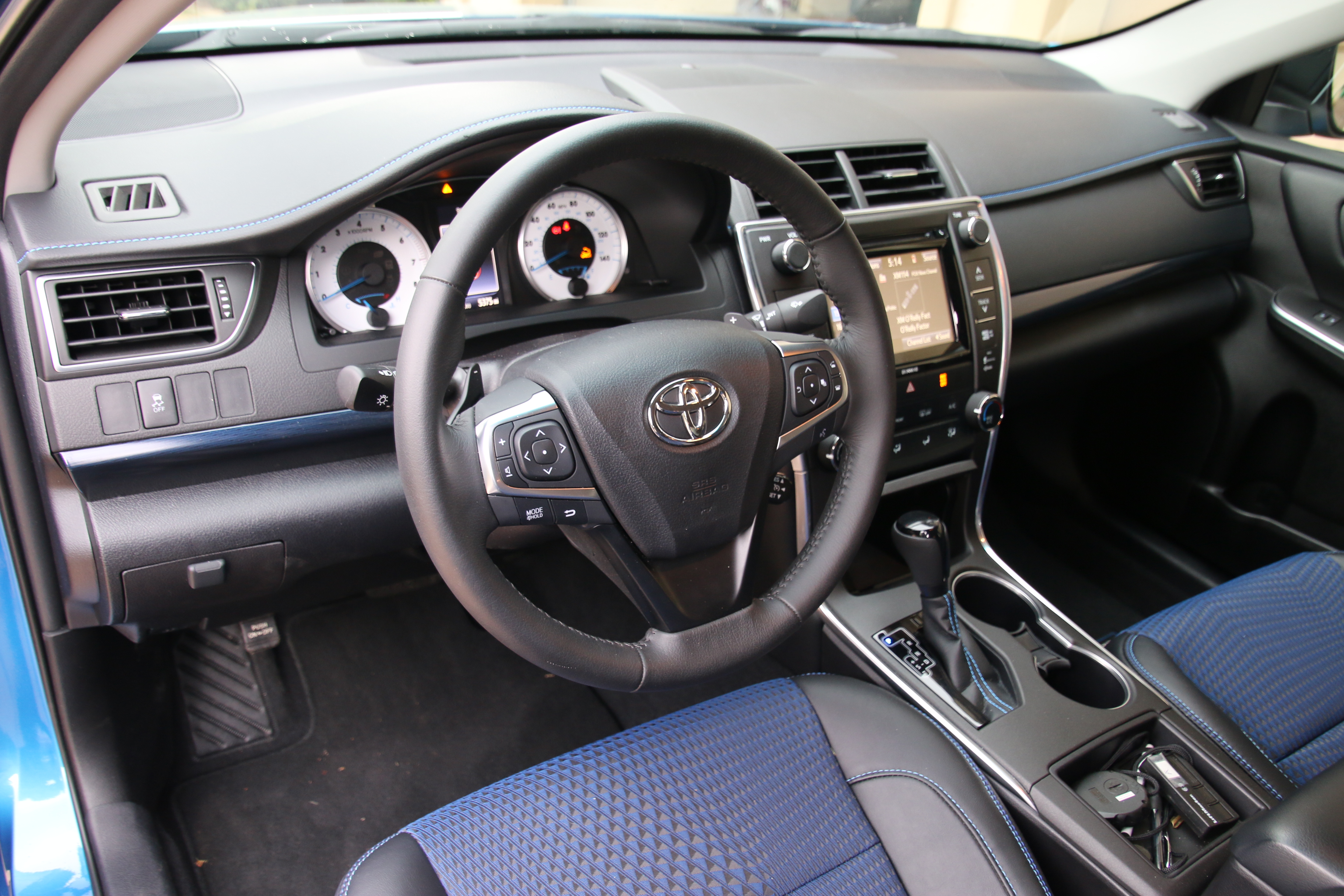
Interior quality is good with comfortable and supportive seats done in a rich cloth. There are some hard plastic trim pieces, but they look quality. Instrumentation is complete with big sporty black/blue tach and speedo on white, which flank left and right of the trip computer, information center.

Rear seating with copious legroom can easily and comfortably handle three adults and the trunk is over 15 cubic feet.

The bottom line including the train ticket from its Georgetown, Ky., assembly plant is $27,075. I just read in an automotive publication the U.S. vehicle content is more than many American cars. And the standard equipment list is long and deep and nothing is left wanting. GPS, check, trick sound system with XM, check, 8-way power driver’s seat, check, back up camera, check. Even the Special Edition embroidered, carpeted floor mats, check. It had everything I would want. The only option was an upgraded radio system at just $525. This Camry is a hard to beat, it’s great value and it’s a (NASCAR winning) Toyota (sort of).

Larry Weitzman has been into cars since he was 5 years old. At 8 he could recite from memory the hp of every car made in the U.S. He has put in thousands of laps on racetracks all over the Western United States.

Comments sought on Squaw-Alpine gondola

Tahoe National Forest is about to begin the environmental review process for the proposed Squaw Valley to Alpine Meadows gondola.

In September, the Forest Service received the application from Squaw Valley Ski Holdings to install, operate, and maintain an aerial ropeway system connecting Squaw Valley and Alpine Meadows ski areas. This proposal also included an alteration to current avalanche mitigation techniques including the installation of Gazex exploders.

If the gondola were approved, it would require an amendment to an existing special use permit for Alpine Meadows Ski Area. The proposal is consistent with the resort’s master development plan. The Forest Service said it passed the screening criteria for consideration to use National Forest System lands and amend the existing permit consistent with Forest Service land use regulations.

A full description of the project, including maps, is available online.

The purpose of the scoping period is for interested parties to provide early and meaningful participation on this project and to learn more about the project. Respondents should include: (1) name, address, telephone number, and organization represented, if any; (2) reference the “Squaw Valley to Alpine Meadows Base-to-Base Gondola Project” and (3) specific facts, concerns or issues, and supporting reasons why they should be considered.

Written comments must be submitted via mail to scoping_comment@squawalpinegondola-eis.com.

Two public meetings will be held on May 9 to gather comments on the scope of the project. Both meetings will be at the Resort at Squaw Creek, Monument Peak Room, 400 Squaw Creek Road, Olympic Valley. The first meeting will be from 2-4pm and the second from 6-8pm. These meetings will be held jointly with Placer County regarding their analysis of the project under the California Environmental Quality Act. Representatives from the Tahoe National Forest, Squaw Valley Ski Holdings, LLC, and Placer County will be present to answer questions and provide additional information on this project.


Ballot measure would end NV Energy monopoly

By Michelle Rindels, AP

A proposed ballot measure called the Energy Choice Initiative aims to deregulate electrical service in Nevada, opening up the market to providers other than NV Energy — the sole provider in most parts of the state. Here’s how it came about and what it could mean for consumers.

Nevada laws allow investor-owned utility companies to be monopolies in their service territories. The governor-appointed members of the Nevada Public Utilities Commission act as a substitute for the competitive forces of the market, approving or rejecting rate changes so companies like NV Energy can make a reasonable profit but aren’t gouging customers.

The regulated monopoly model has emerged over the past century as the state sought to make it worth companies’ while to bring expensive electrical infrastructure to Nevada, but critics say the model is outdated as it becomes cheaper to generate energy and as renewable energy sources become more mainstream.

The initiative petition would enshrine in the Nevada Constitution the right for customers to choose their energy provider and to produce their own power to sell to others. It directs the Nevada Legislature to pass laws authorizing an open, competitive electricity market by mid-2023.

The proposed constitutional amendment notes that lawmakers don’t need to deregulate electricity transmission or distribution. That means businesses and homes might buy electricity from different providers, but a single company could control all of the power lines in a given service territory.

Several major Nevada companies have tried to leave NV Energy’s network in recent years and make or find their own power. They include Wynn Resorts, MGM Resorts and Las Vegas Sands, which consume massive amounts of electricity at their 24/7 casinos and might be able buy cheaper power on wholesale markets.

The Public Utilities Commission allows the companies to leave the grid but is charging them one-time “exit fees” of $86.9 million for MGM, $15.7 million for Wynn and $23.9 million for Sands, with the potential of additional fees in the future.

Regulators say big companies’ departures could leave the broader customer base stuck with the bill for infrastructure that takes decades to pay off, and was built assuming big companies — which account for 7 percent of the utility’s customer base — would keep paying into the system.

The companies have challenged the fees but so far haven’t prevailed.

A PAC called Nevadans for Affordable, Clean Energy Choices filed the initiative petition in February, but the group has not identified its backers and isn’t required to disclose its donors until May 24. Among the companies who have recently pushed to leave the monopoly, MGM Resorts officials say they are not associated with the initiative, while Wynn Resorts officials say the company hasn’t taken a position on the measure or contributed to the PAC.

Representatives for the Las Vegas Sands declined to comment when asked whether they supported the ballot measure or donated to the affiliated PAC.

Electric carmaker Tesla and data storage company Switch have publicly supported the measure, saying it fits in line with their company values and would create opportunities in renewable energy.

NV Energy is not fighting the measure. CEO Paul Caudill says the company wants what’s best for Nevada and is willing to “work in a constructive fashion” on the issue of deregulation.

Lawmakers laid the groundwork to deregulate Nevada’s electrical utilities in the late 1990s and early 2000s.

But as Nevada worked toward that goal, instability emerged in neighboring California’s newly deregulated electrical markets. Electrical bills spiked and power shortages led to rolling blackouts during the energy crisis in 2000 and 2001.

Amid fears deregulation was too risky, then-Gov. Kenny Guinn halted the project in Nevada.

Petition supporters need to gather about 55,000 valid signatures from Nevada voters to qualify the measure for the November ballot. The deadline to submit the signatures to the counties for verification is June 21.

If the measure meets the signature threshold, it must prevail on the 2016 and 2018 ballots before it becomes part of the state constitution.

PAC lawyer Matt Griffin says the petition has been well-received, but couldn’t say how many signatures it’s gathered yet.

The measure comes at a time when Nevada consumers are especially tuned in to energy issues. Regulators approved higher rates last year for customers with rooftop solar panels, and solar companies that laid off workers because of the change are supporting a separate, widely publicized ballot measure to reverse the rate change.

Deregulation has taken different forms in the numerous states that have pursued it, and experts say it can be a good or a bad thing for consumers depending on how it’s executed. Opening up an electricity market can drive competition and lower prices, or it can come with new problems, such as exposing customers more directly to rate hikes and enabling the rise and ultimate collapse of companies, like that of energy giant Enron.

The proposed constitutional amendment is vague and gives the Legislature wide latitude on how it develops a deregulated structure.

Rebecca Wagner, an energy consultant and former member of the Public Utilities Commission, says she would like proponents to offer more specifics about how they’d go about deregulation before she could say whether it’s the right way to go.


Wet weather in forecast for most of the week

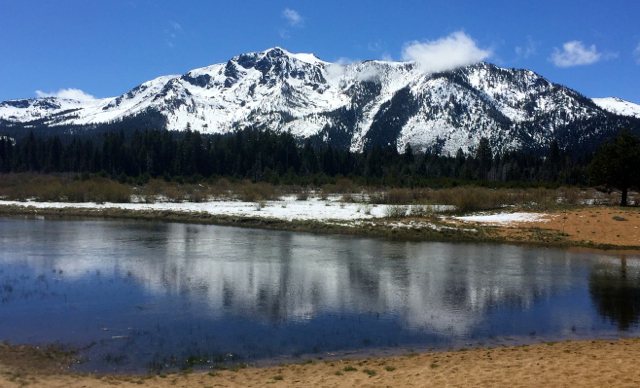
A fresh coat of snow on Mount Tallac after Friday's storm. Photo/LTN

A fresh coat of snow on Mount Tallac after Friday’s storm. Photo/LTN

By Marcella Corona, Reno Gazette-Journal

It’s going to be a cold and wet spring this week with some snowfall expected on Monday in Reno, a forecaster said.

Friday’s storm, which dropped several inches of snow on the Sierra, was only the beginning. Three storms could hit the Reno-Tahoe area through next weekend, meteorologist Scott McGuire, of the National Weather Service, said on Saturday.

“It was a pretty powerful late spring storm that moved through the region yesterday,” McGuire said. “It dropped quite a bit of snow in the sierra and decent rain in other areas.”

Read the whole story


Carol Elder — 1936-2016

Carol Elder

Carol Elder

Longtime South Lake Tahoe resident Carol Roberta Elder died April 17, 2016. She was 80.

Carol was born March 17, 1936, in Reno. She was raised in Marin County. She lived in South Lake Tahoe for the last 56 years.

Carol touched lives in very precious ways. Her passion for life and infectious laugh immediately made a friend of everyone she met. This contributed to Carol having a very successful real estate career in South Lake Tahoe.

Carol was an ardent protector of animals, always fighting for the rights of every one of God’s creatures. Her love for animals was exceeded only by her love for her family. Carol had a strong will for adventure. From being a ski mom attending gates on the side of a mountain, to traveling to Europe with her family and walking for hours to soak in every site, or participating in the countless activities of her children, Carol was always up for more. She had boundless energy. She cherished her garden, her sanctuary where she found true peace and love with God.

She is survived by her loving husband of 52 years, Richard Elder; her children and their families, Michelle Elder and Kyle Settles, Richard and Kim Elder and children Whitney and Jason, Stacey and Dennis Barsema and their children Matthew and wife Gina, Eric, and Jason and wife Ashley; brother Michael Nagy; brother-in-law Steve and wife Willy Elder; and many nieces, nephews and great-grandchildren. She was preceded in death by her parents Rose Helene Bonnenfant and Robert Edmund Nagy, and her son Steven Michael Zaner Elder.

A memorial Mass will be said at 12:30pm April 30 at St. Theresa Catholic Church, 1041 Lyons Ave., South Lake Tahoe. There will be a reception immediately following in the parish hall. A prayer service will be at 5:30pm April 29 at St. Theresa Catholic Church.

In lieu of flowers, please make a donation in Carol’s name to Lake Tahoe Wildlife Care or St. Theresa Catholic Church.


Caltrans ready to work in Placer, Nevada counties

Caltrans has a slew of projects planned for this construction season in Placer and Nevada counties.

Projects range from highway maintenance to multi-million dollar improvements. They include:

  • Interstate 80 (CHP Inspection Station) – A $585,000 project to rehabilitate the Donner CHP Truck Inspection Facility in Truckee just north of Interstate 80, including new roofing and siding, as well as repair a water system. Completion is expected in 2017.
  • Highway 89 (Wildlife Crossing) – A $2.2 million project to construct a paired (two tunnels) wildlife crossing under Highway 89 eight miles north of Truckee as well as erect wildlife barrier fencing to reduce the incidence of wildlife/vehicle collisions on this section of highway through the Tahoe National Forest. Highway 89 Stewardship Team members will also conduct a three-year evaluation of project outcomes.  Completion is expected in December 2016.
  • Highway 89 (Pedestrian Tunnel) – A $14 million project constructing a pedestrian tunnel next to the vehicle tunnel (nicknamed the “Mousehole”) on Highway 89 just east of Truckee will continue work to complete the tunnel, build sidewalks and install landscaping to afford pedestrians safe access along Highway 89 under the Union Pacific railroad.  Completion is expected in 2016.


Other work that will intermittently impact highway traffic this season includes replacement of guardrail and damaged fences, culvert rehabilitation and ongoing maintenance activities.

Up-to-date traffic information is available online.