Food drive focuses on youth in need

Bread & Broth 4 Kids’ second Cram-A-Cruiser event at the Grocery Outlet will be April 30 from 9am-2pm.

A South Lake Tahoe police car will be in the parking lot in front of the store. The goal is to fill it up with as much food as possible, which will then be distributed to kids in need.

The nonprofit fills up bags of food every Friday for 120 South Lake Tahoe children who are in need of extra food over the weekend. Each week, the students receiving the supplemental food get two breakfasts, two lunches, three dinners and four snacks. They get more if it is a three-day weekend or week-long holiday.

Ideal donations include single serving sizes of the following types of non-perishable food:

Macaroni and cheese
Cup-of-noodles
Soup
Top Ramen
Canned vegetables
Fruit cups
Instant oatmeal
Spaghettios, raviolis, chili
Canned tuna
Granola bars
Bags of nuts
Peanut butter
Cheese or peanut butter filled crackers
Fruit snacks.

Cash donations will also be accepted.


Free tennis lessons available for kids at ZCTC

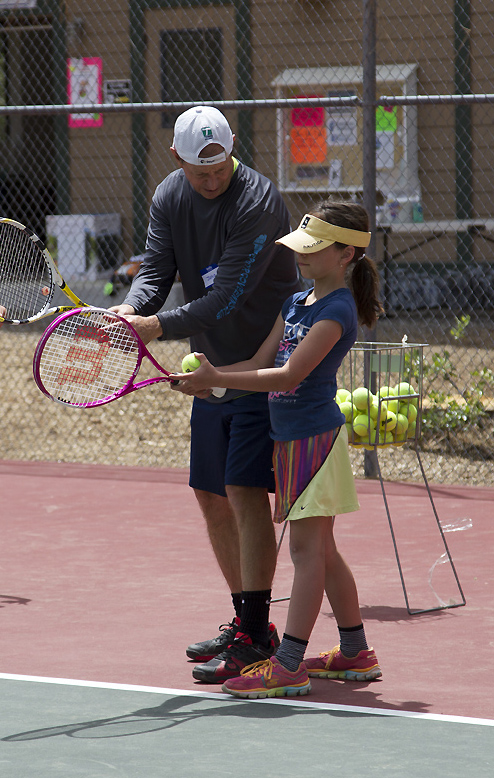
John Wlcek teaches Luna Remmel how to serve. Photo/Provided

John Wlcek teaches Luna Remmel how to serve. Photo/Provided

Youngsters in grades K-8 will have the opportunity to learn the fundamentals of tennis for free in May from a professional at Zephyr Cove Tennis Club.

Deanne Larsell, USPTA certified instructor, will lead the after school sessions with the assistance of players from the club. For those who have played before, more advanced instruction will be provided.

Each lesson is open to students throughout the Lake Tahoe Basin as well as the Carson Valley.

Dates are:

·      May 23, 3:20-4:05pm – grades K-2

·      May 24, 3:20-4:20pm – grades 3-5

·      May 25, 3:20-4:20pm – grades 6-8.

The three-day event is sponsored by ZCTC in conjunction with Douglas County Parks and Recreation Department.

Space is limited and preregistration is required by calling Kahle Community Center at 775.586.7271 or Douglas County Community Services at 775.782.9828.

A limited number of rackets will be available. Come dressed to play – which means athletic wear and non-marking shoes. Be sure to bring water and wear sunscreen. Arrive 15 minutes before the start time.

Zephyr Cove Tennis Club is on Warrior Way off Highway 50 in Zephyr Cove.


Snippets about Lake Tahoe

·       Opening day for High Sierra ASA Softball League in South Lake Tahoe is April 30. The ceremonies begin at 10:30am at South Tahoe High School. High Sierra ASA uses STHS and Tahoe Valley Elementary fields for games.

·       South Lake Tahoe Family Resource Center’s Cinco de Mayo celebration-fundraiser is May 6, 5-10pm at the Heavenly California Lodge.

·       Lake Tahoe Golf Course has opened for the season, while Tahoe Paradise will open April 29, and Edgewood Tahoe on May 9.

·       Mount Rose Ski Area is closing May 8, Mammoth on Memorial Day weekend, and Squaw and Alpine  in May, with no exact date.


Quake report spurs retrofitting Nev. buildings

By Scott Sonner, AP

RENO — A new report raising the likelihood of a destructive earthquake striking Salt Lake City in the next half-century has underscored the urgency to retrofit more than 30,000 older brick homes and other unreinforced buildings at high risk of collapsing.

It’s also getting attention in neighboring Nevada, where a significant quake is overdue along the Sierra. Nevada officials are anxious to see if Utah succeeds in a first-in-the-nation attempt to secure federal disaster funds for private homeowners to aid in such efforts.

The Working Group on Utah Earthquake Probabilities, in conjunction with the U.S. Geological Survey, released a report last week projecting a 43 percent probability that a magnitude-6.75 or higher earthquake will strike in Salt Lake along the Wasatch front within the next 50 years. That’s twice more likely than previously believed.

Experts estimate a mangnitude-7 quake would kill at least 2,000 people, seriously injure 7,400 to 9,300 and cause $33 billion in damage.

“The numbers are staggering,” said Cory Lyman, Salt Lake City’s emergency management director.

“It’s almost incomprehensible,” he said last week at the Seismology Society of America’s annual meeting in Reno.

The Federal Emergency Management Agency estimates that 90 percent of deaths in a large Wasatch earthquake would be directly related to the collapse of bricks, cinder blocks and other unreinforced masonry.

Such structures are vulnerable because they have no steel reinforcing bars.

“Concrete doesn’t bend so when it starts shaking like that, it starts to crumble,” Lyman told The Associated Press on Friday.

“Salt Lake City alone has more than 30,000 residential URMs (unreinforced masonry) that are not likely to withstand the impact of any significant tremor,” he said. “It gets to be a little frightening. To mitigate these horrific numbers, we have to have a strategy.”

Craig dePolo, a research geologist at the Nevada Bureau of Mines and Geology, said most deaths and serious injuries occur when people are struck by falling material while fleeing buildings.

“We tell you not to, but if your life is threatened, it’s a common response,” he said.

Chimneys are particularly vulnerable, as are parapets and cornices, the short walls and decorative ledges that run around some building tops.

Most older roofs are not attached to walls, rather the joists sit in grooves under the weight of the roof. Decades ago, most buildings were built that way so if the roof caught fire, it would burn and drop to the ground, leaving the walls intact, dePolo said.

No one was killed, but nearly all the unreinforced buildings were destroyed in rural Wells in 2008 when a 6.0-magnitude quake struck about 60 miles from the Utah line, he said. He estimates there are 1,400 unreinforced buildings in Reno, Sparks and Carson City above a series of Sierra-front faults where earthquakes of 6.5 hit on average every 30 years but haven’t struck in more than 60 years.

“Thirty to 40 percent of those will partially or totally collapse during strong shaking,” dePolo said.

Current retrofitting plans focus on historic buildings at the University of Nevada, including a $2.7 million project at a century-old dormitory. Cheaper alternatives include posting signs on vulnerable structures that say, “Dangerous Building. If Earthquake, Get Back.”

Utah launched a “Fix the Bricks” program in 2012, encouraging residents to retrofit homes when they put on a new roof or remodel. That brings the price down significantly, in the range of $10,000 for a typical single-family bungalow, Lyman said.

He said they got the idea to apply for a pre-disaster mitigation grant after learning FEMA was footing part of the bill for Oklahomans to build tornado shelters.

“Hopefully by next year we will have a template that others can use,” Lyman said about the proposal that would reimburse homeowners for up to 75 percent of retrofitting costs.

Nevada is counting on that, said Graham Kent, director of the Nevada Seismology Laboratory. “When we first saw their program, we asked if they can make sure to develop it so we can go back and plug in the words ‘Reno’ and ‘Sparks’,” he said.


Sierra trees getting cut to prepare for summer

By Marc Benjamin, Fresno Bee

Once bathed in deep green, the forests in the foothills and Sierra east of the San Joaquin Valley are increasingly turning reddish-brown as drought- and beetle-weary trees die by the month.

It is a somber warning of a potentially dangerous summer.


A study next month examining trees from the air is expected to report a near doubling of the 29 million trees already reportedly dead or dying. In 2014, it was already a crisis when 3.3 million trees had fallen prey to the infestation, said Daniel Berlant, communications director for CalFire.

“From the top of Kern (County) to Tuolumne County is the hardest hit,” Berlant said. “But we are seeing tree mortality moving farther north into the Placer County area at the top of Lake Tahoe.”

Read the whole story


Letter: Live Violence Free thankful for donation

To the community,

Live Violence Free would like to thank Heavenly ski patrol for its incredible generosity and continued contribution to our programs and services. On April 15, Heavenly ski patrol surprised our agency with a donation of $2,500.

We are so grateful to Heavenly ski patrol for its positive impact in our community and for all they do to support our vital programs here at Live Violence Free.

Jenna Poell, Live Violence Free


Explosion at suspected South Tahoe drug lab

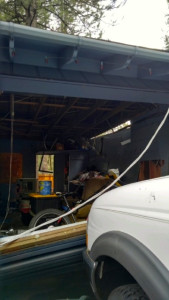
The garage where a suspect drug lab was operating in South Lake Tahoe blew up April 24. Photo/Provided

The garage where a suspected drug lab was operating in South Lake Tahoe blew up April 24. Photo/Provided

A suspected drug lab exploded Sunday night in South Lake Tahoe.

When firefighters got to the house on the corner of Plum Street and Bruce Drive just after 5:30pm April 24 there was no fire.

They put on their gear to make sure nothing was smoldering and no one was inside. Firefighters assisted Animal Control in getting out the two dogs.

Fire officials are calling it a possible honey oil lab. Butane is used to extract THC from marijuana to get the more concentrated honey oil.

The police are in charge of the investigation and they have not responded to inquiries.

— Lake Tahoe News staff report


Tahoe Tails — Adoptable Pets in South Lake Tahoe

Romeo

Romeo

Romeo is a cute designer dog — Basset and Beagle — he’s a Bagel!

He is about 3 years old and a bit confused to find himself in the shelter. He needs a well fenced yard or to be on a runner when outside. Like most hounds he follows his nose wherever it takes him. Romeo would do best in a home without small children.

Romeo is neutered, microchipped, tested for heart worm, and vaccinated. He is at the El Dorado County Animal Services shelter in Meyers, along with many other dogs and cats who are waiting for their new homes. Go to the Tahoe animal shelter’s Facebook page to see photos and descriptions of all pets at the shelter.

Call 530.573.7925 for directions, hours, and other information on adopting a pet.

For spay-neuter assistance for South Tahoe residents, go online.

— Karen Kuentz


Grandeur of Denali doesn’t disappoint

Publisher’s note: This is one in a series of stories about the National Park Service, which is celebrating its 100th anniversary in 2016.

The road to Denali. Photo/Jacob W. Frank/NPS

The road to Denali leads to a world of outdoor wonder. Photo/Jacob W. Frank/NPS

By Kim Wyatt

DENALI NATIONAL PARK & PRESERVE – After almost four hours on the bus, the driver pulled to the side of the road and opened the door.

“Little Stony Creek.”

We heaved our backpacks over our shoulders and stepped off. The bus receded in the distance. We stood in a massive valley, surrounded by broad-shouldered peaks, rolling tundra and absolute silence.

All my problems rolled away with the bus. Across the valley floor, I saw two boulders tumbling down a green slope. I pulled out my binoculars: They weren’t boulders; they were baby grizzly bears, playing. In one swift motion mama bear stood, growing twice in size, nose in air.

“S hit,” I said. “We’ve got to go.”

My hiking companion and I headed up a creek bed and were soon in a small canyon, out of any range I hoped the adult grizzly would find threatening. The hike itself was typical of my experience in Alaska: periods of tundra and rocky streambeds punctuated by river crossings and something I rarely encountered in Tahoe, fear. Of animals, wet feet, the elements. Even in mid-summer, the weather was ever-changing—it looked as if the turbulent sky might rupture any minute. And around seemingly every corner were enormous piles of what looked like regurgitated berry pie: grizzly scat. So we’d sing louder to keep them away, maybe every song I remember from the ’70s. By the time we reached camp I had just exhausted my Tony Orlando and Dawn repertoire.

I rarely thought about dying when backpacking in Yosemite or Desolation Wilderness. But I did in Alaska.

It’s the scope of Denali National Park & Preserve that gets you. At 6 million acres, it’s the third largest national park in the U.S. (the top two are also in Alaska). It contains the highest portion of the magnificent Alaska Range, glaciers and massive rivers spilling into grand valleys. Conservationist Charles Sheldon and dog musher Harry Karstens first wintered in Denali in 1907. Deeply moved by their experience, they lobbied Congress to establish Denali as a national park to conserve wildlife. In 1917, Mount McKinley National Park was created; the park name was changed in 1980 to include the native Athabaskan word “Denali,” meaning “the high one.” I wanted my whole life to see this massive peak, but clouds had obscured previous attempts. At 20,310 feet, Denali creates its own weather, and doesn’t show itself easily.
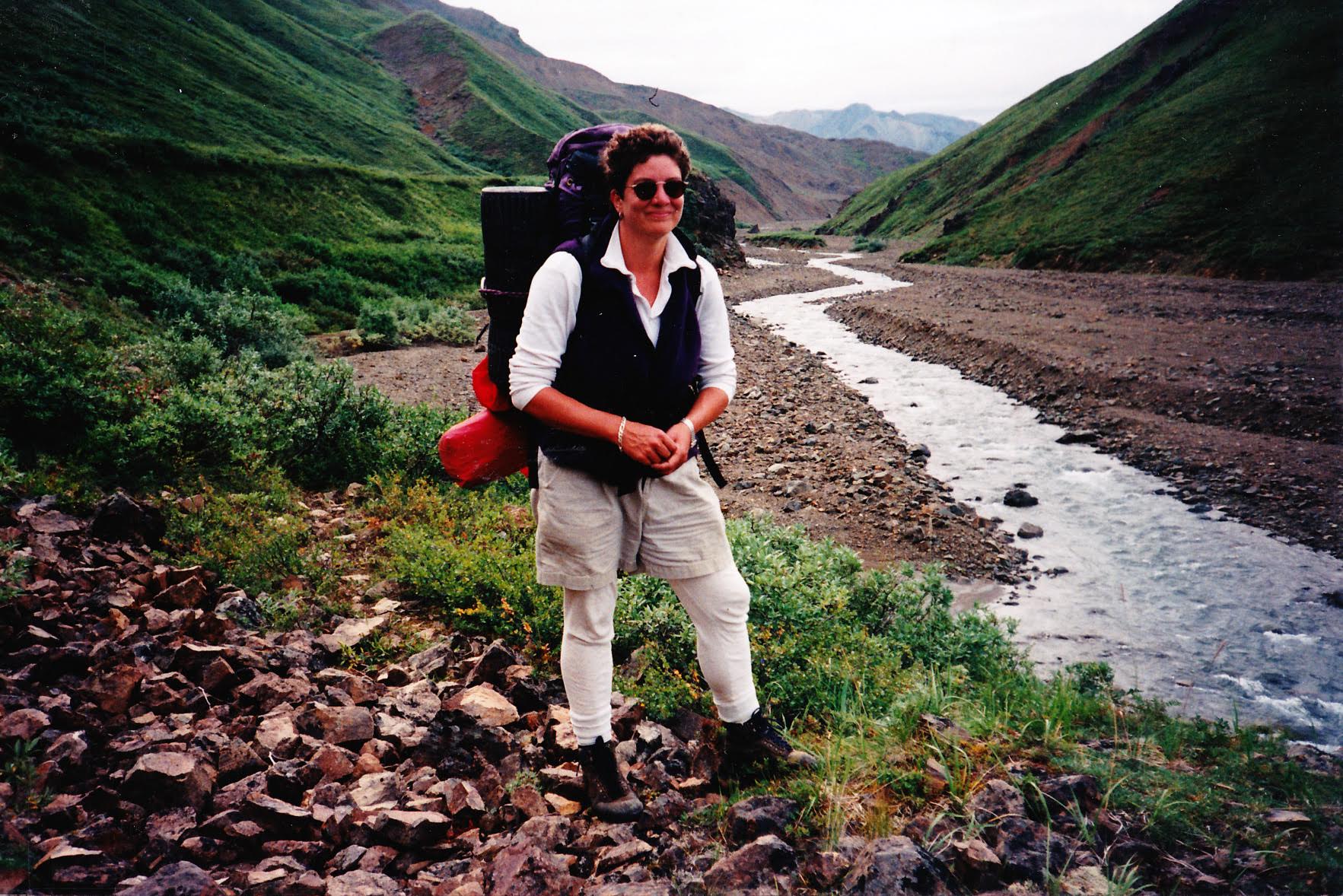
Kim Wyatt backpacks through the wilderness of Denali National Park & Preserve. Photo/Provided

Kim Wyatt backpacks through the wilderness of Denali National Park & Preserve. Photo/Provided

Except for a lottery held twice a year, cars are not allowed on the road inside the park. If you plan to backpack, before being issued a permit you must watch a video on Denali’s humbling weather, the Golden Triangle—your tent, cooking area and bear canister must be at least 100 yards from each other—how to cross a wide, braided river and, finally, advice on bear, wolf and moose encounters. (For example, never run from a grizzly or a wolf. But if charged by a moose in open terrain, run in a zigzag pattern. It’s a lot to remember, how to run/not run.)

Then you can apply for your permit. Denali National Park & Preserve is made up of 87 units, and you have to choose your unit before you apply. There are quotas and limits to the number of people allowed in each one to avoid the kind of scene you have at popular trails in other parks. And then you take a converted school bus to the trailhead. When you’re done hiking, you come out and wait for the bus.

Only four people were allowed in our unit. We never saw the other two.

You must apply for your permit in person. Because Denali is not exactly on the beaten path–it’s about a five-hour drive from Anchorage, where I lived—you should be ready to roll. We’d been warned to have three or four options, as the most popular hikes might already be at their limit. All of our choices were booked, so we took a ranger’s recommendation of Stony Creek, one of her favorites, a hike with varied scenery, and if we were lucky, a superlative view of Denali on a rare clear day. (Weather is something else you need to worry about in Denali. Cloud cover necessitates knowing how to use a map and compass.)

I’d lived and worked in Yosemite for a decade before I moved to Alaska and I felt confident about my trail skills. The problem—or the beauty—in Denali is once you get off the bus, there are no trails. There are no signs. The rivers are wider than highways and there are grizzly bears and wolves and moose that you should run/not run from. And walking on taiga and tundra, rather than granite, is not as easy as it sounds. Alpine tundra is low and scrubby, but brushy tundra is soft: two steps forward, one step back.

After dinner, the clouds hunkered down and we lost any view we might have had, so we retreated to the tent. A few hours later, I woke to the sound of footsteps in front of the tent. My heart seized: Would I stupidly die in grizzly country? But the steps were light, and multiplied until they sounded like castanets. Rain on rocks, perhaps. I peered out the tent’s avalanche chute to see caribou, one after another, walking single file past the tent in twilight. It turned out that we were sleeping on a caribou migration route. I opened the tent door and watched them pass until falling back to sleep.

In the morning, the tent glowed bright yellow. The sun was out! I jumped from my bag and hopped outside and there was Denali in all its glory. My jaw dropped.

An ecstatic current ran through me. While the world around me awoke, the massif held my gaze—a form of communication beyond the corporeal plane. The intimacies of the park were more captivating than its scope: Up close with grizzlies and caribou. Birds and berries. Just me and a grand slam view of Denali in full sun. Places like this change you; they settle your soul.

Why is it important to preserve these wild spaces? Although conservation of species and habitat is crucial, humans need these wild spaces, too. We need the places where we can escape from the pressures of modern life and reconnect to our best selves. Writer Wallace Stegner had it right when he said, “National parks are the best idea we ever had. Absolutely American, absolutely democratic, they reflect us at our best rather than our worst.”

A few years ago, a close friend with cancer asked me to take her to Yosemite National Park before she died. Walking near the Ahwahnee Meadow, she said incredulously, “This belongs to all of us.” I’d never thought of it that way, but, yes, it does. And the more time we spend in our parks, the more likely we are to care for them. Saving our wild landscapes is saving ourselves.

Kim Wyatt is the publisher of the independent press Bona Fide Books, which published “Permanent Vacation: Twenty Writers on Work and Life in Our National Parks”. She worked in Yosemite National Park for 13 years.

Note: Information on backpacking in Denali National Park & Preserve may be found here.


Opinion: Trump is America’s problem, not California’s

By Joe Mathews

Sorry, America, but we Californians are not going to stop Donald Trump for you.

To believe otherwise is to misunderstand California.

Joe Mathews

Joe Mathews

I can see how you got your hopes up. Polls show at least three out of every four of us don’t like him. California Republican strategists have launched a campaign to deny him a victory in June’s presidential primary, and thus prevent him from getting the delegates he needs to secure the Republican nomination. And many California voices want to go further. An immigrant group declared him “persona non grata” in the state; cities have discussed denying him permits for rallies, given his propensity to incite crowds.

He deserves every bit of our scorn. Trump stands against almost everything that our state now represents. Our culture and economy are built on diversity and integration; he divides and race-baits. Mexico is our top export market; he slanders Mexicans and wants to build a wall across a border. We’re devoted to science; he spews discredited nonsense about vaccines. Our industries—technology, entertainment, logistics—are built around trade; he wants to start a trade war.

So why aren’t we up in arms? Because Californians simply have no time to be up in arms about anything. And that’s especially true when the subject is American politics, which takes place in a country, if not a planet, different than our own. It’s also pretty rich of Americans—who hold the most important presidential contests in states smaller than some California counties and limit us to just U.S. two senators—to expect Californians to save them from their own democratic decisions.

In other words: Trump is your problem, America, not ours.

This attitude was perfectly expressed in a joke Gov. Jerry Brown told recently: “If Trump were ever elected, we’d have to build a wall around California to defend ourselves from the rest of this country.”

Fortunately, President Trump is still a long shot. And Californians are loath to waste any of the precious time we don’t spend in traffic. More than 70 percent of us can’t do anything to stop Trump in this election; the only people who can vote in the GOP primary here are a dying subspecies of homo Californiens called Republicans. And, no matter how those Californians vote in June, will Trump really go away? Isn’t he one of those chronic conditions—like diabetes—that we just have to manage?

In other contexts, like public health, California does know how to stop things—and even ban them. And we love to pick on small targets. We’ll ban foie gras or shark fin soup in the blink of an eye.

But Trump is too unwieldy to fit our infrastructure of prohibition. I suppose that could change. Maybe he’ll set himself on fire, and we could throw our anti-smoking laws at him. If he takes a swim in one of our rivers, state biologists could go after him as an invasive species. But even though his campaign rhetoric is a threat to our civic environment, the California Environmental Quality Act—a favorite California tool for delaying new projects of any kind—can’t be used to stall his campaign past the primary date.

The idea of stopping Trump also bumps up against one strong California cultural tendency: tolerance for bad celebrity behavior and over-the-top hucksterism. He’ll sell crummy casinos and bogus “university” classes just as Hollywood sells formulaic sequels as must-see events. Our sales excesses compromise us when we get moralistic.  I’d love to see Santa Barbara’s Katy Perry or Long Beach’s Snoop Dogg issue an anti-Trump anthem, but how exactly would stars like those call him out on his outrageous antics?

If we were serious about stopping Trump, we’d have already rallied Silicon Valley to the cause. These days, most difficult California problems—from taxation to cancer immunotherapy—are addressed by asking Sean Parker, the former Facebook president, to figure something out. And if Twitter’s rules against “behavior that harasses intimidates or uses fear to silence another user’s voice” were seriously enforced, Trump’s account would have been suspended long ago.

Heck, if our fervently anti-Trump Legislature really wanted to make life difficult, it could pass a law declaring that California businesses don’t have to serve hate mongers and their campaigns. Such a move would offer a rejoinder to laws in other states that permit discrimination against gays. Call it a reverse North Carolina.

But California isn’t serious about stopping Trump. That may be just as well. He would use such opposition to portray himself as a victim. Which is why, as California enters the spotlight of the presidential campaign, the best strategy may be to stay true to ourselves, and to ignore Trump as best we can.

Joe Mathews writes the Connecting California column for Zócalo Public Square.