Drug prices keep rising despite criticism

By Katie Thomas, New York Times

From the campaign trail to the halls of Congress, drug makers have spent much of the last year enduring withering criticism over the rising cost of drugs.

It doesn’t seem to be working.

In April alone, Johnson & Johnson raised its prices on several top-selling products, including the leukemia drug Imbruvica, the diabetes treatment Invokana, and Xarelto, an anti-clotting drug, according to a research note published last week by an analyst for Leerink, an investment bank. Other major companies that have raised prices this year include Amgen, Gilead and Celgene, the analyst reported.

Makers have raised prices on brand-name drugs by double-digit percentages since the start of the year, according to interviews with executives at Express Scripts and CVS Caremark, two major drug-benefit managers. And a report last week by the research firm IMS Health found that in 2015, list prices for drugs increased more than 12 percent, in line with the trend over the five previous years.

Read the whole story


Couple wins dispute to build in Angora area

Ray Burns and Teresa Avila-Burns will be able to build in the Angora burn area. Photo/Provided

Ray Burns and Teresa Avila-Burns will be able to build in the Angora burn area. Photo/Provided

By Kathryn Reed

A Bay Area couple learned the hard way that buying a vacant lot in Lake Tahoe does not automatically mean one gets to build on it.

Although, in the disclosure forms of the sale it was noted that the property was partially in a stream environmental zone.

“Prior to their purchase, a house on the property burned down in the Angora Fire, and the prior owner did not rebank his/her right to rebuild the home in time, so the automatic right to rebuild on this property was lost,” Tom Lotshaw with the Tahoe Regional Planning Agency told Lake Tahoe News. “After their purchase, this couple had an option to get a buildable IPES score for the property, but for some reason, we don’t know why, they chose to get a zero – nonbuildable — score, and then sue TRPA.”

IPES stands for individual parcel evaluation system. This is something the bi-state regulatory agency came up with to decide how much of a lot could be covered and which parts of it could be developed.

Teresa Avila-Burns and Ray Burns bought the foreclosed lot in the Angora burn area for $5,000. In December, they filed the lawsuit. The couple enlisted the Pacific Legal Foundation to fight in court for their right to build on the El Dorado County parcel.

The settlement reached this month allows for about 3,100 square feet to be eligible for development. One area is off-limits because of the SEZ.

TRPA said if the couple asked for an IPES score at the get-go, there would have been no need for a lawsuit.

The couple’s lawyer said it wasn’t quite that simple.

“Before turning to PLF for help, Ray and Teresa had wrangled with the regulators for years,” Christopher Kieser attorney for PLF, said in a statement. “Now, faced with being hauled before a court, TRPA is finally recognizing this couple’s fundamental rights, so they can finally move ahead with their dream to build a Lake Tahoe home for their elderly mothers.”


Placer County selling 3 Kings Beach parcels

Placer County is offering three development opportunities in Kings Beach on parcels that used to be owned by the Redevelopment Agency.

The three properties are being offered separately, though it is possible for a developer to combine them into a single related or compatible project.

The 1.3 acre Eastern Gateway property is located on North Lake Boulevard (Highway 28) at the southwest corner intersection of North Lake Boulevard and Chipmunk Street. The property consists of 10 contiguous parcels.

The Kings Beach Center property is located on North Lake Boulevard across the street from the Kings Beach State Recreation Area. The property is approximately 3.5 acres consisting of 16 parcels.

The Town Center South property is also located on North Lake Boulevard. The property is approximately 0.9 acres, four contiguous parcels.

Interested parties have until June 29 to submit letters. Details are online.


Children’s book publishing and memoir classes in Meyers

Bona Fide Books & Letterpress in Meyers will offer two classes of interest to writers in May.

“So You Want to Write and/or Illustrate a Children’s Book—Now What?” is the title of children’s book author and illustrator Kristen Schwartz’s class. It will be an intensive, personalized session aimed toward helping writers and illustrators of children’s, middle grade and young adult books find their footing in the publishing industry.

The class is May 14 from 10am-2:30pm. Space is limited; the fee is $75.

Have you always wanted to tell your story? When you talk about your life, do people say you should write a book? Are you already writing your memoir, hoping to submit it for publication? “Getting to the Story Behind the Story: Writing a Memoir That Matters” will be May 19, 6-9pm.

“Almost Somewhere: 28 Days on the John Muir Trail” author Suzanne Roberts will teach this session for those who have always wanted to tell their story. In this class, writers learn how to get to the heart of the story and write a personal narrative that matters. The class fee is $45/$35 students.

Both classes will be at Bona Fide Books & Letterpress in Meyers, 1069 Magua St., No.4.

Bona Fide Books & Letterpress is an independent press and print shop in Meyers. For more information or to register, call 530.545.1373, email editor@bonafidebooks.com or go online.


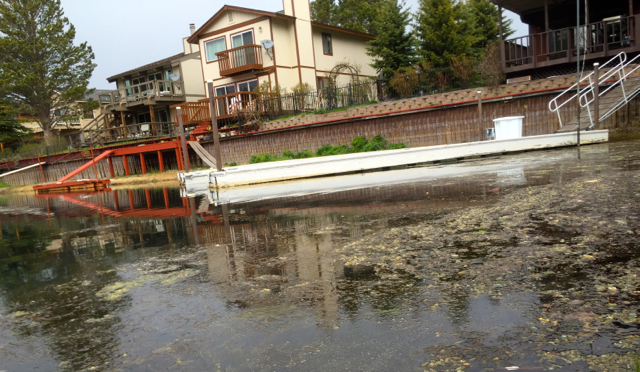
Tahoe Keys struggles to manage invasive weeds

Milfoil was first discovered in the Tahoe Keys in the 1980s and curly pondweed in 2003. Photo/LTN

Milfoil was first discovered in the Tahoe Keys in the 1980s and curlyleaf pondweed in 2003. Photo/LTN

By Kathryn Reed

STATELINE – In less than a year, the Tahoe Keys Property Owners Association has started to backpedal when it comes to being adamant herbicides are the only way to rid the South Lake Tahoe canals of invasive weeds.

At the Tahoe Regional Planning Agency Governing Board meeting this week representatives of the housing development shared that field demonstrations will be conducted this summer with the goal of having a long-term solution in place for 2017. The TKPOA board two weeks ago allocated $250,000 for this summer’s work.

The Keys is the No. 1 source for invasive weeds, with Eurasian milfoil, curlyleaf pondweed and coontail being the most predominant. The weeds affect 90 percent of the lagoons.

At a meeting last August the solution was herbicides.

What has slowed down that potential reality is the number of comments to the draft Integrated Management Plan for Aquatic Invasive Weeds. Many people want other alternatives to be investigated. And while killing the weeds with ultraviolet light was pooh-poohed by authorities at last summer’s meeting, that is no longer the case.

John J. Paoluccio, president of Inventive Resources Inc., was in town last fall to demonstrate how UV light works. People were impressed. So much so that either the Keys or Lakeside Marina is likely to be a testing ground this year.

The Keys also plans to use herbicides in a test situation in isolated tanks on land. This will show how the plants respond to different chemicals.

Before any herbicide could be used in the lake the Lahontan Regional Water Quality Control Board would need to sign off on it. That board has already said the idea of limited use of herbicides on a case-by-case basis would be taken under consideration.

There are 10-deadend lagoons. Those would likely be the first to receive herbicide.

Dye is going to be put into the mouth of the Keys’ two entrance points to see where the current takes it and how fast. This relates to what would happen if an herbicide were used. Dye was used farther back in the canals last year as a test, with the colored water not moving far.

One Governing Board member asked if native species would be harmed. The answer – they shouldn’t be.

While harvesting the weeds is considered a nuisance in some ways because particles are spread and it never solves the problem, tweaking the process may have different results. A fragment capture boat will be deployed to scoop up the remnants. GPS tracking and paying better attention to the wind are other changes.

A water circulation mechanism was installed when the Keys was built in the late 1960s. It has not been used for a couple decades. TKPOA is going to see what it would take to get it operational again.

Another board member asked about the possibility of closing off the two main channels to be able to isolate the Keys in order to deal with the weed problem. While tidal gates exist, a big problem is there is boat traffic year-round. A bigger problem is that the three owners involved with the waterways in the Keys are not all on the same page.

TKPOA and Beach and Harbor Association are in agreement about things that need to be done. The owners of the marina are not cooperating, according to TKPOA and TRPA officials. Because the marina has a different type of permit than the homeowners, there is only so much pressure that can be applied.



Opinion: ‘Dark tourism’ isn’t all bad

By Robert Reid, National Geographic

These days it seems you can’t go more than a few weeks without hearing about some unfortunate selfie faux pas on the Internet.

Tourists posting photos of themselves giving the thumbs up in Auschwitz, for example, or smiling from a rusted-out bumper car in Pripyat, the Ukrainian city that was evacuated after the 1986 Chernobyl nuclear meltdown.

The offending images are seen and blasted around to social media circles. Disparaging comments are made and the shares continue, rippling out to create a full-blown meme about travelers’ growing predilection for “dark tourism.”

The truth is, visiting places associated with death and suffering has been popular a lot longer than the selfie stick.

Read the whole story


Fires create gaps in Pacific Crest Trail

By Associated Press

Vast wildfires have created lengthy gaps in Southern California sections of the famed Pacific Crest Trail, which hikers must bypass via shuttles or alternate routes to avoid dangerous conditions like unstable trees and loose rocks.

Long-distance backpackers must be shuttled by van around the closures or risk incurring $2,500 fines, the Riverside Press-Enterprise reported this week.

To get around a 15.5-mile gap caused by a wildfire last year in the San Bernardino National Forest, hikers are driven from the Whitewater Trail House in Cabazon to Onyx Summit on State Route 38, where the trail reopens.

About 14 miles of the trail approaching the mountain town of Idyllwild are closed three years after a blaze scorched more than 27,000 acres.

Each year, thousands trek sections of the 2,650-mile Pacific Crest Trail, which runs from Mexico to Canada.

Some of the adventurers — who often take on nicknames for their journeys — aren’t thrilled with the idea of getting into a van after retreating into the wilderness. Last week in Idyllwild, Bruce “Man in Black” Cornish of San Diego planned to research an alternate hiking route to bypass the closed section while waiting for friends.

At 59, he retired early from a job as an eighth-grade science teacher to hike the entire route after dreaming about the trip for 20 years.

“The philosophy of this trail is, ‘Hike your own hike’,” he told the newspaper. “If people want to hitch ahead, that’s cool. It’s just not for me.”

Danger in the unstable areas can come from falling branches dubbed “widow-makers,” dead giant trees with weak roots that can fall and crush hikers, the U.S. Forest Service said. Loose rocks, debris including rolling logs, flash floods, trailside stump holes and slippery ash can also pose a danger.

Crews are working to remove charred trees and fill in holes to make the trails passable again. While some hikers are impatient for the work to finish, others don’t mind catching an occasional ride.

“I know some other people who are what we call ‘purists’ — want to hike every inch of the trail,” said Robert “Bobcat” Donnellan, 38, of Asheville, N.C., sitting at a picnic table outside the Whitewater home where he was staying April 13. “I personally don’t care.”


Sanchez: Relaxing species law ‘on the table’ to help state

By Christopher Cadelago, Sacramento Bee

Loretta Sanchez

Loretta Sanchez

Democratic Rep. Loretta Sanchez, campaigning for U.S. Senate, said Tuesday that she would consider amending the federal law governing endangered species to help improve the water supply across the parched state of California.

To help address the drought, Sanchez said she wants to take a broader approach that calls for continued conservation measures, increased storage sites and the construction of Gov. Jerry Brown’s twin Delta tunnels project to move water south. Asked whether the Endangered Species Act should be looked at, Sanchez said yes.

“Everything needs to be on the table when we go in to find a solution,” Sanchez told the editorial boards of McClatchy Newspapers at a meeting in Fresno.

Read the whole story


Calif. gun-control bill headed for fall ballot

By Christopher Cadelago, Sacramento Bee

Lt. Gov. Gavin Newsom, the architect of an omnibus gun-control initiative to require background checks for ammunition, said Thursday that the campaign has collected enough signatures to qualify for the fall ballot.

Newsom planned to submit roughly 600,000 signatures for his “Safety for All,” initiative on Friday, far more than the required 365,000.

“I feel resolved to move forward. The voters I think are ahead of a lot of elected officials of all political stripes,” Newsom said of taking the issue to the ballot. “We have a chance to do something that’s permanent, that can’t be watered down, and send a very potent and powerful message to the National Rifle Association that we think will resonate across the country.”

Read the whole story


Sizable bass reeled in at Lake Tahoe


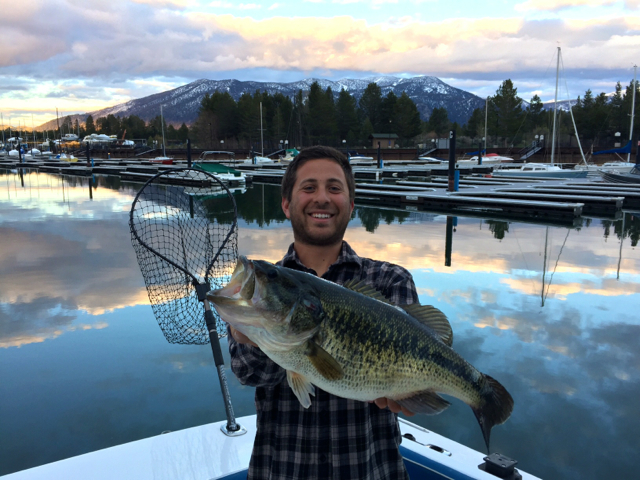
Andrew Lubrano of South Lake Tahoe with a 6 pound, 7 ounce bass caught April 29. Photo/Provided

Andrew Lubrano of South Lake Tahoe with a 6 pound, 7 ounce bass caught April 29. Photo/Provided

It took fishing captain Andrew Lubrano nearly 30 minutes to land a bass today in the Tahoe Keys.

It weighed 6 pounds, 7 ounces. The record for Lake Tahoe is just less than 8 pounds.

“I was just cleaning my boat and threw an extra piece of bait I had into the water,” the charter captain told Lake Tahoe News.

He let the fish back into the water to live another day.

Lubrano joked about all the efforts to eradicate the non-native fish from Tahoe clearly didn’t work.

The area Lubrano caught the fish in was right near where the oil spill occurred a couple weeks ago in the South Lake Tahoe canals.

— Lake Tahoe News staff report