Road Beat: Prius 4 mpg off the charts
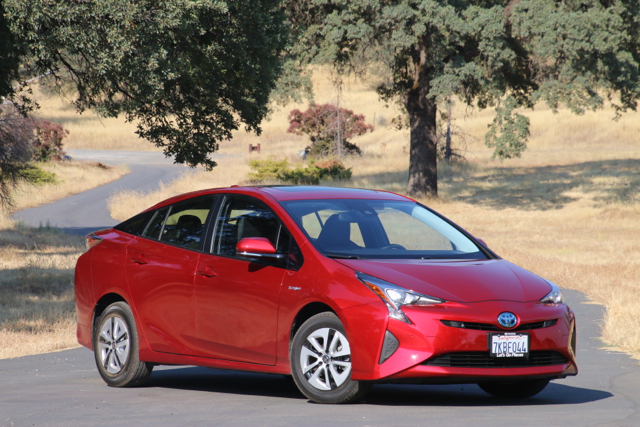
The latest Prius improves upon previous models. Photos/Larry Weitzman
By Larry Weitzman
First introduced to the United States in 1999 and now in a new fourth generation, the first hybrid and still leading hybrid, is the Toyota Prius. Except for the front end, the new Prius is almost unrecognizable from the 2015 third generation model. Now made in several distinct models staring with the lowest priced Prius Two ($24,200), they share similar bodies and sheet metal.
My test vehicle is the popular Prius Four, which is sized comparable to the last generation Prius. Its dimensions all reflect an external compact size with a length, width and height of 179, 69 and 58 inches. Wheelbase is a long 106 inches. There is not only 93 cubic feet in the passenger cabin, but 27 cubic feet in the cargo hold totaling 120 cubic feet or the minimum size for a large car. But most large cars have well over 100 cubic feet in the cabin area, but let’s call it mid-size room with a small CUV trunk.
While the front end is clearly Prius, as its hatchback character lines continue to the rear end and that is where things get interesting when the lines are used to create some pretty wild taillights giving the new Prius some pizazz.

Specifications
Engine
1.8L DOHC, 16 valve, Atkinson cycle inline four 95 hp @ 5,200 rpm 105 lb.-ft. of torque @ 3,600 rpm
Electric Motor
Permanent magnet synchronous motor 71 hp, 120 lb.-ft. of torque (no rpm given) probably 0-1,500 rpm
Combined system 121 hp
Battery
Lithium-ion Capacity 3.6 ampere hour, 600 volts
Transmission
Electronically Controlled CVT
Configuration
Transverse front engine/front wheel drive
Dimensions
Wheelbase 106.3 inches
Length 178.7 inches
Width 69.3 inches
Height 58.1 inches
Track (f/r) 60.2/60.6 inches
Ground clearance 5.1 inches
Weight 3,050 pounds
Cargo capacity 27.4 cubic feet
Passenger volume 93.1 cubic feet
Fuel tank 11.3 gallons
Turning circle 33.5 feet
Wheels (std/opt) 15X6.5/17X7 inch alloys
Tires (std/opt) 195/65X15/215/45X17
Co-efficient of drag 0.24
Performance
0-60 mph 9.91 seconds
50-70 mph 5.59 seconds
50-70 uphill 9.95 seconds
Top speed Not given but with a 0.24 CD, well over 100 mph
Fuel economy EPA rated at 54/50/52 mpg city/highway/combined. Expect 50-54 mpg in rural country driving and 55 mpg on the highway at legal speeds.
But Prius is all about fuel economy and this new one, as well all the new Priuses, produce phenomenal EPA numbers. This new Four is rated at 54/50/52 mpg city/highway/combined. The Prius Two Eco numbers are an even more amazing at 58/53/56 mpg. In the past when I tested Prius hybrids they rarely achieved their EPA fuel economy numbers. Not any more, this new model achieves or beats some of the EP A numbers by about 10 percent.
In actual highway tests at 70 mph in two-way runs this Prius averaged 55.4 mpg. In overall driving during a 100-mile run including 30 percent highway, over two minutes at full throttle testing and rural two lane 55 mph roads with about 10 percent stop and go, the Prius averaged 54 mpg. These are by far the best fuel economy numbers ever recorded by the Road Beat in car testing, even besting most of the motorcycles I have tested except for my test of a super scooter, the Suzuki Burgman 400 which averaged about 62 mpg, upon which got you soaked when driving in the rain. Most if not all of my motorcycle testing generally averaged about 45-50 mpg for large sport and cruiser type bikes. Even my very economical 1000 cc Ducati ST4S sport tourer, which had 108 rear wheel hp, had a best day of about 52 mpg.
Fuel mileage of the Prius was beyond amazing during a 140-mile roundtrip to South Lake Tahoe and back to Placerville. The Prius averaged to Echo Summit (a 6,000-foot climb) 37.8 mpg and overall to the lake shore 42.6 mpg. The return trip averaged an unbelievable 78.5 mpg and an average of 60.6 mpg. Imagine a fuel cost to Lake Tahoe and back on $5. If there is a negative, it’s the small fuel tank of 11.3 gallons. But on a highway trip, your own “tank” will be full long before the fuel tank gets close to fumes.
It is mind boggling that a car could achieve this kind of fuel economy. So how did they do it? It’s powered by a 1.8L DOHC, 16 valve Atkinson cycle, super high compression (13:1) inline four-cylinder engine that cranks out a modest 95 hp at a low 5,200 rpm and 105 pounds of twist also at an even lower 3,600 rpm. In addition, there is a 71 hp electric motor also driving the front wheels with a combined total for both engine and motor of 121 hp. In the Prius Four there is a new 600V Lithium-ion battery pack to power the electric motor which is 35 pounds lighter than the previous generation’s nickel-metal-hydride unit (an NMH battery is still used in the Prius Two). The Prius Four trips the scales at 3,050 pounds which is actually 25 pounds lighter than the model Two. The Two Eco is the lightest at 3,010 pounds.
If you are wondering why the combined hp is not 166 hp, it is due to the fact of a battery output that is limited to about 26 hp. The tightly controlled Prius batteries have shown to be reliable well beyond their warranty and have been cycled over 150,000 times without any significant loss of efficiency.
Performance is about averaged for compact cars with a 0-60 time of 9.91. Passing times from 50-70 mph averaged 5.59 seconds on level ground and 9.95 seconds up a steep grade (6-7 percent). Tip in was strong but when passing on Highway 50 at elevations of 5,000-7,000 feet the go-pedal got a little soft and you had to plan your passes, but otherwise the Prius Four will meet 98 percent of most driver’s performance needs and wants.
Suspension is state of the art double wish bone in all four corners with stabilizer bars at both ends. Standard wheels and tires are 6.5X15 inch shod with 195/65X15 inch rubber, not exactly track ready. But there is an option (Prius Three and Four Touring) for 17X7 inch wheels and more handling friendly 215/45X17 inch shoes. While the wheels are alloys, they are covered with drag reducing hubcaps. Now that’s an Interesting setup, anything (in this case hubcaps) for fuel economy.
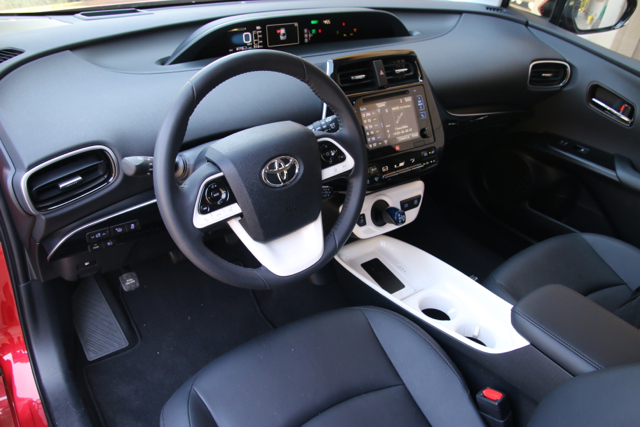
Comfort is another selling point for the Prius.
Normal handling is good and while the 15 inch set up might seem lacking, the Prius has good grip and can be pushed in the twisties. Steering is a bit slow and numb and it requires your attention during aggressive driving, but its prowess will surprise you. Turning circle is a tight 33.5 feet and parking lot maneuvering is excellent.
While ride quality is good perhaps near the best in the compact world, on coarser roads there is tire noise, perhaps due to the high fuel economy tires. On most roads the Prius is quiet and smooth, especially when it runs on pure electric.
Safety systems include four wheel discs with all the braking acronyms including Smart-Stop Technology. In addition, blind spot monitoring and rear cross traffic alert are also standard. Lane departure alert with steering assist and an upgraded radar cruise and more come with the Advanced Technology Packaged ($1,935). I am not a fan of the radar cruise system. Special mention needs to be made for the Prius headlights. They are fantastic especially on low beams.
Inside is comfortable seating for five done in Toyota’s SofTex which is their excellent version of synthetic leather. The big rub is the centered instrument panel. It is designed for a world market so left and right hand drive cars are essentially the same. I found it difficult to read. My tester with that Tech Pack had a helpful heads-up display. While the center stack (radio, Nav and A/C system) is easy to use, to access IP info and setting up the IP info center is not. That needs a fix or a simple explanation in the user manual.
Pricing starts at $24,200 for the Prius Two. A great value with the higher aforementioned EPA economy numbers. The Four stickers at $28,650. My tester had the only two option packages, the Premium Convenience Package ($1,705) and the Advanced Technology ($1,935). My tester also had an extra cost red paint color called Hypersonic Red. It definitely did not make the Prius quicker or faster, but it will lighten your wallet by $395. The Four Season floor mats will ding you for $364. The total bite with $835 for the boat from Aichi, Japan is $33,884. Fabulous fuel mileage will cost you a real premium. If you are an environmentalist, it will make you feel virtuous. If you are a penny-pinching accountant, buy the Prius Two or a base Four, the standard equipment is long and quite complete including a power driver’s seat with power lumbar.
Larry Weitzman has been into cars since he was 5 years old. At 8 he could recite from memory the hp of every car made in the U.S. He has put in thousands of laps on racetracks all over the Western United States.