Snowmaking won’t save Lake Tahoe ski resorts if the overnight temperatures keep rising
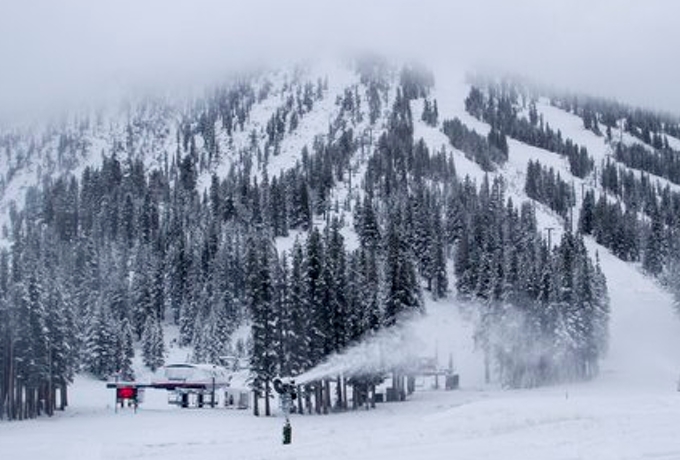
Snowmaking and Mother Nature are allowing Mt. Rose to be the first resort in the greater Lake Tahoe area to open this season. Photo/Provided
By Anne Knowles
Mt. Rose Ski Tahoe kicks off the ski season today, optimistic this season will be a return to normal after a foot of snow fell Monday.
“El Niño typically bodes well for Mt. Rose. This is shaping up to be like ’97, a warm October followed by a successful snow year,” said Mike Pierce, head of marketing at the Nevada resort, referring to 1997 when the Truckee River overflowed and Reno was flooded. “We’re due to break the cycle.”
Pierce isn’t alone in thinking this way.
OpenSnow, a group of local weather forecasters, says there is a 60 to 70 percent chance of above average snowfall in California and Nevada this winter.
“I’m hopeful with El Niño. We got almost 12 inches (Tuesday), heavy base type snow that’s good to have this time of year,” Barrett Burghard, senior manager of snow services at Heavenly Mountain Resort, told Lake Tahoe News. “Last year was the toughest season. But we’ve seen these cycles. Hopefully we’ll have three to four years of good moisture.”
Still, no one knows for sure. The National Weather Service’s Climate Prediction Center currently projects a 33 percent chance Lake Tahoe will have above average precipitation this winter, but it’s hard to know if most of it will be in the form rain or snow only at the highest elevations, 8,000 to 9,000 feet.
“There is little to suggest that a big El Niño causes more snow,” said Kelly Redmond, regional climatologist for the Western United States with the Desert Research Institute, at a recent Incline Village talk. “We tend to get more extreme events.”
At the same time, NWS says there is an even greater chance — 40 percent — temperatures in the basin will be above average. That creates problems not only for precipitation, but also for snowmaking, which the resorts have depended on to make it through the last few seasons.
Snowmaking is most productive and energy efficient, and costs less and consumes less water, the lower the temperature.
No one can control the temperature, which is key, but resorts have invested millions of dollars on more advanced snowmaking equipment in the last few years.
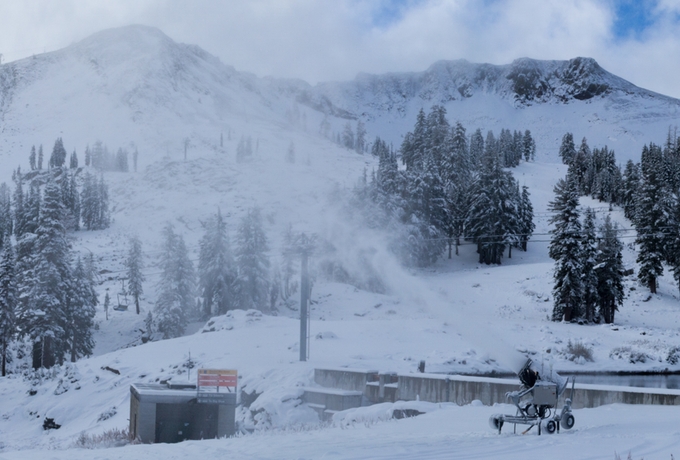
Squaw Valley’s attention to snowmaking dramatically changed when KSL took over ownership. Photo/Provided
Squaw Valley, for example, has spent $8 million in the past five years to upgrade its equipment. The resort says it can operate up to 20 new snowmaking guns with the same amount of compressed air required by a single old gun and make nine times as much snow as it could 10 years ago.
On Tuesday, Squaw spent the day making snow, thanks to a big drop in the temperature. Plans are to open Nov. 25.
Mt. Rose operates 25 SMI Snowmakers’ PoleCat snow guns, Pierce said, which can cover up to 25 percent of its trails. A dozen are fixed; 13 are mobile and hook into hydrants throughout the resort, which tap into an onsite well.
“We’ve been buying water rights for the last 20 years,” Pierce told Lake Tahoe News.
The snowmaking allowed the resort to operate from Nov. 8 to April 19 last season when it received just 167 inches of snow, about half the average.
Heavenly, owned by Vail Resorts, has invested heavily in an elaborate snowmaking operation that allows it to cover more than two-thirds of its 97 trails.
“The biggest change we’ve seen is energy efficiency,” said Heavenly’s Burghard, including more efficient guns and advanced compressor controllers.
This season Heavenly is testing a GPS-based depth sensor attached to PistenBully snowcat that may more precisely measure the snow.
“But as far as the temperatures go, there’s not a lot we can do,” Burghard said.
He said there are additives to aid snowmaking at higher temperatures, but Heavenly doesn’t use them.
“They’re not costly, but we’re in the Lake Tahoe watershed and we’re reluctant to use them,” Burghard said.
Heavenly buys its water for snowmaking from South Tahoe Public Utility District and Kingsbury Grade Improvement District.
Andrew Strain, vice president of planning and government affairs for Heavenly, suggested Nevada look at allowing the use of effluent for snowmaking at mountain resorts not on the lake. He said this during testimony at a state-sponsored drought summit in Carson City in September.
Snowbowl, a ski resort in Arizona, began making snow using effluent in 2013.
The Nevada Department of Environmental Protection has a standing committee on water reuse which is in the early stages of looking at that possibility, according to JoAnn Kittrell, public information manager for the Department of Conservation and Natural Resources.
“It’s tricky for Tahoe. Even as a base, it may have too many nutrients,” Kittrell said. “It might have to be treated to drinking water levels. Then it becomes a question of being cost prohibitive.”