Revered scientist continues Tahoe clarity quest
By Kathryn Reed
INCLINE VILLAGE – Without the work of Charles Goldman, the scientific debate about issues concerning Lake Tahoe might be much different.
The limnologist started studying this area in 1958 when he began teaching at UC Davis. His research is the basis for much of the work that is being done today to improve the clarity of the lake. While the methods to achieve various goals will continue to be debated, the decades’ worth of data are indisputable and provide a basis from which to keep going forward.
In a career spanning more than 50 years, Goldman could point to multiple achievements to hang his hat. Sewage, though, is what he is most proud of. Specifically, keeping treated sewage from Lake Tahoe.
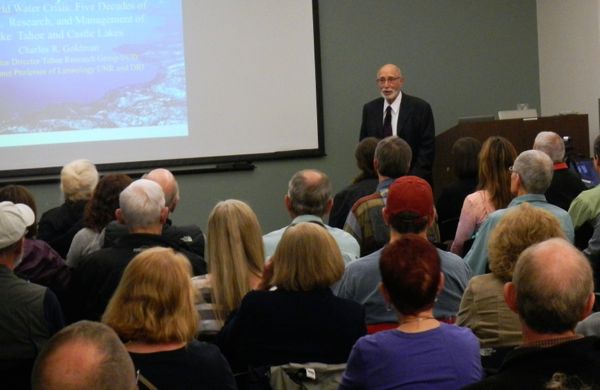
Charles Goldman talks about the changes at Lake Tahoe on June 4 in Incline Village. Photo/LTN
Years ago he took local wastewater and mixed it with samples from the lake. Tahoe’s clear water turned green in three days. It was all the nitrogen that remained in the treated water that was the problem.
“Now we are seeing attacks on science. We are almost back to where the Earth is flat,” Goldman told the more than 80 people attending the June 4 talk at the Tahoe Environmental Research Center on the campus of Sierra Nevada College. He alluded to those who have recently broached the subject of reworking the federal law that mandates wastewater be hauled out of the basin.
The 4-year-old drought has people contemplating ways to deal with water.
Goldman called climate change “the greatest threat to humanity since the development of the atomic bomb.”
He remembers fighting against uncontrolled growth in the basin because of the negative environmental impacts it would have. Threatening phone calls from those wanting to develop the basin were routine. A California Highway Patrol car would follow him from Tahoe to Davis; he never knew if was for protection or some sinister reason.
While he is no longer teaching, Goldman refuses to completely retire. He is advocating the U.S. Forest Service prevent cattle grazing above 5,000 feet. Goldman will present a paper this summer from a 10-year study about the bacteriology of lakes and streams in the High Sierra because of the grazing.
“It’s bad for water quality,” he said.
And on top of that, Goldman added, the program costs more to run than the feds are generating in income.