South Lake Tahoe — a 50-year work in progress
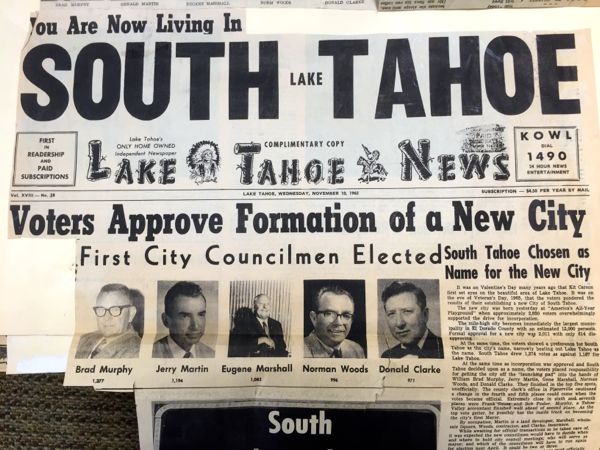
South Lake Tahoe voters in November 1965 agreed to form an incorporated city.
 Publisher’s note: This is one in a series of stories Lake Tahoe News will be running leading up to the 50th anniversary of South Lake Tahoe on Nov. 30.
By Kathryn Reed
“The people of Lake Tahoe’s South Shore formally have taken steps to control and preserve the natural beauty of this area. The overwhelming vote for incorporation proves the people do care what happens to the lake. We now have local government control and do not have to rely on those from other areas to take care of our needs.”
– Wink Ames
Ames was one of the founding fathers of South Lake Tahoe and went on to serve on the City Council. The quote above was his official statement to the media after the votes were counted.
From dirt roads to a major federal highway. From just a few year-round residents, to thousands. From ranching to gaming’s housing hub to a recreation mecca. South Lake Tahoe has gone through a multitude of changes through the years.
Before the vote to incorporate took place in November 1965, the area was divided more into neighborhoods that still exist – Al Tahoe, Bijou, Bijou Park, Stateline, Tahoe Valley and Tallac Village.
There were 12,000 people who called South Lake Tahoe home in 1965. The vote to incorporate was 2,011-614. Voter turnout was 65 percent. With approval, South Lake Tahoe became the 398th city in California.

Norm Woods is the longest serving member on the City Council. Photo/South Lake Tahoe
The first council consisted of Brad Murphy who was the top vote getter at 1,377; Jerry Martin (1,194); Eugene Marshall (1,082); Norm Woods (996); and Donald Clarke (971).
What has changed through the years is not the number of votes, but the voter turnout. With the city having a population of about 21,500 people, a total of 9,414 votes were cast for City Council in November 2014 when voters could vote for three candidates. Wendy David received the most at 1,727.
Woods is the longest serving member at 21 years – 1965-70 and 1976-92. By the time current members Hal Cole and Tom Davis finish their terms, each will have served 20 years. Cole from 1994-2006 and 2008-16; and Davis from 1992-2004 and 2010-2018.
From 1965-68, all mayors served a six-month term. Today they serve a one-year stint.

Echo Motel on Highway 50 and Ski Run Boulevard comes down June 26, 1989, for the first phase of redevelopment. Photo/South Lake Tahoe
Pictures of everyone ever elected to the council are on a wall in the room where the five electeds meet, with the dates served posted as well.
Originally the council met in the basement of what was the Tahoe Savings & Loan Building. It is now El Dorado County offices on Takela Drive.
City offices have moved throughout the years, including being in what is now the senior center. Today they are at Lake Tahoe Airport and on Tata Lane.
Fire, police and snow removal were the three tenants upon which incorporation were sold to the public.
In 1966, the city took over Lake Valley Fire Protection District stations that were in the city limits.
The first police chief, Ray Lauritzen, was hired in April 1967. He then started hiring officers.
Plow drivers were adept enough by the end of 1966 to clear all city streets within 12 hours.
Not everyone was happy with the city being its own entity and no longer under complete control of El Dorado County. A move for disincorporation was put on the ballot in 1968 and was defeated.
John Williams served as the first city manager until 1969.
In 1966, Pioneer Trail was open year-round from Meyers to near the state line.

The base of the gondola was put in by American Ski Company. Photo/Heavenly Mountain Resort
Planners in the early 1970s expected the city to one day have a population of more than 50,000 people. This was at a time when there was talk of Pioneer Trail being more like a freeway. Even Caltrans was going to build a bigger highway and had the right-of-way to do so.
When the Greenway Bike Path, which may start construction this summer, is completed, much of it will be along that former Caltrans right-of-way that goes from Meyers to almost the Nevada border.
Entertainment and recreation have long been integral to South Lake Tahoe’s economy and tourist draw. The Stateline casinos in some form have existed since the 1940s. With the opening of Lake Tahoe Hard Rock this week, there is another reason for people to visit.
While technically there isn’t a ski resort in the city limits, the 1960 Winter Olympics at Squaw Valley put all of Lake Tahoe on the map as a winter wonderland.
Heavenly Mountain Resort’s gondola opened for the 2000-01 season. It made it so skiers near the bulk of the hotel rooms could be whisked to the mountaintop without having to drive to one of the base lodges. Two years later Vail Resorts would own the gondola and ski resort. The village, anchored by two Marriott properties, continues to be the hub of tourist activity in South Lake Tahoe.
While the city has made considerable improvements through years, some things never change. The first talk of doing something with signs was in 1967. Regulations about billboards, neon, motif, color, type and style have been made ever since then. Even last year the council was still talking about what to do about sandwich boards. And signs are likely to continue as a topic when it comes to design standards in the Tahoe Valley Area Plan.
—–
Notes:
-
The city is planning open houses at various city building throughout June and July.
-
A time capsule unveiling and citywide treasure hunt will take place in September.
-
Homecoming and community parade is set for October.
-
The 50th anniversary dinner and gala at Lake Tahoe Resort Hotel is Nov. 7.