Birders flock to South Shore for annual count
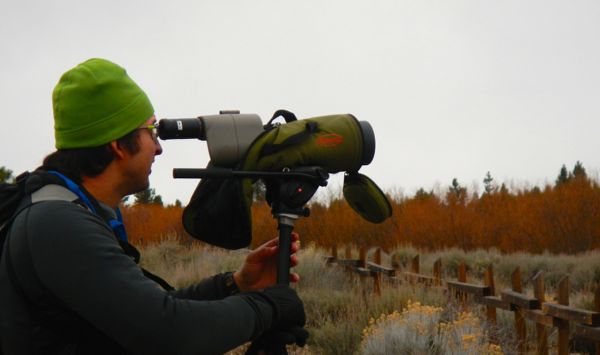
Scott Dietrich uses his scope Dec. 15 to better see a bald eagle. Photos/Kathryn Reed
By Kathryn Reed
With more than 300 bird species in the Lake Tahoe Basin, Scott Dietrich is on a quest to see as many as he can this year. Prior to the Dec. 15 Christmas bird count he was at 185.
Armed with binoculars to scan Cove East, Dietrich was quick to find the bald eagle perched atop a tree across the river and on the far side of the Upper Truckee Marsh. With a scope, there was no mistaking that white headed raptor.
The Incline Village resident has been birding for about seven years. While he does this mostly for fun, he has given birding tours and plans to again starting next May.
Dietrich’s most rare find was a short-eared owl that he saw in the Upper Truckee Marsh earlier in the fall. It’s unusual for this species to be at an elevation like Lake Tahoe’s.
His adventures take him to all parts of the lake, but it’s the South Shore he likes the most.
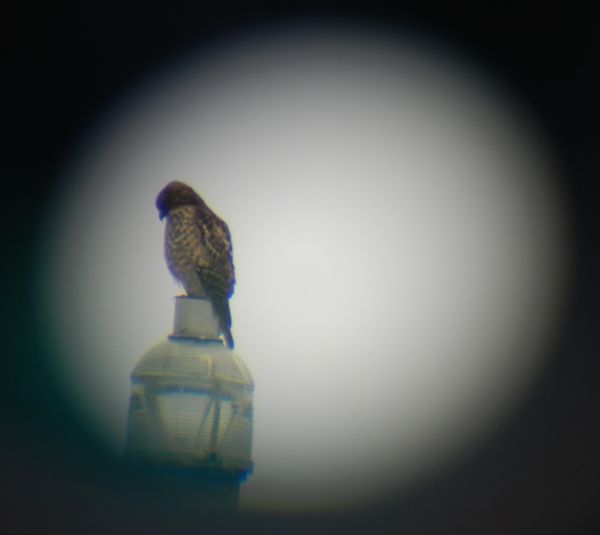
A red-shouldered hawk as seen through a scope.
“The Upper Truckee Marsh is probably the best area in Tahoe to look for rare birds,” Dietrich told Lake Tahoe News. “Lake Forest in Tahoe City is the other area for shorebirds.”
Dietrich was part of Monday’s annual bird count that takes place across the United States. This is the Audubon Society’s 115th annual bird count. Tahoe has been doing it since the early 1980s.
Data from the 2,300 counts will be tabulated by the national organization, which will document migration, breeding and other patterns.
Local numbers are still being calculated.
A 7½-mile radius, with the Upper Truckee Marsh being the center, is scoured for birds. Between 60 and 70 species have been documented the last few years. It’s the only bird count in the basin.
It didn’t matter that the temperature was in the 30s and snow was swirling in the air – this was the largest group to assemble for the annual count. They started at Cove East in South Lake Tahoe and then broke into groups stretching from Meyers to D.L. Bliss State Park to Cave Rock.
Before the group of 20 birders could get out of the roadway at Cove East the scopes were lined up looking at a red-shouldered hawk that was sitting on top of a pole at the Tahoe Keys Marina.
This bird used to be rare in Tahoe, but in the last few years it is common to find them at this higher elevation. Will Richardson, director of the Tahoe Institute for Natural Science, told Lake Tahoe News, “Bird populations are a dynamic thing. There are some natural contractions and expansions. Some is a result of climate change.”
But there is no disputing the avian population is changing.
“The Eurasian collared dove showed up a couple years ago. They came across the whole continent,” Richardson said.
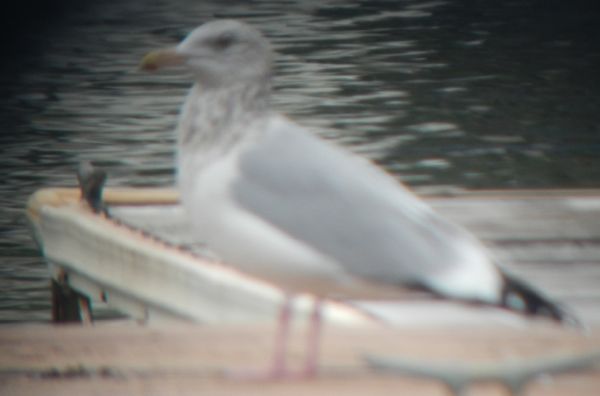
A herring gull through a scope.
Grace Mannell was probably the only one interested in seeing magpies. She recently moved here from the Bay Area, where this long-tailed bird is a rarity.
Some of the birders were on their first official count, others were veterans.
For Lynn and Don Harriman they have been counting birds every Wednesday for the last six years – either at Cove East or in the Upper Truckee Marsh.
“We wanted to see how the birds change through the years,” Don Harriman said of their avocation.
Almost everyone had binoculars, many had notepads to record what they saw, there were field books to help with identification and high-powered scopes — all tools of the trade.
Some of the birds were sitting still in trees, some flew overhead – like the two dozen robins, while others were on the water, and some were on the docks of the Keys – like the herring gull.
Three types of gulls call the Lake Tahoe Basin home – the herring, California, and ring billed. The herring is the most rare of the three. It’s here only in the winter. Those pink legs distinguish it from the others.
—–
Notes:
There will be a bald eagle count on Jan. 9. For more info, go online.