Death Valley’s Racetrack seems otherworldly
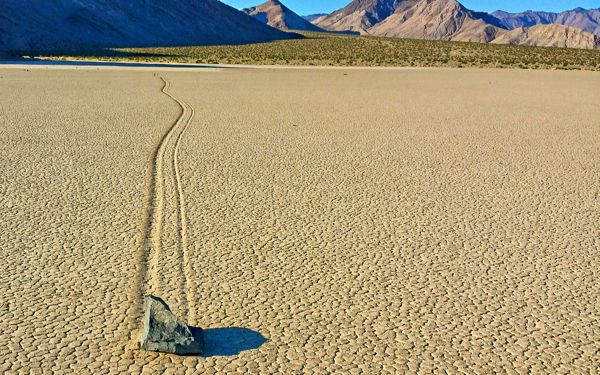
The Racetrack in Death Valley is mesmerizing. Photos/Toogee Sielsch
By Toogee Sielsch
DEATH VALLEY NATIONAL PARK – “It’s your call Ian. Do you want to spend the night around here and check out Scotty’s Castle in the morning, or should we drive the 27 more miles on dirt roads, in the dark, and check out that Racetrack thing in the morning?”
“Racetrack!(?)” Ian replies.
“Good answer!”
The Racetrack – a true scientific enigma until just this last year. Located in the northwest end of the Death Valley National Park, but many miles from Death Valley proper. The Racetrack is a dry ancient lakebed that sits at 3,600 feet. Its playa runs almost due south to north, is just less than 3-miles long by almost 1½-miles wide.
It’s also extremely flat. The difference in altitude from the south to the north end is barely 1.5 inches (4cm), which is basically attributed to a larger buildup of fine sediment at the north end.
It’s in a basin that is surrounded by spectacular colored mountains rich in minerals and even has evidence of an abandoned mining operation above the playa to the southeast side. Named “The Racetrack” for the rocks, called sailing stones, that somehow travel in a mostly south to north pattern across the playa leaving, depending on the size of what is moving across the lake bed, ruts in the rock hard, cracked dirt playa surface. We even found some thick tumbleweed branches that had felt inclined to join the rocks in their quest for the north end of the playa.
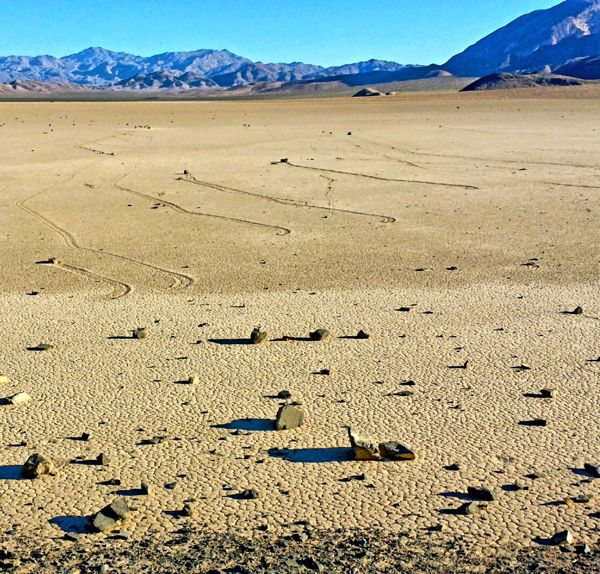
Rocks find their way onto the playa.
There have been many different stories and interpretations of this phenomenon, and most were centered on three elements. The perfect combination of water on the playa turning its surface into a slick and wet mud flat, freezing temperatures create a thin ice layer above the mud, and strong wind. But until just recently when a research team from UC San Diego used video, attached GPS units on some rocks they introduced onto the playa, and were even lucky enough to witness the phenomena, no one knew just exactly how, or even how fast these playa objects moved. Rocks varied in size from those weighing an ounce to those weighing upward of 100-plus pounds. The team clocked some of the rocks moving up to 20 feet per minute. That figure is not a typo. Up to 20 feet per minute, and some movement with winds as light as 10 mph. And as evidenced by their trails, their movement is only sometimes in a straight line. To paraphrase Bob Dylan, “These rocks don’t need a weatherman to know which way the wind is blowing!” The phenomenon takes place on the backside, or thawing phase, of a wet/freeze/thaw/wind event.
Never had I thought too hard about, but I had thought about it before on occasion, the question as to where the rocks came from. As we drove toward The Racetrack in the dark on fairly well maintained dirt roads the question grew in my mind. Along the drive something that stood out under the dark star-filled sky was the silhouette of the peaks and ridges all around us. Not the nice rolling landscape in meadow scenes, but stark hill and mountainsides with steep rocky inclines. By the time we arrived at the southern end of the playa, which was about 10:30pm, our first order of business was to walk out onto the playa a couple hundred yards and get a feel for the place. The sliver of a moon had already set, but the crystal clear sky was literally dirty with stars that emitted more than enough light to get a feel for the landscape that surrounded the playa. We even found a couple of small racers with their tracks leading off into the dark to the south of us.
It was time to hit the sack and get some rest. Sleep came fitfully, in part because of my excitement of what the morning light would reveal, coupled with a night sky literally overflowing with stars making me reluctant to close my eyes for fear of missing something.
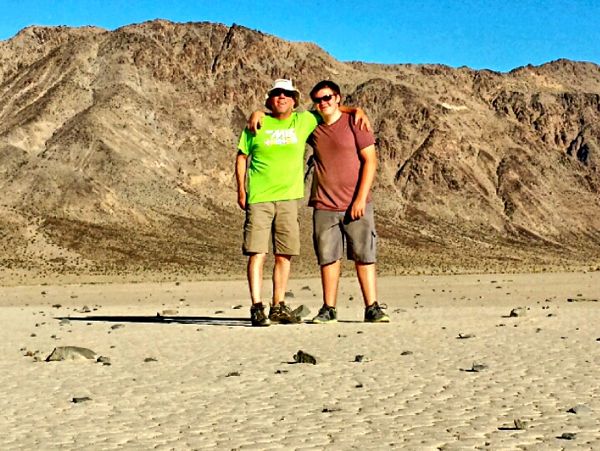
Toogee and Ian Sielsch explore The Racetrack.
First light roused me from a deep sleep, and looking over at my navigator/co-pilot/ favorite youngest son, Ian, I knew he was an hour plus from waking. Time to go explore before the sun heats things up. Walking out on the hardpack cracked playa in the early morning with little air movement had an eerily calming effect akin to looking at sheer glass on Lake Tahoe in the early morning. Becoming more alert with every step onto the playa my attention was drawn to the south and southeast end of the playa, all the while walking among the “sailing rocks” and their trails. Now I want to clarify that the playa is not “littered” with these hapless racers. But the closer I approached the southern end, and many more racers are present, the answer to my nagging question was revealing itself. On that southern end and on the southeastern edge, there are steep inclines of rock outcroppings that sit about 6 feet back from the playa surface. The landscape around the rest of the playa, although ringed with steep ridges, has a gentler incline running hundreds of yards to the base of the inclines. Within that six feet sits a gravely pebble field.
Now I’m pretty sure that the scientists studying this phenomenon were quite content that the answer to my inner question was so rudimentary that they felt no need to highlight this point. But as I inspected this area that seemed to produce the highest amount of racers I felt that it was a very important part of the equation. This six-foot zone was the make or break for many of our rock racing friends. Without actually contacting the surface of the playa, it was quite evident that there would never be a chance of it being part of the legacy of rock racers. Which brought me to the conclusion that – tada – a rock, or a multiple rockslide must have enough velocity as it runs down a 30-plus percent grade (I’m guessing) to cross a rock strewn surface almost completely flat measuring about six feet to become a “Playa Player”!
Without being on the cracked, hard packed surface of the playa that rock’s dreams will never have a chance to be realized.
And in my world, rocks have hopes and dreams!
—-
Getting there:
If entering the park on California Highway 136 from Lone Pine, continue onto Highway 190 through Stovepipe Wells, then turn left about 6.3 miles on the road north to Scotty’s Castle for about 33 miles. When arriving at the junction, take a left to the Ubehebe Crater, than enter the dirt road on the Ubehebe Crater loop to the 27 miles to The Racetrack. The route we took was out of Big Pine taking Highway 168 to the Death Valley Road turnoff, and then on to the Scotty’s Castle Junction that is 76 miles, 60 miles or so on well cared for dirt roads. Then take a right to the Ubehebe Crater Loop.