Getting schooled in science by snowshoeing
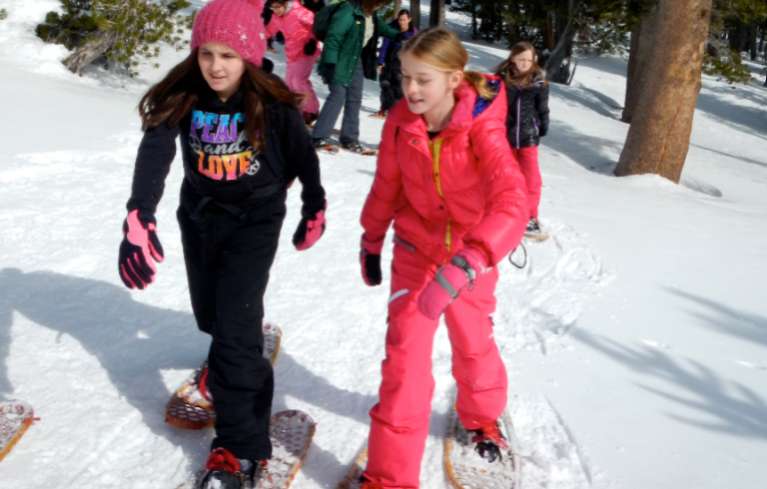
McKenna Villa, left and Braya Weaks from Zephyr Cove Elementary trek at Heavenly. Photos/Kathryn Reed
By Kathryn Reed
Students at Zephyr Cove Elementary School spent a day learning via a different kind of white board – snow.
Thirty-two students in Damon Kixmiller’s fifth-grade class spent a recent Thursday snowshoeing at Heavenly Mountain Resort as part of the U.S. Forest Service’s Winter Trek Conservation Education program.
Kixmiller believes place-based education – like this field trip – helps cement science concepts into the children’s brain. Plus, some of the kids had never been up the gondola before.
Braya Weaks liked the gondola the best.
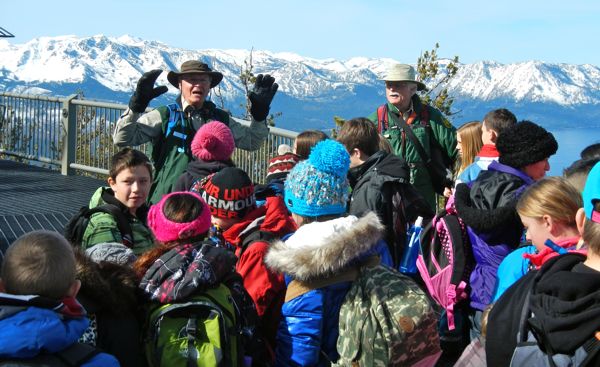
Volunteer Ranger Bob Sweatt talks about what can be seen from the mid-station.
“It was cool to see all the tracks beneath us. I saw some bear tracks,” she said.
The entire experience is rooted in education. It starts at Explore Tahoe where the kids learn about the old style snowshoes they would be wearing. They were once handwoven by the Washoe Indians.
While Kaleb Villa was having fun, he said, “It’s pretty tiring” using the long bamboo snowshoes.
On the ride up the gondola the students learned about the history of Van Sickle Ranch, which they pass over. They see the remnants of the 2002 Gondola Fire, point to where the Upper Truckee River flows into Lake Tahoe, and see Mount Rose in the distance.
Stopping at the mid-station they get out to see the sights and learn some more – like how Mount Rose, Mount Pluto and Mount Watson are old volcanoes.
They are able to answer volunteer Ranger Bob Sweatt’s question about how the area was formed – by glaciers, volcanoes and faults.
Youngsters know the trees were harvested for the silver mines in Nevada.
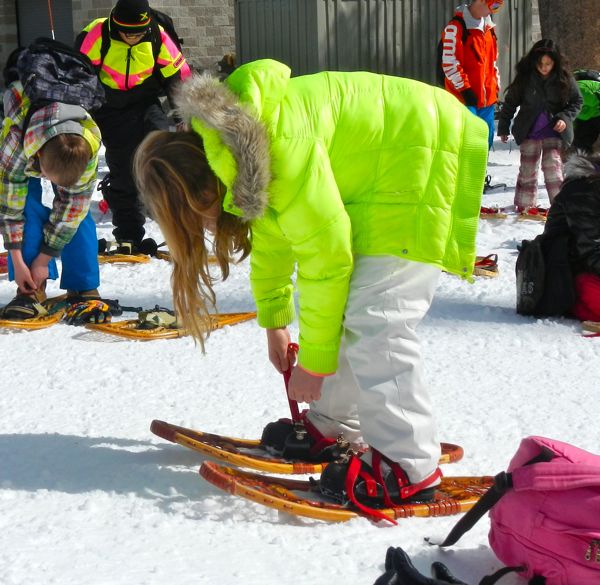
Emma Snipes tightens her snowshoe binding.
The learning started in the classroom before they got to the mountain and continues after. Kixmiller’s class creates a webpage and students do writing assignments related to the experience.
Volunteers help the Forest Service run the program. This has saved the agency money so it can keep offering the program to schools in the area. Some schools have had to skip the program because of financial reasons, like ones in Nevada City and Fallon.
Volunteer Ranger Tim Kosier has the kids sitting in an open space looking a their surroundings and asks them questions.
They know that the tree stump could be habitat for animals. And many of the prints they are likely to see in this area not far from the terminus of the gondola are bounders like rabbits, squirrels and the American pine marten.
“The American pine marten is an indicator species,” Kosier tells the students as they rest in the snow. “They indicate the health of the forest. By putting up cameras and collecting fur from pine martens we see if they are healthy. We are finding that they are healthy.”