Shoulder injuries don’t have to end in surgery
By Kathryn Reed
STATELINE – Knee injuries aren’t the only thing skiers and snowboarders need to worry about. Orthopedists in Lake Tahoe see a number of dislocated shoulders, too.
Kyle Swanson, a doctor with Tahoe Orthopedics & Sports Medicine, went over the various shoulder injuries and treatments during a lecture Oct. 23 at Kahle Community Center.
While dislocation is common in younger people, many shoulder issues tend to be associated with age. But for those who experience a dislocated shoulder when they are younger than 25, there is a 75 percent chance it will happen again.
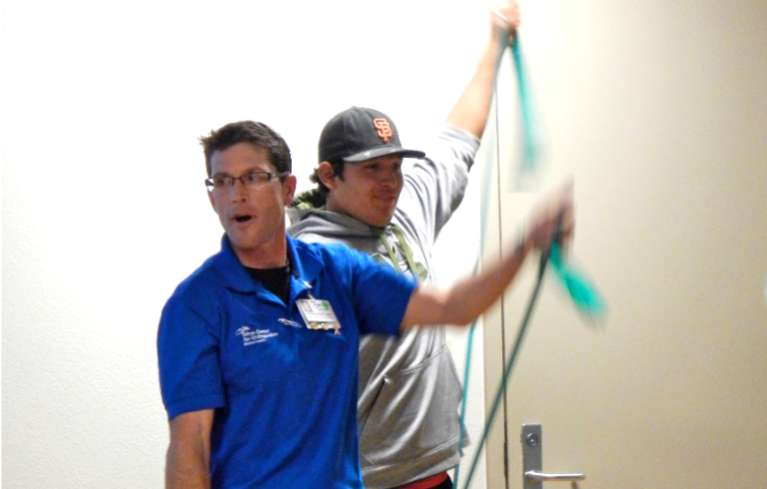
Alan Barichievich, front, demonstrates shoulder exercises. Photo/LTN
Swanson showed videos of some of his surgeries. He does between 50 and 100 a year. Some of the nearly 40 people in the audience turned away at the magnified mess of shoulder innards.
It looked like a pair of pliers pulling the tendon back in place. Anchors are placed several places to hold things together during the healing process. Bone marrow is popping – to which Swanson says, “This is a good thing.” Even the needle for the suturing process is visible on the video.
Swanson is not a huge proponent of cortisone injections – and certainly not more than twice a year. He also believes surgery should be the last resort.
“We are living longer and we are active longer,” Swanson said are the reasons more people are having shoulder issues.
Thirty percent of people between the ages 40 and 60 can expect a rotator cuff tear, and 80 percent of those older than 60.
Surgery is not always needed for rotator cuff tears. It depends on the person. Sometimes physical therapy can help increase range of motion.
The cause could be a single traumatic event or repetitive stress.
Then there are the people who need total shoulder replacement surgery.
What doctors can’t cure is shoulder arthritis.
Eventually anyone who has had an injury to a joint is going to get arthritis, Swanson said. An X-ray is the definitive way to diagnosis it.
“Shoulders can tolerate a lot of arthritis because they are not weight bearing,” Swanson said.
He said studies involving stem cells and platelet-rich plasma are showing positive signs in terms of helping restore the lost cartilage.
Alan Barichievich, director of rehabilitation for Barton Health, said his goal is to keep people out of Swanson’s office.
Stretching and exercising are important. And it’s not the just the shoulder to pay attention to – core exercises like the plank are important, good posture can increase range of motion, how the ribs and thoracic vertebrae move can also affect the shoulder.
“Pushups is one of the greatest exercises. I’m a big proponent of gravity,” Barichievich said.
He brought up a half dozen spectators to participate in a series of eight exercises using a TheraBand. He prefers a circuit of exercises instead of doing a ton of reps.
“The key is doing exercise for prevention,” Swanson said. He would rather people do more repetitions instead of lifting a ton of weight.
—
Note: The next free health lecture from Barton Health is Nov. 6 from 6-7pm at Lake Tahoe Community College’s board room. Barichievich will team with doctor Terry Orr to talk about winter sports knee injuries.