Opinion: Discrimination alive and shameful on Tahoe fields
By Kathryn Reed
Walk onto a tennis court or dive into a swimming pool – it doesn’t matter what sex you are. The net is the same height, the lines spaced the same; 50 meters is 50 meters.
Walk onto a boys’ baseball field and girls’ softball field – the differences are noticeable because of the pitchers’ mound and the distance between the bases.
 Who cares?
No one, probably, when it comes to just these differences.
Who cares about the balance of opportunities offered the two genders as well as the quality of facilities?
A whole heck of a lot of people.
Title IX makes people care, or at least pay attention to potential and real differences, even when they don’t want to. The same goes for California Assembly Bill 2404.
No person in the United States shall, on the basis of sex, be excluded from participation in, be denied the benefits of, or be subjected to discrimination under any education program or activity receiving Federal financial assistance.
That’s what Title IX, the landmark law signed by President Richard Nixon on June 23, 1972, says.
Personal impact
I had just finished first grade when the president signed that law which will be 40-years-old next month. I knew who Nixon was. I was living just outside of Washington, D.C., that year – even went to his inauguration the following January. But I didn’t know what Title IX was. I don’t know when I first knew about it.
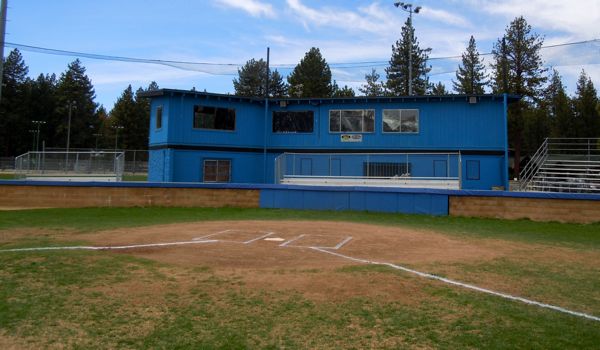
The Babe Ruth field where the STHS boys' varsity team plays comes with an announcers' booth, snack shack and ample seating for spectators. Photos/Kathryn Reed
While Title IX was about making educational opportunities equal for both sexes, its lasting impact when people talk about the law is how it leveled the playing field for boys and girls, men and women.
I’d like to think it didn’t have much impact on my life. I played all the sports I wanted to – still do. Maybe it’s because I had three older sisters and therefore didn’t see any potential discrimination without having a brother.
My guess, though, is plenty of things weren’t fair. I played softball as a third-grader. We were called the Fireflies. I swam competitively for years in AAU, having competed in the Far Western Nationals. I played a year of JV softball. I lettered in tennis all four years in high school. I even played a year of college tennis.
Title IX opened doors that were previously dead-bolted shut to girls. Last year, according to the Women’s Sports Foundation, 3,173,549 girls played a sport in high school. Forty years ago that number was 294,015. Other reports show 1 in 27 girls played a sport pre-Title IX and now 2 in 5 participate. The number of female college athletes has increased by 500 percent in the last 40 years, another report says.
I’ve played softball on some of the fields in Tahoe. A co-ed team practiced at Sierra House Elementary. I’m so glad none of my employees twisted or broke an ankle. It was and still is a scary place to run. And the way the ball skips – well, that would be comical if it weren’t scary as well.
We played our games at the softball field by the middle school.
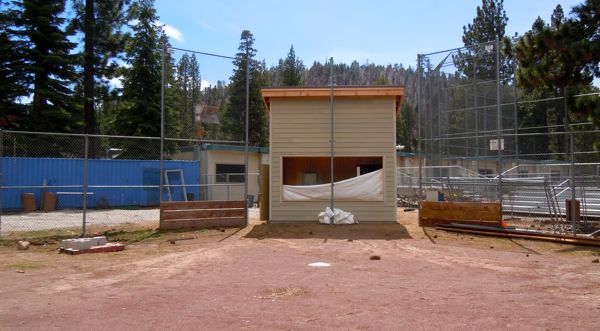
The softball field under construction at STHS.
I also played on a women’s team at Zephyr Cove. Much better facilities in Nevada.
As for tennis on the South Shore – well, the treatment of non-revenue generating sports is worth another column, as is a private operator making money off the high school courts.
But then again, private entities making money off taxpayer built facilities is the norm around here – whether it’s the city or school district allowing it.
Reality check
With numbers like those presented above the easy conclusion is Title IX has done its job.
Not so fast.
AB2404’s passage in 2005 would not have been necessary if all were fair on the playing fields in the Golden State. The law came into being after a group in Los Angeles fought to have city recreation facilities for each gender be the same quality.
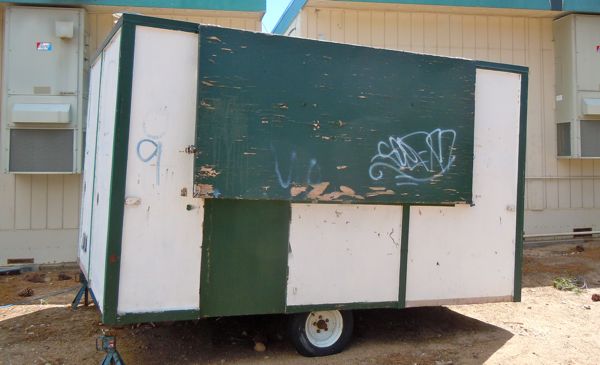
The snack cart the girls get to use.
The inequality of playing fields in South Lake Tahoe has long been a contentious issue. Ask anyone who has played softball or whose child has and they shake their head. They are dismayed about the substantial inequities in the fields in town and embarrassed when playing off the hill and seeing what other towns have.
“Most communities have convertible fields. That is how they are doing it in modern times, but South Lake Tahoe is not in modern times,” Marilyn Breisacher told Soroptimist International South Lake Tahoe when she spoke to the group May 9.
Breisacher was there to talk about Title IX and AB2404 as someone who has been involved with softball for the past 10 years. But she is also on the Fields Advisory Committee for the South Lake Tahoe Recreation Facilities Joint Powers Authority. The committee was formed to make recommendations to the three-member JPA board about how to spend the $500,000 it has that came from turning Measure S into Measure R.
The other members of the committee are:
• Chuck Leonard: committee chair, also chair of the Community Athletic Coordinating Council.
• John Dalton: experience includes soccer coach and Little League.
• Brian Hogan: experience includes Little League, soccer, softball.
• Steve Noll: experience includes Lake Tahoe Bicycle Coalition, softball, baseball, soccer, fields design.
• Ken Riegal: experience includes CAAC board member, soccer.
• Steve Weiss: former South Lake Tahoe recreation director.
At the April 30 meeting of this committee the agenda item titled “Equity of facilities issue: Review and discuss city attorney’s office opinion on requirements of AB2404 and Title IX as it applies to Measure R funds” was tabled. Presumably it will be discussed at the May 21 4-6pm meeting at Lake Tahoe Airport.
Issues to be resolved include, but are not limited to:
• Whether the half million dollars allocated via Measure R for ball field improvements can go to baseball fields and not softball fields.
• Whether girls’ playing fields would all need to be brought up to the same standard as the boys’ fields before boys’ facilities get a dime.
• Is AB2404 relevant when it comes to spending this money?
• Who has jurisdiction when the fields mostly belong to Lake Tahoe Unified School District, are maintained by the city of South Lake Tahoe, but private money has been used to put in infrastructure like the snack shack at the Babe Ruth fields on Lyons Avenue? With federal money being involved with the district, Title IX becomes an issue. With the city having teams play on the fields and doing the upkeep, it becomes an AB2404 issue. With boys’ baseball dads raising the money and doing the work on upgrades, it becomes a turf war in multiple definitions of that phrase.
Discrimination on the diamond
Have someone who knows the fields take you on a tour. To the uneducated, it’s hard to see the true differences.
Go to the fields on Lyons Avenue by South Tahoe Middle School. To the left is where the boys play. It has a grass infield – just like Big League parks have. Plenty of seating is available for spectators. A large announcers’ booth and snack shack are there.
Look to the right. That’s the softball field. It has a dirt infield. Seating? Keep looking. Announcers’ booth? No. Ability to share the snack shack? On rare occasions, during tournaments, if a fee is paid to Babe Ruth.
A field is being built at South Tahoe High School for softball. Remember, this is 40 years after Title IX was signed by the president of the United States (clearly not united genders) of America.
The dugouts are in, as is the announcers’ booth. But school district officials are scrambling to make the field not be an embarrassment. Steve Morales, facilities director for the district, at the April 30 fields committee meeting said bleachers would be put in in front of the announcers’ booth.
This will allow fans to see action down the first and third baselines. No one sitting to the right of home plate behind the fence and parallel to the dugouts will be able to know if the runner is safe or out at first.
But when the bleachers behind home are in, how will the announcer be able to relay what is going on or the scorekeeper to rule on a play? Another quandary in the world of ball fields in South Lake Tahoe.
JV boys are allowed to play on girls’ fields, but girls may not play on boys’ fields – at least in South Lake Tahoe.
Boys’ fields come with batting cages – even bathrooms. The girls, well, they don’t have equal amenities.
Bigger picture missing
In having attended part of the last fields committee meeting before going to another assignment, I witnessed democracy and open meeting decorum close to the worst I’ve seen.
Leonard, the chair of the committee, clearly has no sense of how to run a meeting. Committee members were allowed to speak at the same time – therefore over each other. How John Upton, the lone paid staff member of the JPA board, could take notes is beyond me. I couldn’t follow the multiple conversations.
These meetings are supposed to follow the Brown Act – California’s open meeting law. Upton, a former elected official to multiple boards, could have kept the gang in check.
It was clearly the men against the woman. I don’t know how many times I heard the guys tell the gal – go raise money and you can have a better field. Neanderthals is the word that came to mind while listening in disbelief to their diatribe.
Do they have a wife, a daughter, a sister, a mother who would want to play on the same quality field as the males in the family?
Each of the committee members seems to have his or her own turf to protect, with little consideration given to what’s best for the greater good of the community. It would have seemed better for the JPA board to appoint people who didn’t have a horse in the race.
A true assessment of the fields and the inventory needs to be done – not Weiss walking around the grounds and reporting back. The committee needs to know what it costs to upkeep each field and what it would cost to improve it. The committee needs to know what kind of money is generated from as well as what the potential income from the fields is.
Why is there no discussion of leveraging the half million dollars into bigger bucks either through going after grants, seeking partnerships or even getting corporate naming rights to a field?
Why isn’t there discussion of how best to spend the people’s money so the people get the biggest bang for their buck?
The $500,000 is taxpayer money.
Measure S dollars were audited once by the county auditor-controller. They can be again.